

reactions occurring in the indoor environment,
mainly from the HO x , NO x ,, and VOC perspectives as these are responsible for the majority of
indoor air chemistry.
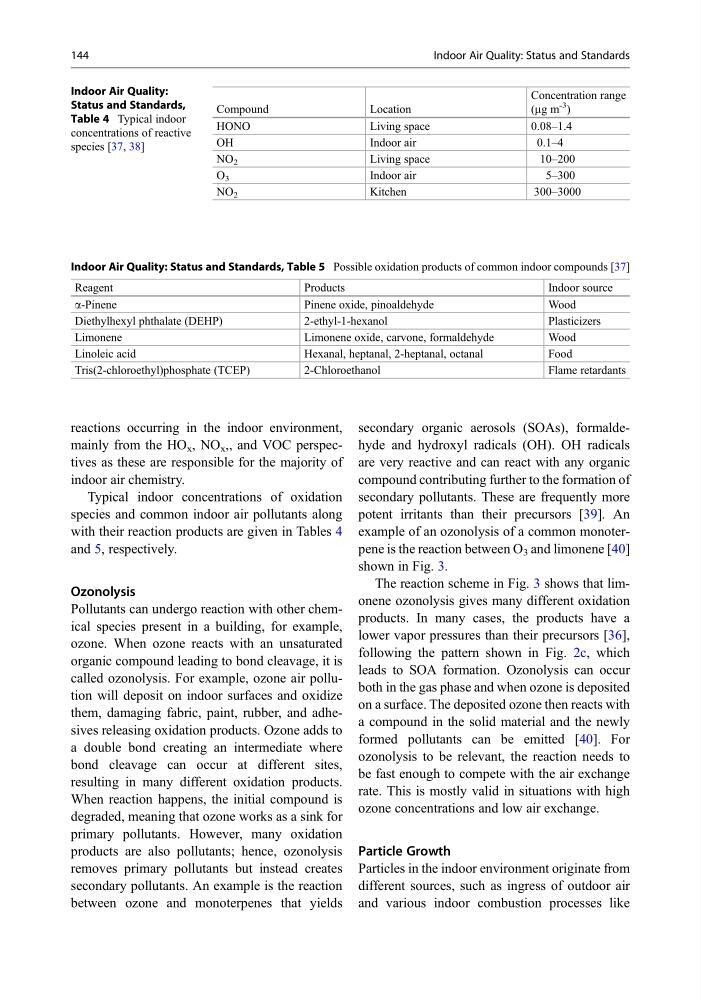
Typical indoor concentrations of oxidation
species and common indoor air pollutants along
with their reaction products are given in Tables 4
and 5, respectively.
Ozonolysis
Pollutants can undergo reaction with other chemical species present in a building, for example,
ozone. When ozone reacts with an unsaturated
organic compound leading to bond cleavage, it is
called ozonolysis. For example, ozone air pollution will deposit on indoor surfaces and oxidize
them, damaging fabric, paint, rubber, and adhesives releasing oxidation products. Ozone adds to
a double bond creating an intermediate where
bond cleavage can occur at different sites,
resulting in many different oxidation products.
When reaction happens, the initial compound is
degraded, meaning that ozone works as a sink for
primary pollutants. However, many oxidation
products are also pollutants; hence, ozonolysis
removes primary pollutants but instead creates
secondary pollutants. An example is the reaction
between ozone and monoterpenes that yields
secondary organic aerosols (SOAs), formaldehyde and hydroxyl radicals (OH). OH radicals
are very reactive and can react with any organic
compound contributing further to the formation of
secondary pollutants. These are frequently more
potent irritants than their precursors [39]. An
example of an ozonolysis of a common monoterpene is the reaction between O 3 and limonene [40]
shown in Fig. 3.
The reaction scheme in Fig. 3 shows that limonene ozonolysis gives many different oxidation
products. In many cases, the products have a
lower vapor pressures than their precursors [36],
following the pattern shown in Fig. 2c, which
leads to SOA formation. Ozonolysis can occur
both in the gas phase and when ozone is deposited
on a surface. The deposited ozone then reacts with
a compound in the solid material and the newly
formed pollutants can be emitted [40]. For
ozonolysis to be relevant, the reaction needs to
be fast enough to compete with the air exchange
rate. This is mostly valid in situations with high
ozone concentrations and low air exchange.
Particle Growth
Particles in the indoor environment originate from
different sources, such as ingress of outdoor air
and various indoor combustion processes like
Indoor Air Quality:
Status and Standards,
Table 4 Typical indoor
concentrations of reactive
species [37, 38]
Compound
Location
Concentration range
(mg m
˗3
)
HONO
Living space
0.08–1.4
OH
Indoor air
0.1–4
NO 2
Living space
10–200
O 3
Indoor air
5–300
NO 2
Kitchen
300–3000
Indoor Air Quality: Status and Standards, Table 5 Possible oxidation products of common indoor compounds [37]
Reagent
Products
Indoor source
a-Pinene
Pinene oxide, pinoaldehyde
Wood
Diethylhexyl phthalate (DEHP)
2-ethyl-1-hexanol
Plasticizers
Limonene
Limonene oxide, carvone, formaldehyde
Wood
Linoleic acid
Hexanal, heptanal, 2-heptanal, octanal
Food
Tris(2-chloroethyl)phosphate (TCEP)
2-Chloroethanol
Flame retardants
144
Indoor Air Quality: Status and Standards
mainly from the HO x , NO x ,, and VOC perspectives as these are responsible for the majority of
indoor air chemistry.
Typical indoor concentrations of oxidation
species and common indoor air pollutants along
with their reaction products are given in Tables 4
and 5, respectively.
Ozonolysis
Pollutants can undergo reaction with other chemical species present in a building, for example,
ozone. When ozone reacts with an unsaturated
organic compound leading to bond cleavage, it is
called ozonolysis. For example, ozone air pollution will deposit on indoor surfaces and oxidize
them, damaging fabric, paint, rubber, and adhesives releasing oxidation products. Ozone adds to
a double bond creating an intermediate where
bond cleavage can occur at different sites,
resulting in many different oxidation products.
When reaction happens, the initial compound is
degraded, meaning that ozone works as a sink for
primary pollutants. However, many oxidation
products are also pollutants; hence, ozonolysis
removes primary pollutants but instead creates
secondary pollutants. An example is the reaction
between ozone and monoterpenes that yields
secondary organic aerosols (SOAs), formaldehyde and hydroxyl radicals (OH). OH radicals
are very reactive and can react with any organic
compound contributing further to the formation of
secondary pollutants. These are frequently more
potent irritants than their precursors [39]. An
example of an ozonolysis of a common monoterpene is the reaction between O 3 and limonene [40]
shown in Fig. 3.
The reaction scheme in Fig. 3 shows that limonene ozonolysis gives many different oxidation
products. In many cases, the products have a
lower vapor pressures than their precursors [36],
following the pattern shown in Fig. 2c, which
leads to SOA formation. Ozonolysis can occur
both in the gas phase and when ozone is deposited
on a surface. The deposited ozone then reacts with
a compound in the solid material and the newly
formed pollutants can be emitted [40]. For
ozonolysis to be relevant, the reaction needs to
be fast enough to compete with the air exchange
rate. This is mostly valid in situations with high
ozone concentrations and low air exchange.
Particle Growth
Particles in the indoor environment originate from
different sources, such as ingress of outdoor air
and various indoor combustion processes like
Indoor Air Quality:
Status and Standards,
Table 4 Typical indoor
concentrations of reactive
species [37, 38]
Compound
Location
Concentration range
(mg m
˗3
)
HONO
Living space
0.08–1.4
OH
Indoor air
0.1–4
NO 2
Living space
10–200
O 3
Indoor air
5–300
NO 2
Kitchen
300–3000
Indoor Air Quality: Status and Standards, Table 5 Possible oxidation products of common indoor compounds [37]
Reagent
Products
Indoor source
a-Pinene
Pinene oxide, pinoaldehyde
Wood
Diethylhexyl phthalate (DEHP)
2-ethyl-1-hexanol
Plasticizers
Limonene
Limonene oxide, carvone, formaldehyde
Wood
Linoleic acid
Hexanal, heptanal, 2-heptanal, octanal
Food
Tris(2-chloroethyl)phosphate (TCEP)
2-Chloroethanol
Flame retardants
144
Indoor Air Quality: Status and Standards