

The MOUDI have found more widespread use
than low-pressure impactors because they are
equipped with a lower pressure drop-inertial filter
for classifying nanoparticles, restricting loss of
volatile species [122]. To facilitate much longer
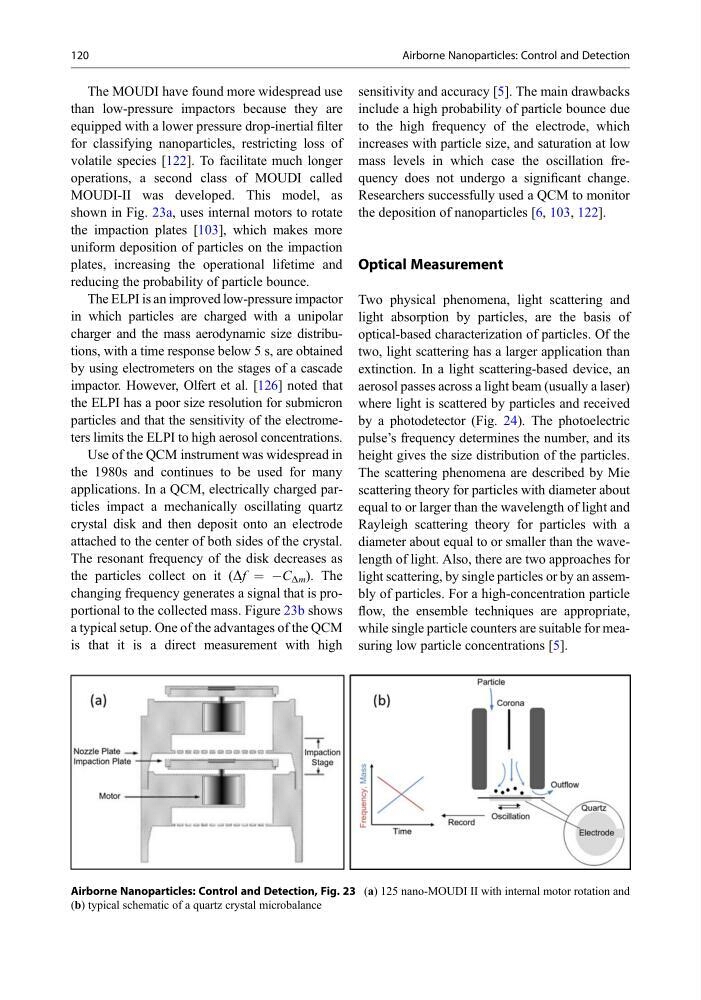
operations, a second class of MOUDI called
MOUDI-II was developed. This model, as
shown in Fig. 23a, uses internal motors to rotate
the impaction plates [103], which makes more
uniform deposition of particles on the impaction
plates, increasing the operational lifetime and
reducing the probability of particle bounce.
The ELPI is an improved low-pressure impactor
in which particles are charged with a unipolar
charger and the mass aerodynamic size distributions, with a time response below 5 s, are obtained
by using electrometers on the stages of a cascade
impactor. However, Olfert et al. [126] noted that
the ELPI has a poor size resolution for submicron
particles and that the sensitivity of the electrometers limits the ELPI to high aerosol concentrations.
Use of the QCM instrument was widespread in
the 1980s and continues to be used for many
applications. In a QCM, electrically charged particles impact a mechanically oscillating quartz
crystal disk and then deposit onto an electrode
attached to the center of both sides of the crystal.
The resonant frequency of the disk decreases as
the particles collect on it (Df ¼ ÀC Dm ). The
changing frequency generates a signal that is proportional to the collected mass. Figure 23b shows
a typical setup. One of the advantages of the QCM
is that it is a direct measurement with high
sensitivity and accuracy [5]. The main drawbacks
include a high probability of particle bounce due
to the high frequency of the electrode, which
increases with particle size, and saturation at low
mass levels in which case the oscillation frequency does not undergo a significant change.
Researchers successfully used a QCM to monitor
the deposition of nanoparticles [6, 103, 122].
Optical Measurement
Two physical phenomena, light scattering and
light absorption by particles, are the basis of
optical-based characterization of particles. Of the
two, light scattering has a larger application than
extinction. In a light scattering-based device, an
aerosol passes across a light beam (usually a laser)
where light is scattered by particles and received
by a photodetector (Fig. 24). The photoelectric
pulse’s frequency determines the number, and its
height gives the size distribution of the particles.
The scattering phenomena are described by Mie
scattering theory for particles with diameter about
equal to or larger than the wavelength of light and
Rayleigh scattering theory for particles with a
diameter about equal to or smaller than the wavelength of light. Also, there are two approaches for
light scattering, by single particles or by an assembly of particles. For a high-concentration particle
flow, the ensemble techniques are appropriate,
while single particle counters are suitable for measuring low particle concentrations [5].
Airborne Nanoparticles: Control and Detection, Fig. 23 (a) 125 nano-MOUDI II with internal motor rotation and
(b) typical schematic of a quartz crystal microbalance
120
Airborne Nanoparticles: Control and Detection
than low-pressure impactors because they are
equipped with a lower pressure drop-inertial filter
for classifying nanoparticles, restricting loss of
volatile species [122]. To facilitate much longer
operations, a second class of MOUDI called
MOUDI-II was developed. This model, as
shown in Fig. 23a, uses internal motors to rotate
the impaction plates [103], which makes more
uniform deposition of particles on the impaction
plates, increasing the operational lifetime and
reducing the probability of particle bounce.
The ELPI is an improved low-pressure impactor
in which particles are charged with a unipolar
charger and the mass aerodynamic size distributions, with a time response below 5 s, are obtained
by using electrometers on the stages of a cascade
impactor. However, Olfert et al. [126] noted that
the ELPI has a poor size resolution for submicron
particles and that the sensitivity of the electrometers limits the ELPI to high aerosol concentrations.
Use of the QCM instrument was widespread in
the 1980s and continues to be used for many
applications. In a QCM, electrically charged particles impact a mechanically oscillating quartz
crystal disk and then deposit onto an electrode
attached to the center of both sides of the crystal.
The resonant frequency of the disk decreases as
the particles collect on it (Df ¼ ÀC Dm ). The
changing frequency generates a signal that is proportional to the collected mass. Figure 23b shows
a typical setup. One of the advantages of the QCM
is that it is a direct measurement with high
sensitivity and accuracy [5]. The main drawbacks
include a high probability of particle bounce due
to the high frequency of the electrode, which
increases with particle size, and saturation at low
mass levels in which case the oscillation frequency does not undergo a significant change.
Researchers successfully used a QCM to monitor
the deposition of nanoparticles [6, 103, 122].
Optical Measurement
Two physical phenomena, light scattering and
light absorption by particles, are the basis of
optical-based characterization of particles. Of the
two, light scattering has a larger application than
extinction. In a light scattering-based device, an
aerosol passes across a light beam (usually a laser)
where light is scattered by particles and received
by a photodetector (Fig. 24). The photoelectric
pulse’s frequency determines the number, and its
height gives the size distribution of the particles.
The scattering phenomena are described by Mie
scattering theory for particles with diameter about
equal to or larger than the wavelength of light and
Rayleigh scattering theory for particles with a
diameter about equal to or smaller than the wavelength of light. Also, there are two approaches for
light scattering, by single particles or by an assembly of particles. For a high-concentration particle
flow, the ensemble techniques are appropriate,
while single particle counters are suitable for measuring low particle concentrations [5].
Airborne Nanoparticles: Control and Detection, Fig. 23 (a) 125 nano-MOUDI II with internal motor rotation and
(b) typical schematic of a quartz crystal microbalance
120
Airborne Nanoparticles: Control and Detection