

impactor can be varied to control the cutoff size of
particles that will pass. In the cascade, large particles are trapped first followed by successively
smaller particles that are separated in the terminal
stages. The size resolution of the instrument is
controlled by the number of stages. Among these
systems, the MOUDI and ELPI have been used to
obtain a smaller cutoff allowing characterization
of nanoparticles. Problems with cascade impactors include particle bounce, overloading of particles on the impaction plate, and interstage loss
[103]. Some workers have used oil-coated substrates [123] and porous substrates [124] to overcome the problem of particle bounce. Also, to
avoid the effect of humidity, Chen et al. [125]
suggested controlling the relative humidity
(RH) of the incoming aerosol of the MOUDI.
Another issue is particle clogging in the nozzles
because of long-term or high particle concentration sampling. This problem can increase the pressure drop across the plates; thus, the nozzles need
to be cleaned periodically [122].
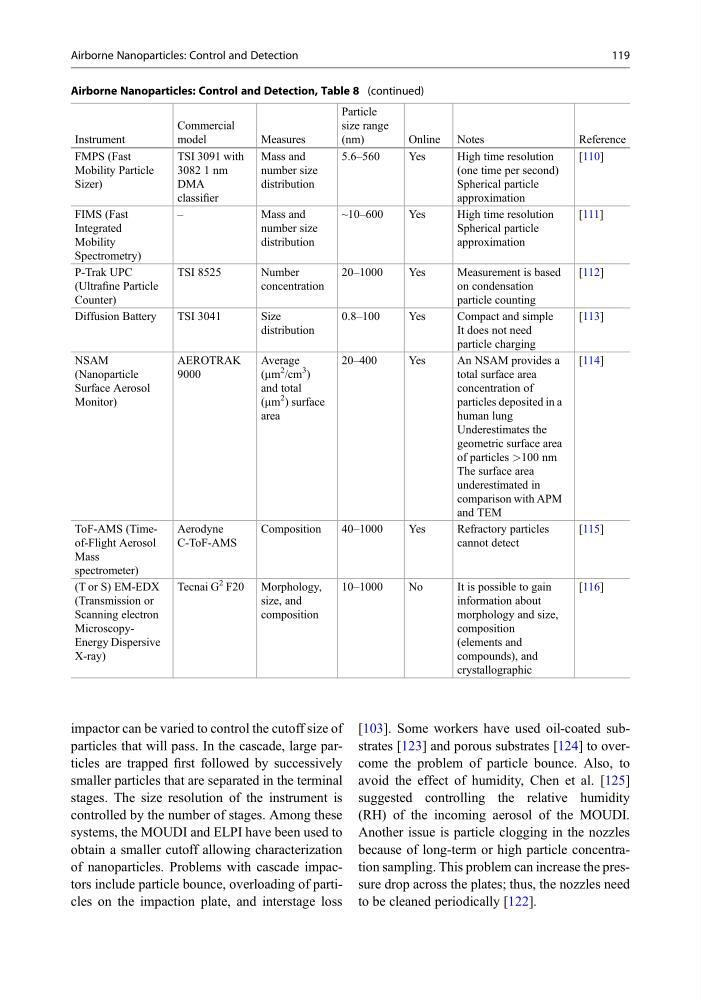
Airborne Nanoparticles: Control and Detection, Table 8 (continued)
Instrument
Commercial
model
Measures
Particle
size range
(nm)
Online Notes
Reference
FMPS (Fast
Mobility Particle
Sizer)
TSI 3091 with
3082 1 nm
DMA
classifier
Mass and
number size
distribution
5.6–560
Yes
High time resolution
(one time per second)
Spherical particle
approximation
[110]
FIMS (Fast
Integrated
Mobility
Spectrometry)
–
Mass and
number size
distribution
~10–600
Yes
High time resolution
Spherical particle
approximation
[111]
P-Trak UPC
(Ultrafine Particle
Counter)
TSI 8525
Number
concentration
20–1000
Yes
Measurement is based
on condensation
particle counting
[112]
Diffusion Battery
TSI 3041
Size
distribution
0.8–100
Yes
Compact and simple
It does not need
particle charging
[113]
NSAM
(Nanoparticle
Surface Aerosol
Monitor)
AEROTRAK
9000
Average
(mm
2
/cm
3
)
and total
(mm
2
) surface
area
20–400
Yes
An NSAM provides a
total surface area
concentration of
particles deposited in a
human lung
Underestimates the
geometric surface area
of particles >100 nm
The surface area
underestimated in
comparison with APM
and TEM
[114]
ToF-AMS (Timeof-Flight Aerosol
Mass
spectrometer)
Aerodyne
C-ToF-AMS
Composition
40–1000
Yes
Refractory particles
cannot detect
[115]
(T or S) EM-EDX
(Transmission or
Scanning electron
MicroscopyEnergy Dispersive
X-ray)
Tecnai G
2 F20 Morphology,
size, and
composition
10–1000
No
It is possible to gain
information about
morphology and size,
composition
(elements and
compounds), and
crystallographic
[116]
Airborne Nanoparticles: Control and Detection
119
particles that will pass. In the cascade, large particles are trapped first followed by successively
smaller particles that are separated in the terminal
stages. The size resolution of the instrument is
controlled by the number of stages. Among these
systems, the MOUDI and ELPI have been used to
obtain a smaller cutoff allowing characterization
of nanoparticles. Problems with cascade impactors include particle bounce, overloading of particles on the impaction plate, and interstage loss
[103]. Some workers have used oil-coated substrates [123] and porous substrates [124] to overcome the problem of particle bounce. Also, to
avoid the effect of humidity, Chen et al. [125]
suggested controlling the relative humidity
(RH) of the incoming aerosol of the MOUDI.
Another issue is particle clogging in the nozzles
because of long-term or high particle concentration sampling. This problem can increase the pressure drop across the plates; thus, the nozzles need
to be cleaned periodically [122].
Airborne Nanoparticles: Control and Detection, Table 8 (continued)
Instrument
Commercial
model
Measures
Particle
size range
(nm)
Online Notes
Reference
FMPS (Fast
Mobility Particle
Sizer)
TSI 3091 with
3082 1 nm
DMA
classifier
Mass and
number size
distribution
5.6–560
Yes
High time resolution
(one time per second)
Spherical particle
approximation
[110]
FIMS (Fast
Integrated
Mobility
Spectrometry)
–
Mass and
number size
distribution
~10–600
Yes
High time resolution
Spherical particle
approximation
[111]
P-Trak UPC
(Ultrafine Particle
Counter)
TSI 8525
Number
concentration
20–1000
Yes
Measurement is based
on condensation
particle counting
[112]
Diffusion Battery
TSI 3041
Size
distribution
0.8–100
Yes
Compact and simple
It does not need
particle charging
[113]
NSAM
(Nanoparticle
Surface Aerosol
Monitor)
AEROTRAK
9000
Average
(mm
2
/cm
3
)
and total
(mm
2
) surface
area
20–400
Yes
An NSAM provides a
total surface area
concentration of
particles deposited in a
human lung
Underestimates the
geometric surface area
of particles >100 nm
The surface area
underestimated in
comparison with APM
and TEM
[114]
ToF-AMS (Timeof-Flight Aerosol
Mass
spectrometer)
Aerodyne
C-ToF-AMS
Composition
40–1000
Yes
Refractory particles
cannot detect
[115]
(T or S) EM-EDX
(Transmission or
Scanning electron
MicroscopyEnergy Dispersive
X-ray)
Tecnai G
2 F20 Morphology,
size, and
composition
10–1000
No
It is possible to gain
information about
morphology and size,
composition
(elements and
compounds), and
crystallographic
[116]
Airborne Nanoparticles: Control and Detection
119