

to collide and grow, leading to nonlinear growth.
The acoustic agglomeration can be further
enhanced by orthokinetic collision [96], hydrodynamic interaction [92], and Brownian agglomeration [95]. Zu et al. [95] investigated an acoustic
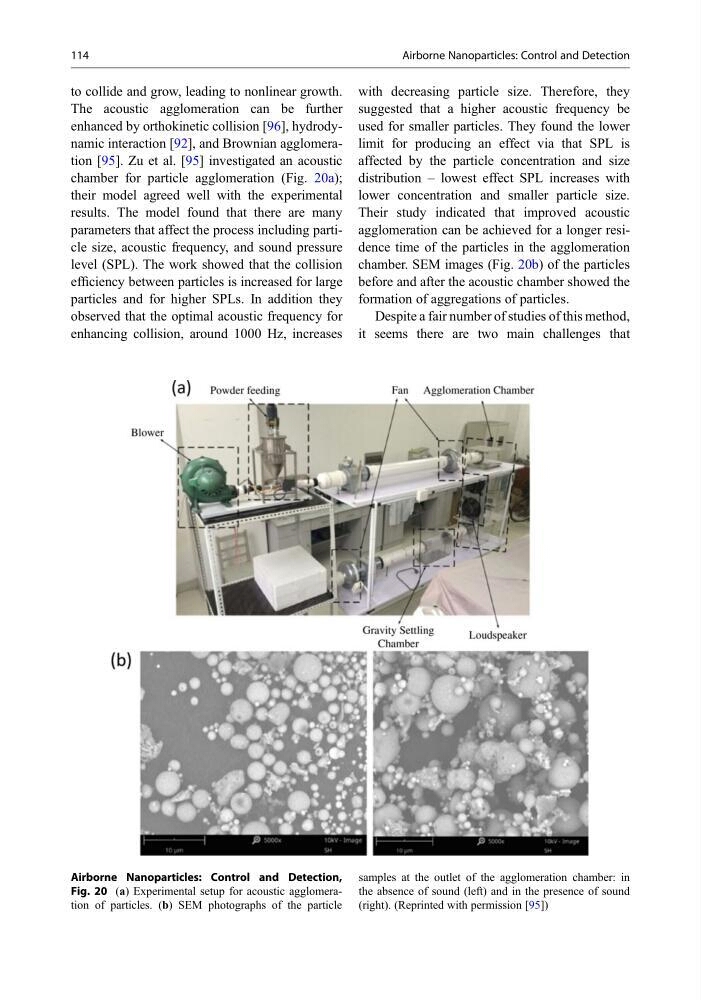
chamber for particle agglomeration (Fig. 20a);
their model agreed well with the experimental
results. The model found that there are many
parameters that affect the process including particle size, acoustic frequency, and sound pressure
level (SPL). The work showed that the collision
efficiency between particles is increased for large
particles and for higher SPLs. In addition they
observed that the optimal acoustic frequency for
enhancing collision, around 1000 Hz, increases
with decreasing particle size. Therefore, they
suggested that a higher acoustic frequency be
used for smaller particles. They found the lower
limit for producing an effect via that SPL is
affected by the particle concentration and size
distribution – lowest effect SPL increases with
lower concentration and smaller particle size.
Their study indicated that improved acoustic
agglomeration can be achieved for a longer residence time of the particles in the agglomeration
chamber. SEM images (Fig. 20b) of the particles
before and after the acoustic chamber showed the
formation of aggregations of particles.
Despite a fair number of studies of this method,
it seems there are two main challenges that
Airborne Nanoparticles: Control and Detection,
Fig. 20 (a) Experimental setup for acoustic agglomeration of particles. (b) SEM photographs of the particle
samples at the outlet of the agglomeration chamber: in
the absence of sound (left) and in the presence of sound
(right). (Reprinted with permission [95])
114
Airborne Nanoparticles: Control and Detection
The acoustic agglomeration can be further
enhanced by orthokinetic collision [96], hydrodynamic interaction [92], and Brownian agglomeration [95]. Zu et al. [95] investigated an acoustic
chamber for particle agglomeration (Fig. 20a);
their model agreed well with the experimental
results. The model found that there are many
parameters that affect the process including particle size, acoustic frequency, and sound pressure
level (SPL). The work showed that the collision
efficiency between particles is increased for large
particles and for higher SPLs. In addition they
observed that the optimal acoustic frequency for
enhancing collision, around 1000 Hz, increases
with decreasing particle size. Therefore, they
suggested that a higher acoustic frequency be
used for smaller particles. They found the lower
limit for producing an effect via that SPL is
affected by the particle concentration and size
distribution – lowest effect SPL increases with
lower concentration and smaller particle size.
Their study indicated that improved acoustic
agglomeration can be achieved for a longer residence time of the particles in the agglomeration
chamber. SEM images (Fig. 20b) of the particles
before and after the acoustic chamber showed the
formation of aggregations of particles.
Despite a fair number of studies of this method,
it seems there are two main challenges that
Airborne Nanoparticles: Control and Detection,
Fig. 20 (a) Experimental setup for acoustic agglomeration of particles. (b) SEM photographs of the particle
samples at the outlet of the agglomeration chamber: in
the absence of sound (left) and in the presence of sound
(right). (Reprinted with permission [95])
114
Airborne Nanoparticles: Control and Detection