

reduction in surface tension drive the coagulation
of nanoparticles. Soot aggregates are one example
of the result of such interactions. Mendelevich
et al. [90] have tested a geometric approach for
clustering nanoparticles in transportation exhaust
systems in which the flow velocity across a pipe is
manipulated by design. They evaluated the ability
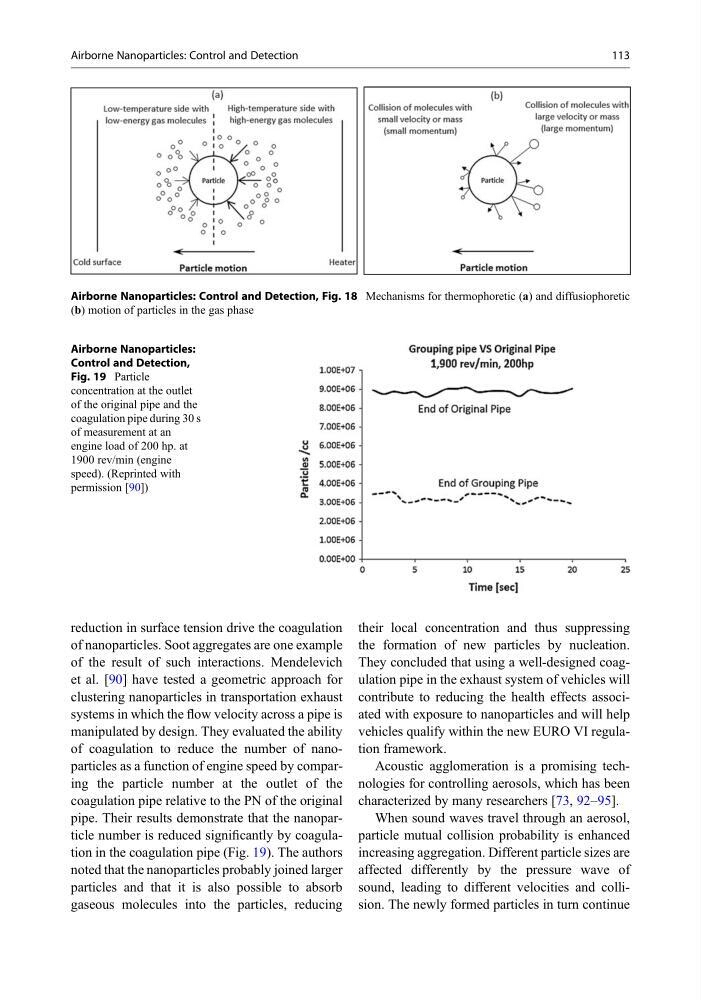
of coagulation to reduce the number of nanoparticles as a function of engine speed by comparing the particle number at the outlet of the
coagulation pipe relative to the PN of the original
pipe. Their results demonstrate that the nanoparticle number is reduced significantly by coagulation in the coagulation pipe (Fig. 19). The authors
noted that the nanoparticles probably joined larger
particles and that it is also possible to absorb
gaseous molecules into the particles, reducing
their local concentration and thus suppressing
the formation of new particles by nucleation.
They concluded that using a well-designed coagulation pipe in the exhaust system of vehicles will
contribute to reducing the health effects associated with exposure to nanoparticles and will help
vehicles qualify within the new EURO VI regulation framework.
Acoustic agglomeration is a promising technologies for controlling aerosols, which has been
characterized by many researchers [73, 92–95].
When sound waves travel through an aerosol,
particle mutual collision probability is enhanced
increasing aggregation. Different particle sizes are
affected differently by the pressure wave of
sound, leading to different velocities and collision. The newly formed particles in turn continue
Airborne Nanoparticles: Control and Detection, Fig. 18 Mechanisms for thermophoretic (a) and diffusiophoretic
(b) motion of particles in the gas phase
Airborne Nanoparticles:
Control and Detection,
Fig. 19 Particle
concentration at the outlet
of the original pipe and the
coagulation pipe during 30 s
of measurement at an
engine load of 200 hp. at
1900 rev/min (engine
speed). (Reprinted with
permission [90])
Airborne Nanoparticles: Control and Detection
113
of nanoparticles. Soot aggregates are one example
of the result of such interactions. Mendelevich
et al. [90] have tested a geometric approach for
clustering nanoparticles in transportation exhaust
systems in which the flow velocity across a pipe is
manipulated by design. They evaluated the ability
of coagulation to reduce the number of nanoparticles as a function of engine speed by comparing the particle number at the outlet of the
coagulation pipe relative to the PN of the original
pipe. Their results demonstrate that the nanoparticle number is reduced significantly by coagulation in the coagulation pipe (Fig. 19). The authors
noted that the nanoparticles probably joined larger
particles and that it is also possible to absorb
gaseous molecules into the particles, reducing
their local concentration and thus suppressing
the formation of new particles by nucleation.
They concluded that using a well-designed coagulation pipe in the exhaust system of vehicles will
contribute to reducing the health effects associated with exposure to nanoparticles and will help
vehicles qualify within the new EURO VI regulation framework.
Acoustic agglomeration is a promising technologies for controlling aerosols, which has been
characterized by many researchers [73, 92–95].
When sound waves travel through an aerosol,
particle mutual collision probability is enhanced
increasing aggregation. Different particle sizes are
affected differently by the pressure wave of
sound, leading to different velocities and collision. The newly formed particles in turn continue
Airborne Nanoparticles: Control and Detection, Fig. 18 Mechanisms for thermophoretic (a) and diffusiophoretic
(b) motion of particles in the gas phase
Airborne Nanoparticles:
Control and Detection,
Fig. 19 Particle
concentration at the outlet
of the original pipe and the
coagulation pipe during 30 s
of measurement at an
engine load of 200 hp. at
1900 rev/min (engine
speed). (Reprinted with
permission [90])
Airborne Nanoparticles: Control and Detection
113