

second power of radius. Therefore, this mechanism is more important for small particles than for
large [70, 81]. Typical temperature gradients are
on the order of 20,000 K/m; for UFPs this results
in thermophoretic mobilities on the order of
Brownian mobilities [70].
Researchers have studied this phenomenon
both theoretically and experimentally [82–
84]. Tsai and Lu [85] constructed a thermophoretic precipitator to collect nanoscale particles
and analyzed its performance. The system built by
Gonzales et al. [86] achieved near-complete
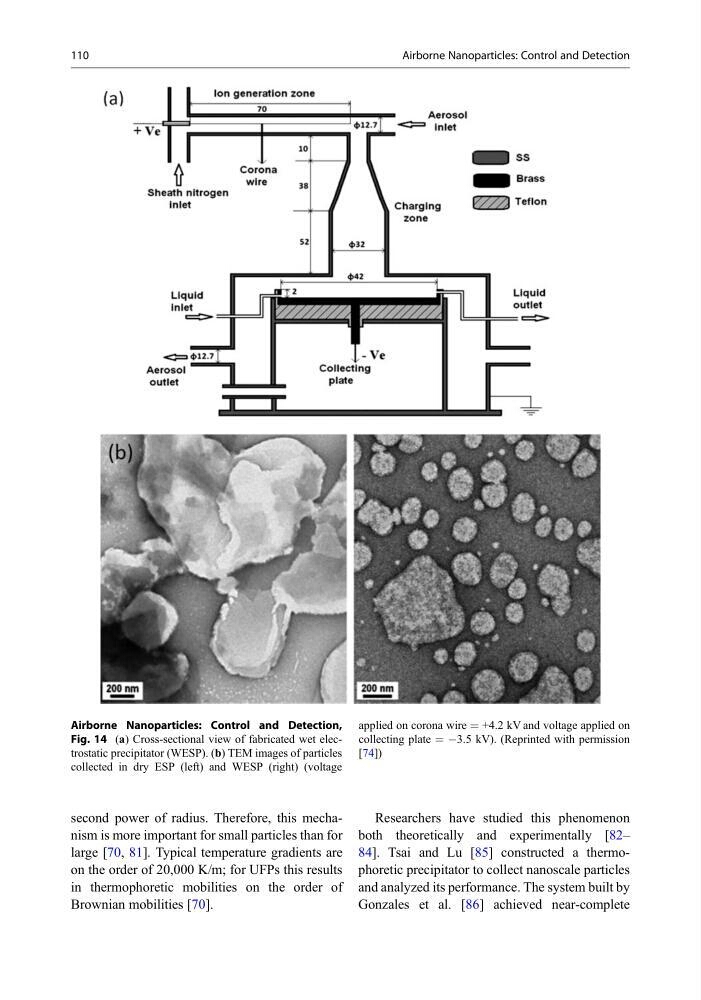
Airborne Nanoparticles: Control and Detection,
Fig. 14 (a) Cross-sectional view of fabricated wet electrostatic precipitator (WESP). (b) TEM images of particles
collected in dry ESP (left) and WESP (right) (voltage
applied on corona wire ¼ +4.2 kV and voltage applied on
collecting plate ¼ À3.5 kV). (Reprinted with permission
[74])
110
Airborne Nanoparticles: Control and Detection
large [70, 81]. Typical temperature gradients are
on the order of 20,000 K/m; for UFPs this results
in thermophoretic mobilities on the order of
Brownian mobilities [70].
Researchers have studied this phenomenon
both theoretically and experimentally [82–
84]. Tsai and Lu [85] constructed a thermophoretic precipitator to collect nanoscale particles
and analyzed its performance. The system built by
Gonzales et al. [86] achieved near-complete
Airborne Nanoparticles: Control and Detection,
Fig. 14 (a) Cross-sectional view of fabricated wet electrostatic precipitator (WESP). (b) TEM images of particles
collected in dry ESP (left) and WESP (right) (voltage
applied on corona wire ¼ +4.2 kV and voltage applied on
collecting plate ¼ À3.5 kV). (Reprinted with permission
[74])
110
Airborne Nanoparticles: Control and Detection