

deposition of NaCl and Fe nanoparticles, for distributions with mean diameters of 50 and 3.6 nm,
respectively, in a particle flow below 15 mL/min.
Particle filtration was homogeneous regardless of
particle size.
Boddu et al. [82] reported a near-complete
filtration of carbon nanoparticles with a mean
size of 60 nm at a mass density of 1 Â 10
3
mg/
m
3 . They observed that the particle filtration performance decreased to near 70% for 190 nm
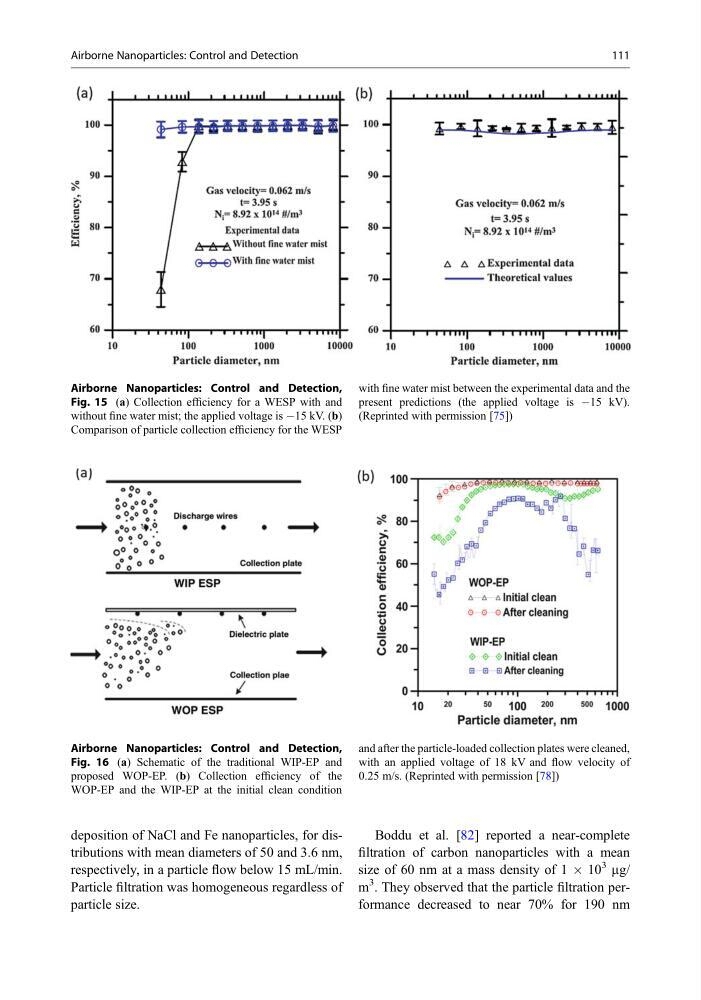
Airborne Nanoparticles: Control and Detection,
Fig. 15 (a) Collection efficiency for a WESP with and
without fine water mist; the applied voltage is À15 kV. (b)
Comparison of particle collection efficiency for the WESP
with fine water mist between the experimental data and the
present predictions (the applied voltage is À15 kV).
(Reprinted with permission [75])
Airborne Nanoparticles: Control and Detection,
Fig. 16 (a) Schematic of the traditional WIP-EP and
proposed WOP-EP. (b) Collection efficiency of the
WOP-EP and the WIP-EP at the initial clean condition
and after the particle-loaded collection plates were cleaned,
with an applied voltage of 18 kV and flow velocity of
0.25 m/s. (Reprinted with permission [78])
Airborne Nanoparticles: Control and Detection
111
respectively, in a particle flow below 15 mL/min.
Particle filtration was homogeneous regardless of
particle size.
Boddu et al. [82] reported a near-complete
filtration of carbon nanoparticles with a mean
size of 60 nm at a mass density of 1 Â 10
3
mg/
m
3 . They observed that the particle filtration performance decreased to near 70% for 190 nm
Airborne Nanoparticles: Control and Detection,
Fig. 15 (a) Collection efficiency for a WESP with and
without fine water mist; the applied voltage is À15 kV. (b)
Comparison of particle collection efficiency for the WESP
with fine water mist between the experimental data and the
present predictions (the applied voltage is À15 kV).
(Reprinted with permission [75])
Airborne Nanoparticles: Control and Detection,
Fig. 16 (a) Schematic of the traditional WIP-EP and
proposed WOP-EP. (b) Collection efficiency of the
WOP-EP and the WIP-EP at the initial clean condition
and after the particle-loaded collection plates were cleaned,
with an applied voltage of 18 kV and flow velocity of
0.25 m/s. (Reprinted with permission [78])
Airborne Nanoparticles: Control and Detection
111