

¼ 1 À exp
ÀoA
Q
ð13Þ
where o is migration velocity, A is the collector
electrode area, and Q is volumetric gas flow. It has
been pointed out that Eq. (13) is for particles with
similar drift velocities and not for mixtures of
particle sizes having different drift velocities. An
underlying assumption in the equation is that the
particles are permanently collected.
The assumption works well when the collection efficiency is low; for high collection efficiencies (> 99%), other mechanisms besides
drift velocity dominate particle collection.
Re-entrainment (from rapping and scouring),
low electrical resistivity, and uneven flow through
the filter can limit collection efficiency leading to
particle collection slower than predicted with
Eq. (13). Empirical modifications to the equations
have been made, to describe the behavior of ESPs
with ultrahigh collection efficiency. The Hazen
equation (Eq. (14)) and Matts-Ohnfeldt equation
(Eq. (15)) build on the Deutsch equation:
¼ 1 À 1 þ
oA
nQ
Àn
ð14Þ
¼ 1 À exp
ÀoA
Q
x
ð15Þ
where n is an empirical constant set at 3 to 5 and
x is an empirical constant set at 0.5 based on
experimental data [70, 71].
Various studies have shown that the collection
efficiency for nanoparticles by ESPs is largely
dependent on structural properties including
stages of collection, combination with other
methods, choice of wet vs. dry ESP, discharge
electrode positioning, type of collection electrodes and so on, and specific collection conditions including cleaning gas velocity, type, size,
and concentration of particles.
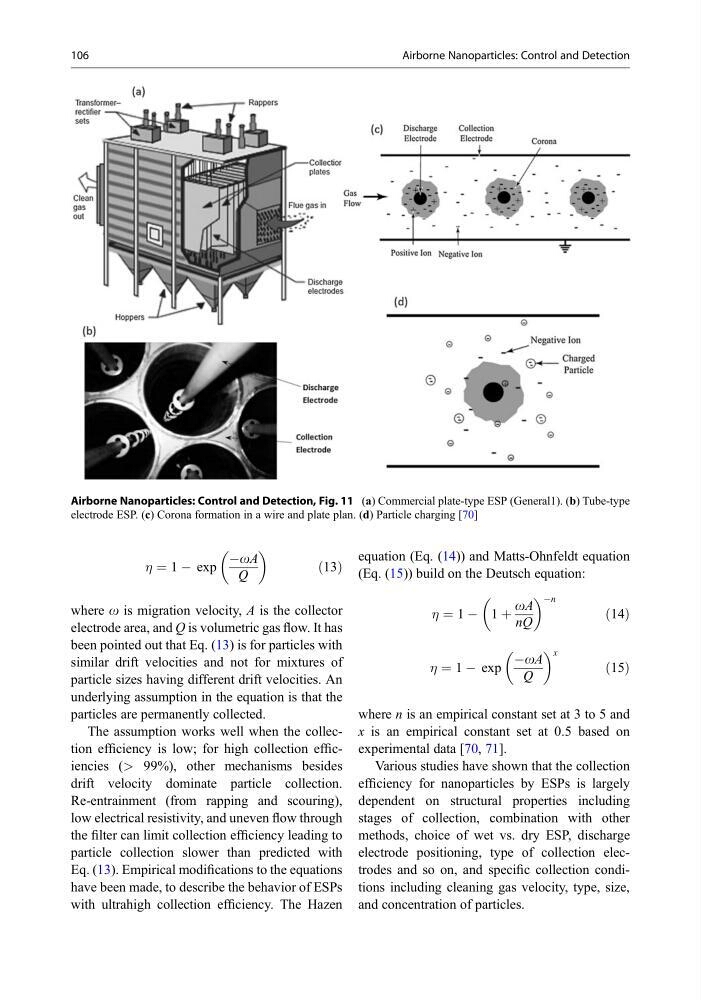
Airborne Nanoparticles: Control and Detection, Fig. 11 (a) Commercial plate-type ESP (General1). (b) Tube-type
electrode ESP. (c) Corona formation in a wire and plate plan. (d) Particle charging [70]
106
Airborne Nanoparticles: Control and Detection
ÀoA
Q
ð13Þ
where o is migration velocity, A is the collector
electrode area, and Q is volumetric gas flow. It has
been pointed out that Eq. (13) is for particles with
similar drift velocities and not for mixtures of
particle sizes having different drift velocities. An
underlying assumption in the equation is that the
particles are permanently collected.
The assumption works well when the collection efficiency is low; for high collection efficiencies (> 99%), other mechanisms besides
drift velocity dominate particle collection.
Re-entrainment (from rapping and scouring),
low electrical resistivity, and uneven flow through
the filter can limit collection efficiency leading to
particle collection slower than predicted with
Eq. (13). Empirical modifications to the equations
have been made, to describe the behavior of ESPs
with ultrahigh collection efficiency. The Hazen
equation (Eq. (14)) and Matts-Ohnfeldt equation
(Eq. (15)) build on the Deutsch equation:
¼ 1 À 1 þ
oA
nQ
Àn
ð14Þ
¼ 1 À exp
ÀoA
Q
x
ð15Þ
where n is an empirical constant set at 3 to 5 and
x is an empirical constant set at 0.5 based on
experimental data [70, 71].
Various studies have shown that the collection
efficiency for nanoparticles by ESPs is largely
dependent on structural properties including
stages of collection, combination with other
methods, choice of wet vs. dry ESP, discharge
electrode positioning, type of collection electrodes and so on, and specific collection conditions including cleaning gas velocity, type, size,
and concentration of particles.
Airborne Nanoparticles: Control and Detection, Fig. 11 (a) Commercial plate-type ESP (General1). (b) Tube-type
electrode ESP. (c) Corona formation in a wire and plate plan. (d) Particle charging [70]
106
Airborne Nanoparticles: Control and Detection