

Zhuang et al. [72] have investigated the effect of
various operating conditions on the collection efficiency for nanoparticles in the range of 50–500 nm
in a cylindrical (tubular) ESP. The ESP was operated in either one- or two-stage mode. It was found
that collection efficiencies dropped as the corona
current decreased due to a too small drift effect for
particles toward the collection electrodes at high air
velocities (Fig. 12a). They also found that a lower
electrical resistivity of particles caused a decrease
in the collection efficiency owing to decreased
attractive force at collector surfaces after deposition. Particles of NaCl and Al 2 O 3 showed lower
conductivity and ion emission, resulting in poor
corona current and thus a decrease in the collection
efficiency. The two-stage ESP had a higher collection efficiency than the one-stage ESP (Fig. 21a),
and for both ESPs the collection efficiency for
nanoparticles in the range of 70–100 nm was better
than for other sizes (Fig. 12a, b).
Kim et al. [73] used a combined electrospray/
ESP to enhance the collection efficiency of monodisperse nanometer-sized particles (Fig. 13). The
combination enhanced the collection of particles
by 21–36% depending on the particle size and in
addition reduced the energy consumption of the
ESP.
There are a number of technical challenges
associated with collecting sticky and aggregative
soft nanoparticles with a conventional ESP. Dey
et al. [74] have designed a positive mode charged
wet electrostatic precipitation (WESP) (Fig. 14a)
to address them. The goal of their system is to
collect soft nanoparticles including monodisperse
polystyrene latex (PSL), polydisperse sucrose,
and stearic acid particles directly into liquid
media. The collection efficiency of WESP was
70–90% for particles of 80–600 nm diameter, in
agreement with theoretical modeling, and
40–70% for small particles of 20–80 nm diameter.
The performance for these small particles was
significantly lower than the theoretical estimate,
possibly due to incomplete neutralization of negative charges during air-jet atomization.
Figure 14b shows transmission electron microscopy (TEM) images of aggregated nanoparticles
on a collecting plate for the dry ESP and nonaggregated nanoparticles on the collecting plate
of the WESP.
An efficient wire-to-plate wet electrostatic precipitator (WESP) for nanoparticles was designed
by Chen et al. [75], targeting submicron- and
micron-sized particles emitted from semiconductor manufacturing. A fixed voltage of À15 kV was
supplied by tungsten wire discharge electrodes to
produce the electric field and corona ions. Water
mist at room temperature was used to quench the
high-temperature exhaust gas in order to enhance
particle condensation growth and improve the
collection efficiency of nanoparticles. The nanoparticle collection efficiency was 67.9–92.9%
without fine water mist, which increased to
99.2–99.7% when the water mist was used
(Fig. 15a). As shown in Fig. 15b, the results are
in good agreement with the formula ¼ 1 – exp
(Àa (N De ) b + g, where a, b, and g are empirical
regression coefficients determined from the
experiment and N De is the Deutsch number.
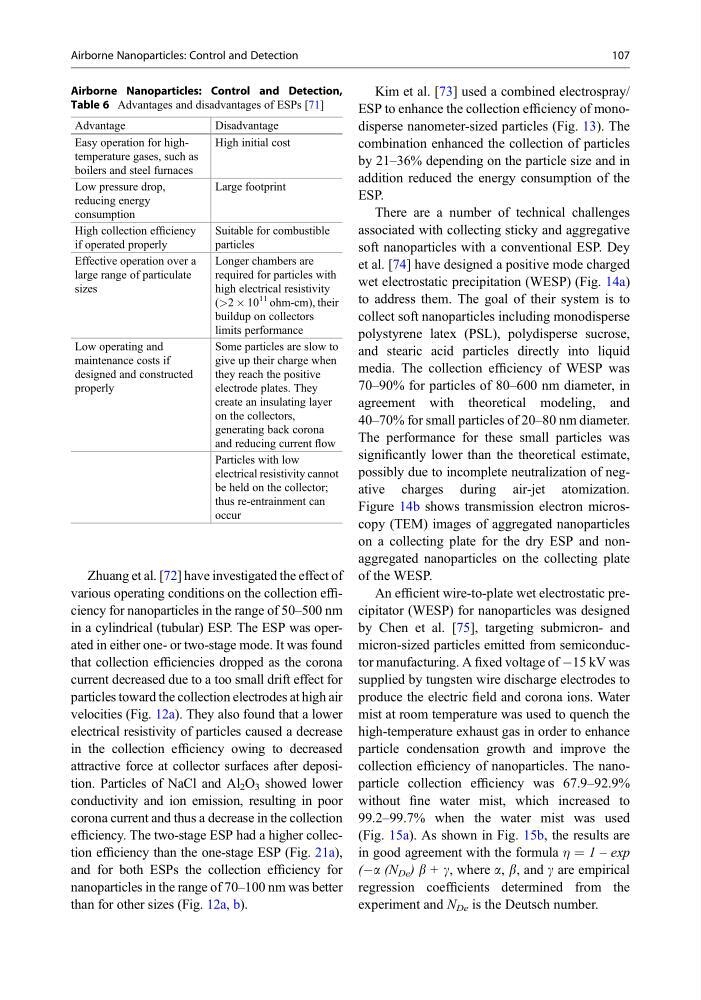
Airborne Nanoparticles: Control and Detection,
Table 6 Advantages and disadvantages of ESPs [71]
Advantage
Disadvantage
Easy operation for hightemperature gases, such as
boilers and steel furnaces
High initial cost
Low pressure drop,
reducing energy
consumption
Large footprint
High collection efficiency
if operated properly
Suitable for combustible
particles
Effective operation over a
large range of particulate
sizes
Longer chambers are
required for particles with
high electrical resistivity
(>2 Â 10
11 ohm-cm), their
buildup on collectors
limits performance
Low operating and
maintenance costs if
designed and constructed
properly
Some particles are slow to
give up their charge when
they reach the positive
electrode plates. They
create an insulating layer
on the collectors,
generating back corona
and reducing current flow
Particles with low
electrical resistivity cannot
be held on the collector;
thus re-entrainment can
occur
Airborne Nanoparticles: Control and Detection
107
various operating conditions on the collection efficiency for nanoparticles in the range of 50–500 nm
in a cylindrical (tubular) ESP. The ESP was operated in either one- or two-stage mode. It was found
that collection efficiencies dropped as the corona
current decreased due to a too small drift effect for
particles toward the collection electrodes at high air
velocities (Fig. 12a). They also found that a lower
electrical resistivity of particles caused a decrease
in the collection efficiency owing to decreased
attractive force at collector surfaces after deposition. Particles of NaCl and Al 2 O 3 showed lower
conductivity and ion emission, resulting in poor
corona current and thus a decrease in the collection
efficiency. The two-stage ESP had a higher collection efficiency than the one-stage ESP (Fig. 21a),
and for both ESPs the collection efficiency for
nanoparticles in the range of 70–100 nm was better
than for other sizes (Fig. 12a, b).
Kim et al. [73] used a combined electrospray/
ESP to enhance the collection efficiency of monodisperse nanometer-sized particles (Fig. 13). The
combination enhanced the collection of particles
by 21–36% depending on the particle size and in
addition reduced the energy consumption of the
ESP.
There are a number of technical challenges
associated with collecting sticky and aggregative
soft nanoparticles with a conventional ESP. Dey
et al. [74] have designed a positive mode charged
wet electrostatic precipitation (WESP) (Fig. 14a)
to address them. The goal of their system is to
collect soft nanoparticles including monodisperse
polystyrene latex (PSL), polydisperse sucrose,
and stearic acid particles directly into liquid
media. The collection efficiency of WESP was
70–90% for particles of 80–600 nm diameter, in
agreement with theoretical modeling, and
40–70% for small particles of 20–80 nm diameter.
The performance for these small particles was
significantly lower than the theoretical estimate,
possibly due to incomplete neutralization of negative charges during air-jet atomization.
Figure 14b shows transmission electron microscopy (TEM) images of aggregated nanoparticles
on a collecting plate for the dry ESP and nonaggregated nanoparticles on the collecting plate
of the WESP.
An efficient wire-to-plate wet electrostatic precipitator (WESP) for nanoparticles was designed
by Chen et al. [75], targeting submicron- and
micron-sized particles emitted from semiconductor manufacturing. A fixed voltage of À15 kV was
supplied by tungsten wire discharge electrodes to
produce the electric field and corona ions. Water
mist at room temperature was used to quench the
high-temperature exhaust gas in order to enhance
particle condensation growth and improve the
collection efficiency of nanoparticles. The nanoparticle collection efficiency was 67.9–92.9%
without fine water mist, which increased to
99.2–99.7% when the water mist was used
(Fig. 15a). As shown in Fig. 15b, the results are
in good agreement with the formula ¼ 1 – exp
(Àa (N De ) b + g, where a, b, and g are empirical
regression coefficients determined from the
experiment and N De is the Deutsch number.
Airborne Nanoparticles: Control and Detection,
Table 6 Advantages and disadvantages of ESPs [71]
Advantage
Disadvantage
Easy operation for hightemperature gases, such as
boilers and steel furnaces
High initial cost
Low pressure drop,
reducing energy
consumption
Large footprint
High collection efficiency
if operated properly
Suitable for combustible
particles
Effective operation over a
large range of particulate
sizes
Longer chambers are
required for particles with
high electrical resistivity
(>2 Â 10
11 ohm-cm), their
buildup on collectors
limits performance
Low operating and
maintenance costs if
designed and constructed
properly
Some particles are slow to
give up their charge when
they reach the positive
electrode plates. They
create an insulating layer
on the collectors,
generating back corona
and reducing current flow
Particles with low
electrical resistivity cannot
be held on the collector;
thus re-entrainment can
occur
Airborne Nanoparticles: Control and Detection
107