

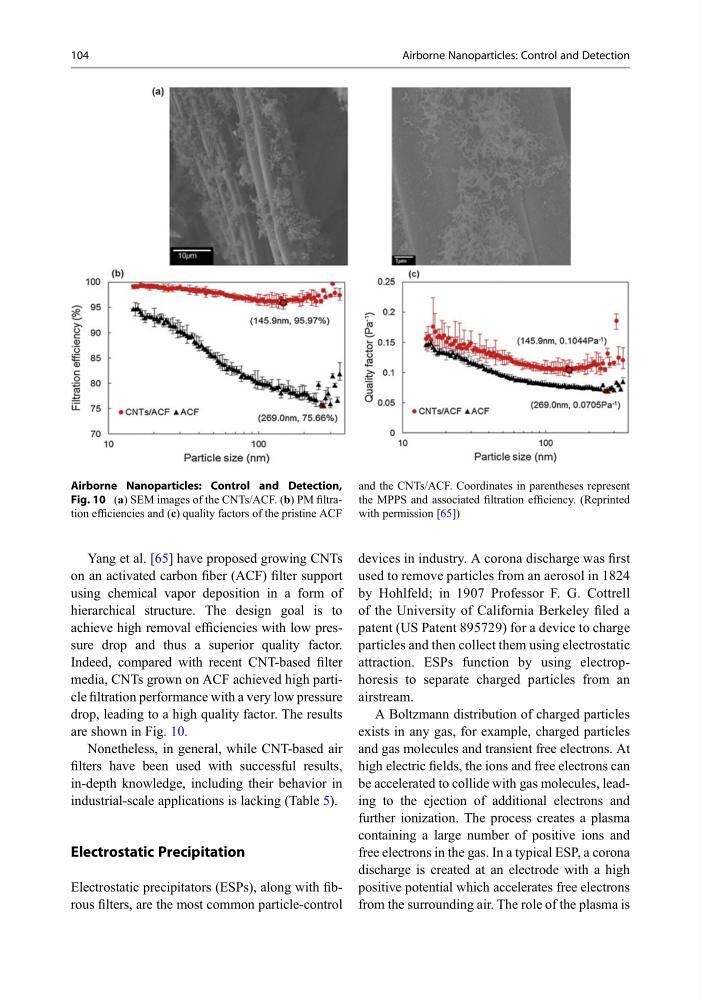
Yang et al. [65] have proposed growing CNTs
on an activated carbon fiber (ACF) filter support
using chemical vapor deposition in a form of
hierarchical structure. The design goal is to
achieve high removal efficiencies with low pressure drop and thus a superior quality factor.
Indeed, compared with recent CNT-based filter
media, CNTs grown on ACF achieved high particle filtration performance with a very low pressure
drop, leading to a high quality factor. The results
are shown in Fig. 10.
Nonetheless, in general, while CNT-based air
filters have been used with successful results,
in-depth knowledge, including their behavior in
industrial-scale applications is lacking (Table 5).
Electrostatic Precipitation
Electrostatic precipitators (ESPs), along with fibrous filters, are the most common particle-control
devices in industry. A corona discharge was first
used to remove particles from an aerosol in 1824
by Hohlfeld; in 1907 Professor F. G. Cottrell
of the University of California Berkeley filed a
patent (US Patent 895729) for a device to charge
particles and then collect them using electrostatic
attraction. ESPs function by using electrophoresis to separate charged particles from an
airstream.
A Boltzmann distribution of charged particles
exists in any gas, for example, charged particles
and gas molecules and transient free electrons. At
high electric fields, the ions and free electrons can
be accelerated to collide with gas molecules, leading to the ejection of additional electrons and
further ionization. The process creates a plasma
containing a large number of positive ions and
free electrons in the gas. In a typical ESP, a corona
discharge is created at an electrode with a high
positive potential which accelerates free electrons
from the surrounding air. The role of the plasma is
Airborne Nanoparticles: Control and Detection,
Fig. 10 (a) SEM images of the CNTs/ACF. (b) PM filtration efficiencies and (c) quality factors of the pristine ACF
and the CNTs/ACF. Coordinates in parentheses represent
the MPPS and associated filtration efficiency. (Reprinted
with permission [65])
104
Airborne Nanoparticles: Control and Detection
on an activated carbon fiber (ACF) filter support
using chemical vapor deposition in a form of
hierarchical structure. The design goal is to
achieve high removal efficiencies with low pressure drop and thus a superior quality factor.
Indeed, compared with recent CNT-based filter
media, CNTs grown on ACF achieved high particle filtration performance with a very low pressure
drop, leading to a high quality factor. The results
are shown in Fig. 10.
Nonetheless, in general, while CNT-based air
filters have been used with successful results,
in-depth knowledge, including their behavior in
industrial-scale applications is lacking (Table 5).
Electrostatic Precipitation
Electrostatic precipitators (ESPs), along with fibrous filters, are the most common particle-control
devices in industry. A corona discharge was first
used to remove particles from an aerosol in 1824
by Hohlfeld; in 1907 Professor F. G. Cottrell
of the University of California Berkeley filed a
patent (US Patent 895729) for a device to charge
particles and then collect them using electrostatic
attraction. ESPs function by using electrophoresis to separate charged particles from an
airstream.
A Boltzmann distribution of charged particles
exists in any gas, for example, charged particles
and gas molecules and transient free electrons. At
high electric fields, the ions and free electrons can
be accelerated to collide with gas molecules, leading to the ejection of additional electrons and
further ionization. The process creates a plasma
containing a large number of positive ions and
free electrons in the gas. In a typical ESP, a corona
discharge is created at an electrode with a high
positive potential which accelerates free electrons
from the surrounding air. The role of the plasma is
Airborne Nanoparticles: Control and Detection,
Fig. 10 (a) SEM images of the CNTs/ACF. (b) PM filtration efficiencies and (c) quality factors of the pristine ACF
and the CNTs/ACF. Coordinates in parentheses represent
the MPPS and associated filtration efficiency. (Reprinted
with permission [65])
104
Airborne Nanoparticles: Control and Detection