

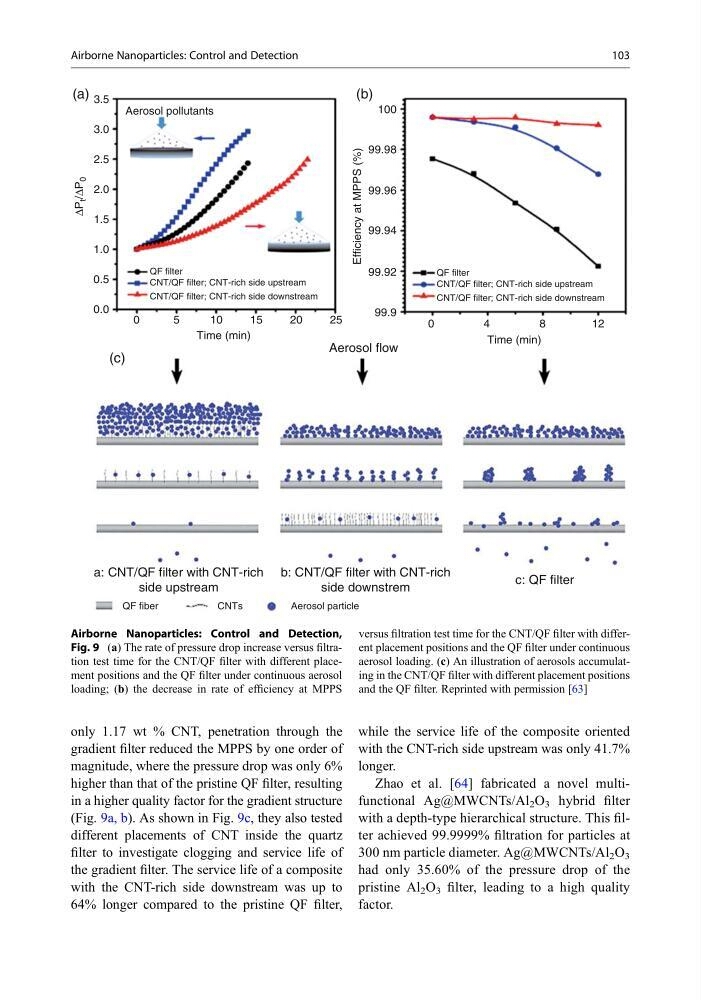
only 1.17 wt % CNT, penetration through the
gradient filter reduced the MPPS by one order of
magnitude, where the pressure drop was only 6%
higher than that of the pristine QF filter, resulting
in a higher quality factor for the gradient structure
(Fig. 9a, b). As shown in Fig. 9c, they also tested
different placements of CNT inside the quartz
filter to investigate clogging and service life of
the gradient filter. The service life of a composite
with the CNT-rich side downstream was up to
64% longer compared to the pristine QF filter,
while the service life of the composite oriented
with the CNT-rich side upstream was only 41.7%
longer.
Zhao et al. [64] fabricated a novel multifunctional Ag@MWCNTs/Al 2 O 3 hybrid filter
with a depth-type hierarchical structure. This filter achieved 99.9999% filtration for particles at
300 nm particle diameter. Ag@MWCNTs/Al 2 O 3
had only 35.60% of the pressure drop of the
pristine Al 2 O 3 filter, leading to a high quality
factor.
3.5
Aerosol pollutants
(a)
(b)
(c)
3.0
2.5
2.0
1.5
1.0
0.5
QF filter
CNT/QF filter; CNT-rich side upstream
CNT/QF filter; CNT-rich side downstream
QF filter
CNT/QF filter; CNT-rich side upstream
CNT/QF filter; CNT-rich side downstream
0
5
1 0
Time (min)
Time (min)
0
4
8
1 2
100
99.98
99.96
99.94
Efficiency at MPPS (%)
99.92
99.9
Aerosol flow
a: CNT/QF filter with CNT-rich
side upstream
b: CNT/QF filter with CNT-rich
side downstrem
c: QF filter
QF fiber
CNTs
Aerosol particle
15
20
25
0.0
ΔP
t /ΔP
0
Airborne Nanoparticles: Control and Detection,
Fig. 9 (a) The rate of pressure drop increase versus filtration test time for the CNT/QF filter with different placement positions and the QF filter under continuous aerosol
loading; (b) the decrease in rate of efficiency at MPPS
versus filtration test time for the CNT/QF filter with different placement positions and the QF filter under continuous
aerosol loading. (c) An illustration of aerosols accumulating in the CNT/QF filter with different placement positions
and the QF filter. Reprinted with permission [63]
Airborne Nanoparticles: Control and Detection
103
gradient filter reduced the MPPS by one order of
magnitude, where the pressure drop was only 6%
higher than that of the pristine QF filter, resulting
in a higher quality factor for the gradient structure
(Fig. 9a, b). As shown in Fig. 9c, they also tested
different placements of CNT inside the quartz
filter to investigate clogging and service life of
the gradient filter. The service life of a composite
with the CNT-rich side downstream was up to
64% longer compared to the pristine QF filter,
while the service life of the composite oriented
with the CNT-rich side upstream was only 41.7%
longer.
Zhao et al. [64] fabricated a novel multifunctional Ag@MWCNTs/Al 2 O 3 hybrid filter
with a depth-type hierarchical structure. This filter achieved 99.9999% filtration for particles at
300 nm particle diameter. Ag@MWCNTs/Al 2 O 3
had only 35.60% of the pressure drop of the
pristine Al 2 O 3 filter, leading to a high quality
factor.
3.5
Aerosol pollutants
(a)
(b)
(c)
3.0
2.5
2.0
1.5
1.0
0.5
QF filter
CNT/QF filter; CNT-rich side upstream
CNT/QF filter; CNT-rich side downstream
QF filter
CNT/QF filter; CNT-rich side upstream
CNT/QF filter; CNT-rich side downstream
0
5
1 0
Time (min)
Time (min)
0
4
8
1 2
100
99.98
99.96
99.94
Efficiency at MPPS (%)
99.92
99.9
Aerosol flow
a: CNT/QF filter with CNT-rich
side upstream
b: CNT/QF filter with CNT-rich
side downstrem
c: QF filter
QF fiber
CNTs
Aerosol particle
15
20
25
0.0
ΔP
t /ΔP
0
Airborne Nanoparticles: Control and Detection,
Fig. 9 (a) The rate of pressure drop increase versus filtration test time for the CNT/QF filter with different placement positions and the QF filter under continuous aerosol
loading; (b) the decrease in rate of efficiency at MPPS
versus filtration test time for the CNT/QF filter with different placement positions and the QF filter under continuous
aerosol loading. (c) An illustration of aerosols accumulating in the CNT/QF filter with different placement positions
and the QF filter. Reprinted with permission [63]
Airborne Nanoparticles: Control and Detection
103