

Li et al. [63] fabricated CNT/quartz fiber
(QF) filter as a depth-type hierarchical structure
through in situ growth of CNTs on quartz fiber
(QF) filters using a floating catalyst chemical
vapor deposition (CVD) method. They observed
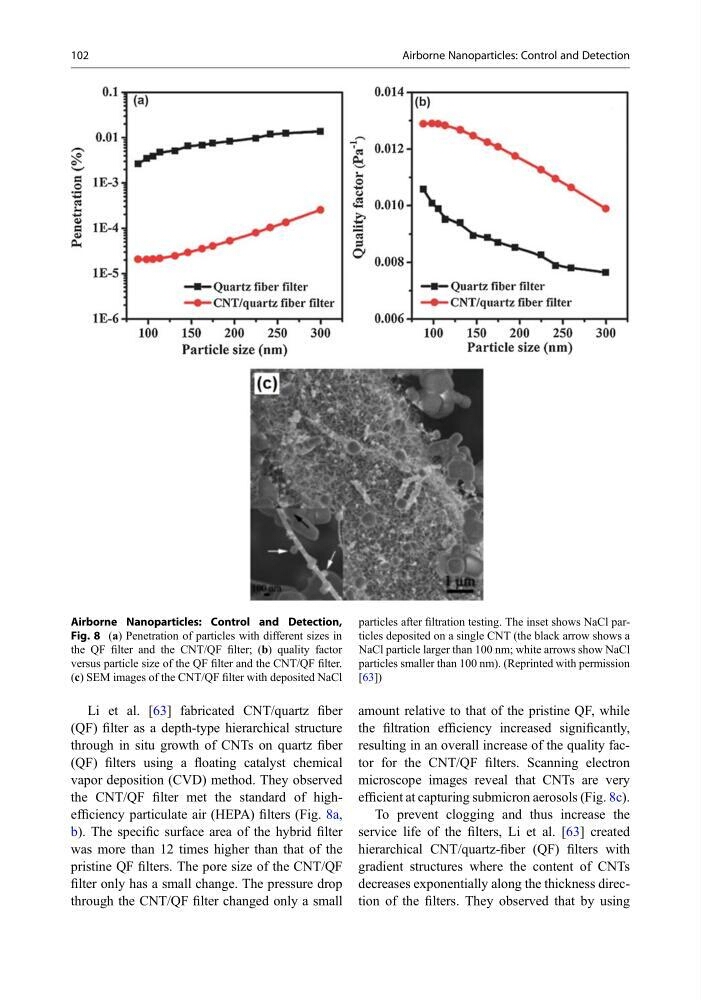
the CNT/QF filter met the standard of highefficiency particulate air (HEPA) filters (Fig. 8a,
b). The specific surface area of the hybrid filter
was more than 12 times higher than that of the
pristine QF filters. The pore size of the CNT/QF
filter only has a small change. The pressure drop
through the CNT/QF filter changed only a small
amount relative to that of the pristine QF, while
the filtration efficiency increased significantly,
resulting in an overall increase of the quality factor for the CNT/QF filters. Scanning electron
microscope images reveal that CNTs are very
efficient at capturing submicron aerosols (Fig. 8c).
To prevent clogging and thus increase the
service life of the filters, Li et al. [63] created
hierarchical CNT/quartz-fiber (QF) filters with
gradient structures where the content of CNTs
decreases exponentially along the thickness direction of the filters. They observed that by using
Airborne Nanoparticles: Control and Detection,
Fig. 8 (a) Penetration of particles with different sizes in
the QF filter and the CNT/QF filter; (b) quality factor
versus particle size of the QF filter and the CNT/QF filter.
(c) SEM images of the CNT/QF filter with deposited NaCl
particles after filtration testing. The inset shows NaCl particles deposited on a single CNT (the black arrow shows a
NaCl particle larger than 100 nm; white arrows show NaCl
particles smaller than 100 nm). (Reprinted with permission
[63])
102
Airborne Nanoparticles: Control and Detection
(QF) filter as a depth-type hierarchical structure
through in situ growth of CNTs on quartz fiber
(QF) filters using a floating catalyst chemical
vapor deposition (CVD) method. They observed
the CNT/QF filter met the standard of highefficiency particulate air (HEPA) filters (Fig. 8a,
b). The specific surface area of the hybrid filter
was more than 12 times higher than that of the
pristine QF filters. The pore size of the CNT/QF
filter only has a small change. The pressure drop
through the CNT/QF filter changed only a small
amount relative to that of the pristine QF, while
the filtration efficiency increased significantly,
resulting in an overall increase of the quality factor for the CNT/QF filters. Scanning electron
microscope images reveal that CNTs are very
efficient at capturing submicron aerosols (Fig. 8c).
To prevent clogging and thus increase the
service life of the filters, Li et al. [63] created
hierarchical CNT/quartz-fiber (QF) filters with
gradient structures where the content of CNTs
decreases exponentially along the thickness direction of the filters. They observed that by using
Airborne Nanoparticles: Control and Detection,
Fig. 8 (a) Penetration of particles with different sizes in
the QF filter and the CNT/QF filter; (b) quality factor
versus particle size of the QF filter and the CNT/QF filter.
(c) SEM images of the CNT/QF filter with deposited NaCl
particles after filtration testing. The inset shows NaCl particles deposited on a single CNT (the black arrow shows a
NaCl particle larger than 100 nm; white arrows show NaCl
particles smaller than 100 nm). (Reprinted with permission
[63])
102
Airborne Nanoparticles: Control and Detection