

mechanisms in the FMF regime. The low pressure
drop results from the high porosity and low thickness of the films.
Yildiz et al. [62] prepared aligned CNT sheets
by embedding them between polypropylene meltblown fabrics. The diameters of the CNTs were
25–40 nm with lengths of ~1 mm and thicknesses
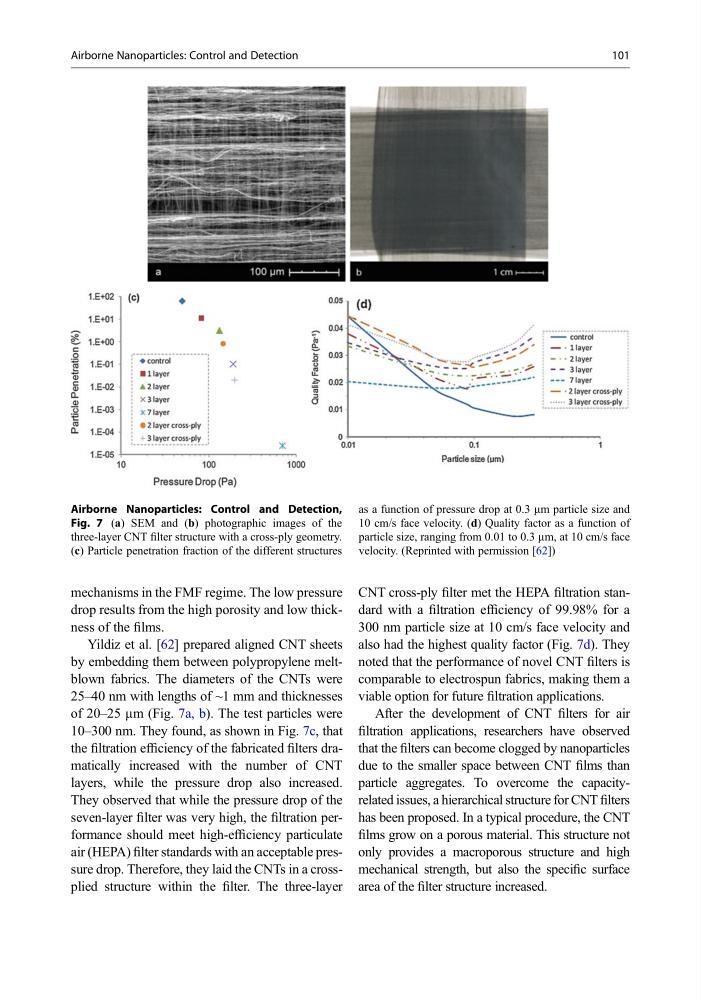
of 20–25 mm (Fig. 7a, b). The test particles were
10–300 nm. They found, as shown in Fig. 7c, that
the filtration efficiency of the fabricated filters dramatically increased with the number of CNT
layers, while the pressure drop also increased.
They observed that while the pressure drop of the
seven-layer filter was very high, the filtration performance should meet high-efficiency particulate
air (HEPA) filter standards with an acceptable pressure drop. Therefore, they laid the CNTs in a crossplied structure within the filter. The three-layer
CNT cross-ply filter met the HEPA filtration standard with a filtration efficiency of 99.98% for a
300 nm particle size at 10 cm/s face velocity and
also had the highest quality factor (Fig. 7d). They
noted that the performance of novel CNT filters is
comparable to electrospun fabrics, making them a
viable option for future filtration applications.
After the development of CNT filters for air
filtration applications, researchers have observed
that the filters can become clogged by nanoparticles
due to the smaller space between CNT films than
particle aggregates. To overcome the capacityrelated issues, a hierarchical structure for CNT filters
has been proposed. In a typical procedure, the CNT
films grow on a porous material. This structure not
only provides a macroporous structure and high
mechanical strength, but also the specific surface
area of the filter structure increased.
Airborne Nanoparticles: Control and Detection,
Fig. 7 (a) SEM and (b) photographic images of the
three-layer CNT filter structure with a cross-ply geometry.
(c) Particle penetration fraction of the different structures
as a function of pressure drop at 0.3 mm particle size and
10 cm/s face velocity. (d) Quality factor as a function of
particle size, ranging from 0.01 to 0.3 mm, at 10 cm/s face
velocity. (Reprinted with permission [62])
Airborne Nanoparticles: Control and Detection
101
drop results from the high porosity and low thickness of the films.
Yildiz et al. [62] prepared aligned CNT sheets
by embedding them between polypropylene meltblown fabrics. The diameters of the CNTs were
25–40 nm with lengths of ~1 mm and thicknesses
of 20–25 mm (Fig. 7a, b). The test particles were
10–300 nm. They found, as shown in Fig. 7c, that
the filtration efficiency of the fabricated filters dramatically increased with the number of CNT
layers, while the pressure drop also increased.
They observed that while the pressure drop of the
seven-layer filter was very high, the filtration performance should meet high-efficiency particulate
air (HEPA) filter standards with an acceptable pressure drop. Therefore, they laid the CNTs in a crossplied structure within the filter. The three-layer
CNT cross-ply filter met the HEPA filtration standard with a filtration efficiency of 99.98% for a
300 nm particle size at 10 cm/s face velocity and
also had the highest quality factor (Fig. 7d). They
noted that the performance of novel CNT filters is
comparable to electrospun fabrics, making them a
viable option for future filtration applications.
After the development of CNT filters for air
filtration applications, researchers have observed
that the filters can become clogged by nanoparticles
due to the smaller space between CNT films than
particle aggregates. To overcome the capacityrelated issues, a hierarchical structure for CNT filters
has been proposed. In a typical procedure, the CNT
films grow on a porous material. This structure not
only provides a macroporous structure and high
mechanical strength, but also the specific surface
area of the filter structure increased.
Airborne Nanoparticles: Control and Detection,
Fig. 7 (a) SEM and (b) photographic images of the
three-layer CNT filter structure with a cross-ply geometry.
(c) Particle penetration fraction of the different structures
as a function of pressure drop at 0.3 mm particle size and
10 cm/s face velocity. (d) Quality factor as a function of
particle size, ranging from 0.01 to 0.3 mm, at 10 cm/s face
velocity. (Reprinted with permission [62])
Airborne Nanoparticles: Control and Detection
101