

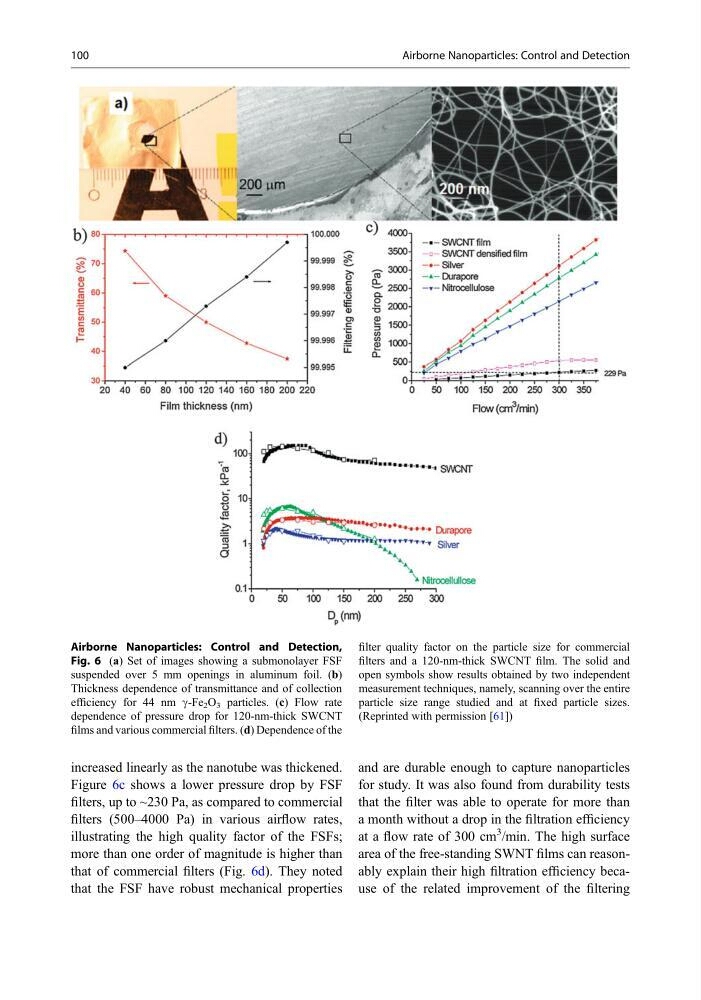
increased linearly as the nanotube was thickened.
Figure 6c shows a lower pressure drop by FSF
filters, up to ~230 Pa, as compared to commercial
filters (500–4000 Pa) in various airflow rates,
illustrating the high quality factor of the FSFs;
more than one order of magnitude is higher than
that of commercial filters (Fig. 6d). They noted
that the FSF have robust mechanical properties
and are durable enough to capture nanoparticles
for study. It was also found from durability tests
that the filter was able to operate for more than
a month without a drop in the filtration efficiency
at a flow rate of 300 cm
3 /min. The high surface
area of the free-standing SWNT films can reasonably explain their high filtration efficiency because of the related improvement of the filtering
Airborne Nanoparticles: Control and Detection,
Fig. 6 (a) Set of images showing a submonolayer FSF
suspended over 5 mm openings in aluminum foil. (b)
Thickness dependence of transmittance and of collection
efficiency for 44 nm g-Fe 2 O 3 particles. (c) Flow rate
dependence of pressure drop for 120-nm-thick SWCNT
films and various commercial filters. (d) Dependence of the
filter quality factor on the particle size for commercial
filters and a 120-nm-thick SWCNT film. The solid and
open symbols show results obtained by two independent
measurement techniques, namely, scanning over the entire
particle size range studied and at fixed particle sizes.
(Reprinted with permission [61])
100
Airborne Nanoparticles: Control and Detection
Figure 6c shows a lower pressure drop by FSF
filters, up to ~230 Pa, as compared to commercial
filters (500–4000 Pa) in various airflow rates,
illustrating the high quality factor of the FSFs;
more than one order of magnitude is higher than
that of commercial filters (Fig. 6d). They noted
that the FSF have robust mechanical properties
and are durable enough to capture nanoparticles
for study. It was also found from durability tests
that the filter was able to operate for more than
a month without a drop in the filtration efficiency
at a flow rate of 300 cm
3 /min. The high surface
area of the free-standing SWNT films can reasonably explain their high filtration efficiency because of the related improvement of the filtering
Airborne Nanoparticles: Control and Detection,
Fig. 6 (a) Set of images showing a submonolayer FSF
suspended over 5 mm openings in aluminum foil. (b)
Thickness dependence of transmittance and of collection
efficiency for 44 nm g-Fe 2 O 3 particles. (c) Flow rate
dependence of pressure drop for 120-nm-thick SWCNT
films and various commercial filters. (d) Dependence of the
filter quality factor on the particle size for commercial
filters and a 120-nm-thick SWCNT film. The solid and
open symbols show results obtained by two independent
measurement techniques, namely, scanning over the entire
particle size range studied and at fixed particle sizes.
(Reprinted with permission [61])
100
Airborne Nanoparticles: Control and Detection