

transport across epithelia of the respiratory tract
and subsequently into the interstitium or by lymphatics which can distribute throughout the body.
Another is axonal translocation of NPs to ganglionic and CNS structures by their uptake by the
sensory nerve endings of airway epithelia. Nanotoxicological studies have demonstrated that
inhaled NPs can deposit in the nasal cavity,
being absorbed by the olfactory epithelium and
translocated into the brain through the blood-brain
barrier [17].
Nanoparticle Control Technologies
One of the most important concerns for air pollution control is the removal of nanoparticles from
airstreams. A variety of technologies have been
used in recent years. It should be noted that air
quality regulatory organizations are imposing
increasingly strict rules as knowledge of the
health effects of nanoparticles has grown. In parallel with increased knowledge, it has become
increasingly urgent to implement suitable particle
control systems. The most effective and important
technologies for capturing nanoscale particles will
be examined, based on their physical properties,
the required degree of control, cost, etc. [23].
Nanoparticle Filtration
Filtration is the most commonly used method for
trapping airborne particles. Different types of filters are used to target a wide range of airborne
particles. The most common forms are fibrous,
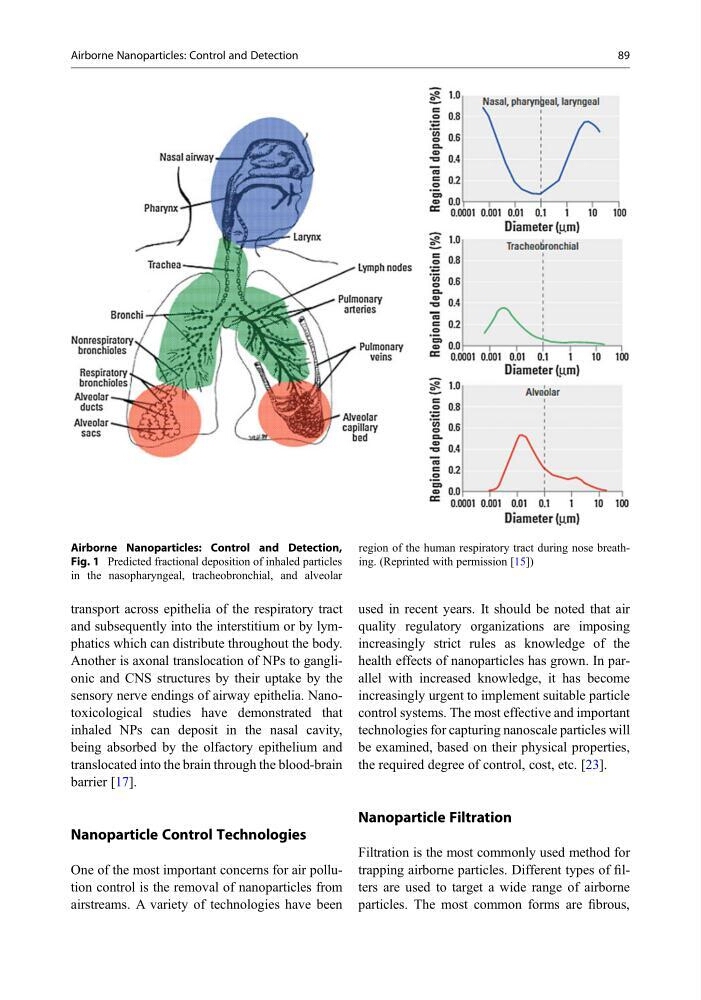
Airborne Nanoparticles: Control and Detection,
Fig. 1 Predicted fractional deposition of inhaled particles
in the nasopharyngeal, tracheobronchial, and alveolar
region of the human respiratory tract during nose breathing. (Reprinted with permission [15])
Airborne Nanoparticles: Control and Detection
89
and subsequently into the interstitium or by lymphatics which can distribute throughout the body.
Another is axonal translocation of NPs to ganglionic and CNS structures by their uptake by the
sensory nerve endings of airway epithelia. Nanotoxicological studies have demonstrated that
inhaled NPs can deposit in the nasal cavity,
being absorbed by the olfactory epithelium and
translocated into the brain through the blood-brain
barrier [17].
Nanoparticle Control Technologies
One of the most important concerns for air pollution control is the removal of nanoparticles from
airstreams. A variety of technologies have been
used in recent years. It should be noted that air
quality regulatory organizations are imposing
increasingly strict rules as knowledge of the
health effects of nanoparticles has grown. In parallel with increased knowledge, it has become
increasingly urgent to implement suitable particle
control systems. The most effective and important
technologies for capturing nanoscale particles will
be examined, based on their physical properties,
the required degree of control, cost, etc. [23].
Nanoparticle Filtration
Filtration is the most commonly used method for
trapping airborne particles. Different types of filters are used to target a wide range of airborne
particles. The most common forms are fibrous,
Airborne Nanoparticles: Control and Detection,
Fig. 1 Predicted fractional deposition of inhaled particles
in the nasopharyngeal, tracheobronchial, and alveolar
region of the human respiratory tract during nose breathing. (Reprinted with permission [15])
Airborne Nanoparticles: Control and Detection
89