

can be divided into industrial and urban. Industrial
activities release NPs into the atmosphere inside
factories working with metallurgy, power and
cement production, mining, incineration, and
any industrial product that uses fossil fuels as an
energy source for power generation. In urban
areas, vehicles are a common source of NP outdoors, being produced by internal combustion
engines, road dust and wear on brakes and tires.
Important indoor sources of NP include cooking,
cleaning and smoking. Of course, the chemical
and physical nature of NPs emitted in industrial
and urban areas can be quite different. Indoor
emissions can be most important for determining
health impacts because humans normally spend
>80% of their time in the indoor environment
[16]. Engineered nanoparticles are commonly
used in stain-resistant clothing, sporting goods,
tires, sunscreens, cosmetics, and toothpaste and
as food additives, etc. and are specifically
engineered in the laboratory to form nanostructures such as nanotubes, nanofibers, and
nanowires [15, 16].
Epidemiological and clinical studies on
humans and rodents, and also in vitro cell cultures,
have shown the health effects of laboratorygenerated and ambient NPs. Researchers have
documented the association of ambient NPs with
adverse cardiovascular and respiratory effects in
humans [17–19]; however, not all studies have not
seen these associations [20, 21]. Intensive deposition of laboratory-engineered NPs in the respiratory tract, even greater with asthma or chronic
obstructive pulmonary disease, has been seen in
controlled clinical studies. On the other hand,
controlled exposure to carbonaceous NPs has
been seen to cause many symptoms in the cardiovascular system including systemic inflammation
and changes in pulmonary diffusion capacity and
the appearance of coagulation markers in the
blood. In vivo tests by Brown et al. [22] have
shown an increased inflammatory response after
the introduction of 64 nm polystyrene particles
into the rat lung, and they have observed a proinflammatory effect after in vitro cell culture with
the model NPs. In addition, an oxidative stressrelated cellular response with ambient NPs has
been reported by Li et al. [18].
The main deposition mechanism for inhaled
NPs in the respiratory tract is diffusion; other
deposition mechanisms including inertial impaction, gravitational settling, and electrostatic force
are not significant. Figure 1 shows three exposure
regions for inhaled aerosol particles in the human
respiratory tract including the nasopharyngeal,
tracheobronchial, and the alveolar region. The
figures on the right (Fig. 1) show which sizes of
PM can deposit in each region of the respiratory
tract. With an increase in size from 1 to 100 nm,
high percentages of inhaled NPs are deposited on
the upper regions of the respiratory tract. For
example, ~90% and ~10% of 1 nm particles are
deposited in the nasopharyngeal and the tracheobronchial regions, respectively, while no particles
are deposited in the alveolar region. In contrast,
50% of 20 nm particles are deposited only in the
alveolar region [15]. Manigrasso et al. [19] estimated a respiratory deposition of 6.6 Â 10
10 particles of 5.6–560-nm-diameter particles per hour
for persons close to traffic, in short-term peak
exposure events. It has been seen that deposited
NPs are transported to extrapulmonary organs to a
greater extent and by a larger variety of transfer
routes than for larger-sized particles. One is the
conduction of NPs into blood by transcytotic
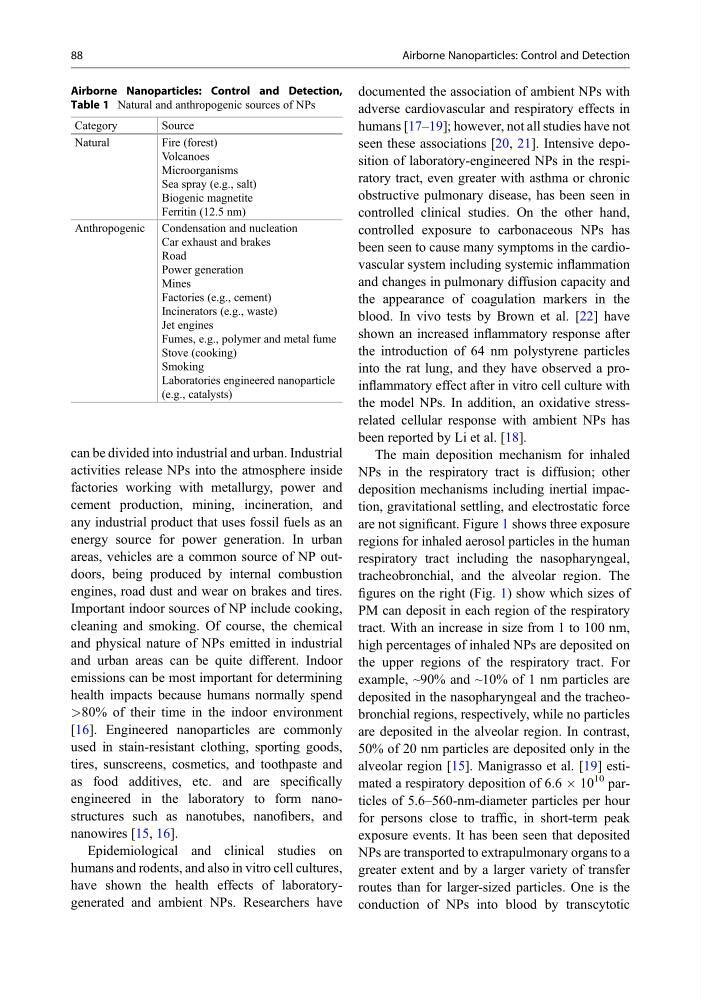
Airborne Nanoparticles: Control and Detection,
Table 1 Natural and anthropogenic sources of NPs
Category
Source
Natural
Fire (forest)
Volcanoes
Microorganisms
Sea spray (e.g., salt)
Biogenic magnetite
Ferritin (12.5 nm)
Anthropogenic Condensation and nucleation
Car exhaust and brakes
Road
Power generation
Mines
Factories (e.g., cement)
Incinerators (e.g., waste)
Jet engines
Fumes, e.g., polymer and metal fume
Stove (cooking)
Smoking
Laboratories engineered nanoparticle
(e.g., catalysts)
88
Airborne Nanoparticles: Control and Detection
activities release NPs into the atmosphere inside
factories working with metallurgy, power and
cement production, mining, incineration, and
any industrial product that uses fossil fuels as an
energy source for power generation. In urban
areas, vehicles are a common source of NP outdoors, being produced by internal combustion
engines, road dust and wear on brakes and tires.
Important indoor sources of NP include cooking,
cleaning and smoking. Of course, the chemical
and physical nature of NPs emitted in industrial
and urban areas can be quite different. Indoor
emissions can be most important for determining
health impacts because humans normally spend
>80% of their time in the indoor environment
[16]. Engineered nanoparticles are commonly
used in stain-resistant clothing, sporting goods,
tires, sunscreens, cosmetics, and toothpaste and
as food additives, etc. and are specifically
engineered in the laboratory to form nanostructures such as nanotubes, nanofibers, and
nanowires [15, 16].
Epidemiological and clinical studies on
humans and rodents, and also in vitro cell cultures,
have shown the health effects of laboratorygenerated and ambient NPs. Researchers have
documented the association of ambient NPs with
adverse cardiovascular and respiratory effects in
humans [17–19]; however, not all studies have not
seen these associations [20, 21]. Intensive deposition of laboratory-engineered NPs in the respiratory tract, even greater with asthma or chronic
obstructive pulmonary disease, has been seen in
controlled clinical studies. On the other hand,
controlled exposure to carbonaceous NPs has
been seen to cause many symptoms in the cardiovascular system including systemic inflammation
and changes in pulmonary diffusion capacity and
the appearance of coagulation markers in the
blood. In vivo tests by Brown et al. [22] have
shown an increased inflammatory response after
the introduction of 64 nm polystyrene particles
into the rat lung, and they have observed a proinflammatory effect after in vitro cell culture with
the model NPs. In addition, an oxidative stressrelated cellular response with ambient NPs has
been reported by Li et al. [18].
The main deposition mechanism for inhaled
NPs in the respiratory tract is diffusion; other
deposition mechanisms including inertial impaction, gravitational settling, and electrostatic force
are not significant. Figure 1 shows three exposure
regions for inhaled aerosol particles in the human
respiratory tract including the nasopharyngeal,
tracheobronchial, and the alveolar region. The
figures on the right (Fig. 1) show which sizes of
PM can deposit in each region of the respiratory
tract. With an increase in size from 1 to 100 nm,
high percentages of inhaled NPs are deposited on
the upper regions of the respiratory tract. For
example, ~90% and ~10% of 1 nm particles are
deposited in the nasopharyngeal and the tracheobronchial regions, respectively, while no particles
are deposited in the alveolar region. In contrast,
50% of 20 nm particles are deposited only in the
alveolar region [15]. Manigrasso et al. [19] estimated a respiratory deposition of 6.6 Â 10
10 particles of 5.6–560-nm-diameter particles per hour
for persons close to traffic, in short-term peak
exposure events. It has been seen that deposited
NPs are transported to extrapulmonary organs to a
greater extent and by a larger variety of transfer
routes than for larger-sized particles. One is the
conduction of NPs into blood by transcytotic
Airborne Nanoparticles: Control and Detection,
Table 1 Natural and anthropogenic sources of NPs
Category
Source
Natural
Fire (forest)
Volcanoes
Microorganisms
Sea spray (e.g., salt)
Biogenic magnetite
Ferritin (12.5 nm)
Anthropogenic Condensation and nucleation
Car exhaust and brakes
Road
Power generation
Mines
Factories (e.g., cement)
Incinerators (e.g., waste)
Jet engines
Fumes, e.g., polymer and metal fume
Stove (cooking)
Smoking
Laboratories engineered nanoparticle
(e.g., catalysts)
88
Airborne Nanoparticles: Control and Detection