

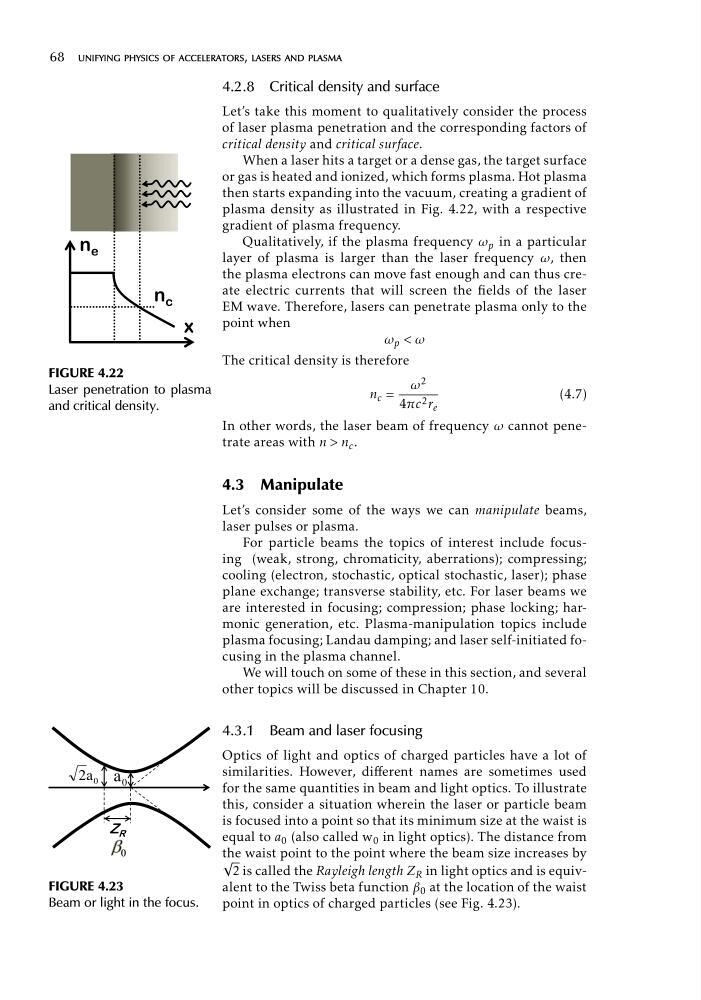
FIGURE 4.22
Laser penetration to plasma
and critical density.
2a a
0
0
0 0
FIGURE 4.23
Beam
in
or light the focus.
68 unifying physics of accelerators, lasers and plasma
4.2.8 Critical density and surface
Let’s take this moment to qualitatively consider the process
of laser plasma penetration and the corresponding factors of
critical density and critical surface.
When a laser hits a target or a dense gas, the target surface
or gas is heated and ionized, which forms plasma. Hot plasma
then starts expanding into the vacuum, creating a gradient of
plasma density as illustrated in Fig. 4.22, with a respective
gradient of plasma frequency.
Qualitatively, if the plasma frequency ω p in a particular
layer of plasma is larger than the laser frequency ω, then
the plasma electrons can move fast enough and can thus create electric currents that will screen the fields of the laser
EM wave. Therefore, lasers can penetrate plasma only to the
point when
ω p < ω
The critical density is therefore
ω 2
n c =
(4.7)
4πc 2 r e
In other words, the laser beam of frequency ω cannot penetrate areas with n > n c .
4.3 Manipulate
Let’s consider some of the ways we can manipulate beams,
laser pulses or plasma.
For particle beams the topics of interest include focusing (weak, strong, chromaticity, aberrations); compressing;
cooling (electron, stochastic, optical stochastic, laser); phase
plane exchange; transverse stability, etc. For laser beams we
are interested in focusing; compression; phase locking; harmonic generation, etc. Plasma-manipulation topics include
plasma focusing; Landau damping; and laser self-initiated focusing in the plasma channel.
We will touch on some of these in this section, and several
other topics will be discussed in Chapter 10.
4.3.1 Beam and laser focusing
Optics of light and optics of charged particles have a lot of
similarities. However, different names are sometimes used
for the same quantities in beam and light optics. To illustrate
this, consider a situation wherein the laser or particle beam
is focused into a point so that its minimum size at the waist is
equal to a 0 (also called w 0 in light optics). The distance from
the √ waist point to the point where the beam size increases by
2 is called the Rayleigh length Z R
is equivin light optics and
alent to the Twiss beta function β at the location of the waist
0
point in optics of charged particles (see Fig. 4.23).
Laser penetration to plasma
and critical density.
2a a
0
0
0 0
FIGURE 4.23
Beam
in
or light the focus.
68 unifying physics of accelerators, lasers and plasma
4.2.8 Critical density and surface
Let’s take this moment to qualitatively consider the process
of laser plasma penetration and the corresponding factors of
critical density and critical surface.
When a laser hits a target or a dense gas, the target surface
or gas is heated and ionized, which forms plasma. Hot plasma
then starts expanding into the vacuum, creating a gradient of
plasma density as illustrated in Fig. 4.22, with a respective
gradient of plasma frequency.
Qualitatively, if the plasma frequency ω p in a particular
layer of plasma is larger than the laser frequency ω, then
the plasma electrons can move fast enough and can thus create electric currents that will screen the fields of the laser
EM wave. Therefore, lasers can penetrate plasma only to the
point when
ω p < ω
The critical density is therefore
ω 2
n c =
(4.7)
4πc 2 r e
In other words, the laser beam of frequency ω cannot penetrate areas with n > n c .
4.3 Manipulate
Let’s consider some of the ways we can manipulate beams,
laser pulses or plasma.
For particle beams the topics of interest include focusing (weak, strong, chromaticity, aberrations); compressing;
cooling (electron, stochastic, optical stochastic, laser); phase
plane exchange; transverse stability, etc. For laser beams we
are interested in focusing; compression; phase locking; harmonic generation, etc. Plasma-manipulation topics include
plasma focusing; Landau damping; and laser self-initiated focusing in the plasma channel.
We will touch on some of these in this section, and several
other topics will be discussed in Chapter 10.
4.3.1 Beam and laser focusing
Optics of light and optics of charged particles have a lot of
similarities. However, different names are sometimes used
for the same quantities in beam and light optics. To illustrate
this, consider a situation wherein the laser or particle beam
is focused into a point so that its minimum size at the waist is
equal to a 0 (also called w 0 in light optics). The distance from
the √ waist point to the point where the beam size increases by
2 is called the Rayleigh length Z R
is equivin light optics and
alent to the Twiss beta function β at the location of the waist
0
point in optics of charged particles (see Fig. 4.23).