

[
1HJDWLYH 3RVLWLYH
,QWHJUDOFRQWRXU
,RQ
(OHFWURQ
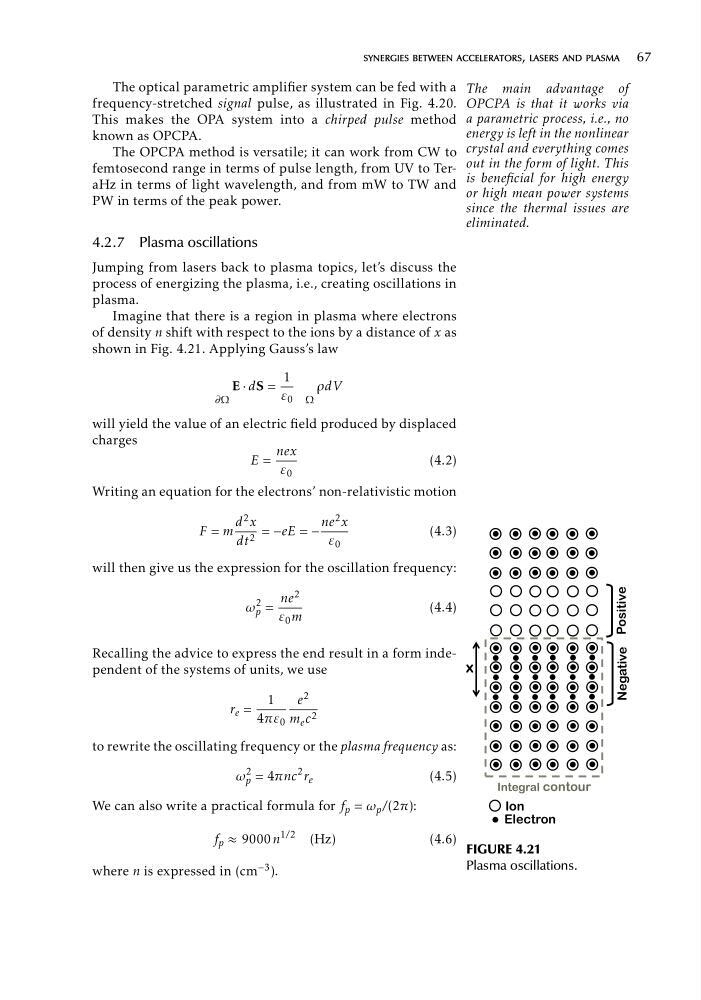
FIGURE 4.21
Plasma oscillations.
synergies between accelerators, lasers and plasma 67
The optical parametric amplifier system can be fed with a
frequency-stretched signal pulse, as illustrated in Fig. 4.20.
This makes the OPA system into a chirped pulse method
known as OPCPA.
The OPCPA method is versatile; it can work from CW to
femtosecond range in terms of pulse length, from UV to TeraHz in terms of light wavelength, and from mW to TW and
PW in terms of the peak power.
4.2.7 Plasma oscillations
Jumping from lasers back to plasma topics, let’s discuss the
process of energizing the plasma, i.e., creating oscillations in
plasma.
Imagine that there is a region in plasma where electrons
of density n shift with respect to the ions by a distance of x as
shown in Fig. 4.21. Applying Gauss’s law
1
E · dS =
ρdV
∂Ω
ε 0 Ω
will yield the value of an electric field produced by displaced
charges
nex
E =
(4.2)
ε 0
Writing an equation for the electrons’ non-relativistic motion
d 2
2
x
ne x
F = m
= −eE = −
(4.3)
dt 2
ε 0
will then give us the expression for the oscillation frequency:
2
ne
ω p
2 =
(4.4)
ε 0 m
Recalling the advice to express the end result in a form independent of the systems of units, we use
2
1
e
r e = 4πε 0 m e c 2
to rewrite the oscillating frequency or the plasma frequency as:
ω p
2 = 4πnc
2 r e
(4.5)
We can also write a practical formula for f p = ω p /(2π):
f p ≈ 9000 n
1/2 (Hz)
(4.6)
where n is expressed in (cm −3 ).
The main advantage of
OPCPA is that it works via
a parametric process, i.e., no
energy is left in the nonlinear
crystal and everything comes
out in the form of light. This
is beneficial for high energy
or high mean power systems
since the thermal issues are
eliminated.
1HJDWLYH 3RVLWLYH
,QWHJUDOFRQWRXU
,RQ
(OHFWURQ
FIGURE 4.21
Plasma oscillations.
synergies between accelerators, lasers and plasma 67
The optical parametric amplifier system can be fed with a
frequency-stretched signal pulse, as illustrated in Fig. 4.20.
This makes the OPA system into a chirped pulse method
known as OPCPA.
The OPCPA method is versatile; it can work from CW to
femtosecond range in terms of pulse length, from UV to TeraHz in terms of light wavelength, and from mW to TW and
PW in terms of the peak power.
4.2.7 Plasma oscillations
Jumping from lasers back to plasma topics, let’s discuss the
process of energizing the plasma, i.e., creating oscillations in
plasma.
Imagine that there is a region in plasma where electrons
of density n shift with respect to the ions by a distance of x as
shown in Fig. 4.21. Applying Gauss’s law
1
E · dS =
ρdV
∂Ω
ε 0 Ω
will yield the value of an electric field produced by displaced
charges
nex
E =
(4.2)
ε 0
Writing an equation for the electrons’ non-relativistic motion
d 2
2
x
ne x
F = m
= −eE = −
(4.3)
dt 2
ε 0
will then give us the expression for the oscillation frequency:
2
ne
ω p
2 =
(4.4)
ε 0 m
Recalling the advice to express the end result in a form independent of the systems of units, we use
2
1
e
r e = 4πε 0 m e c 2
to rewrite the oscillating frequency or the plasma frequency as:
ω p
2 = 4πnc
2 r e
(4.5)
We can also write a practical formula for f p = ω p /(2π):
f p ≈ 9000 n
1/2 (Hz)
(4.6)
where n is expressed in (cm −3 ).
The main advantage of
OPCPA is that it works via
a parametric process, i.e., no
energy is left in the nonlinear
crystal and everything comes
out in the form of light. This
is beneficial for high energy
or high mean power systems
since the thermal issues are
eliminated.