

synergies between accelerators, lasers and plasma 69
4.3.2 Weak and strong focusing
Analogies between light and beam optics — as well as mechanical analogies (in the spirit of TRIZ or synectics) — can
help us build up an intuitive understanding of complex phenomena. Let’s illustrate this in an example of weak versus
strong focusing.
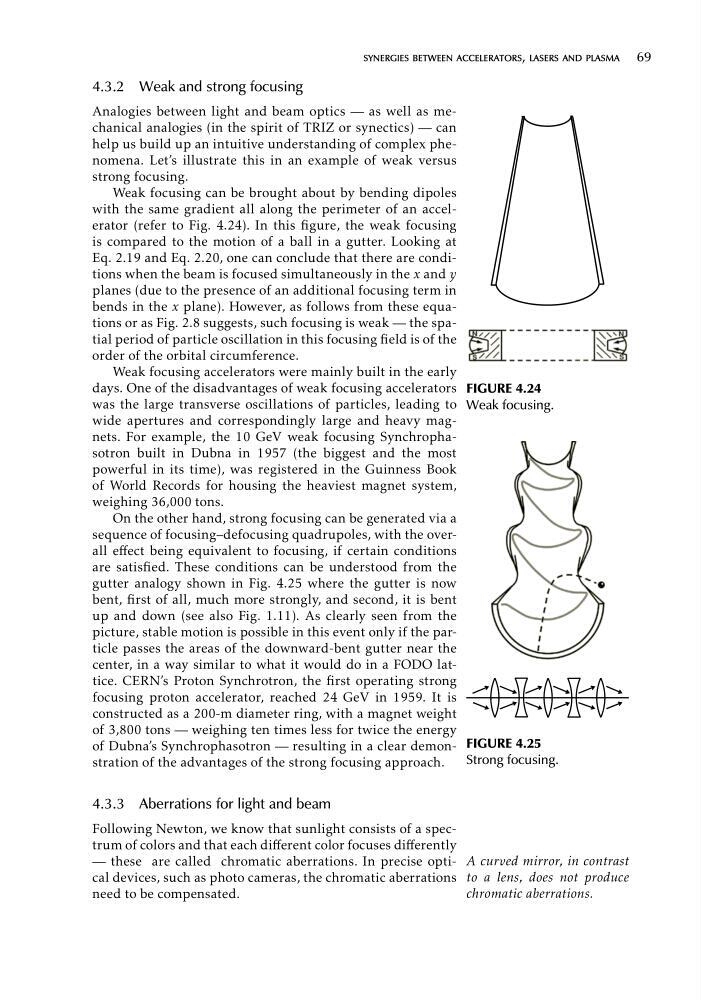
Weak focusing can be brought about by bending dipoles
with the same gradient all along the perimeter of an accelerator (refer to Fig. 4.24). In this figure, the weak focusing
is compared to the motion of a ball in a gutter. Looking at
Eq. 2.19 and Eq. 2.20, one can conclude that there are conditions when the beam is focused simultaneously in the x and y
planes (due to the presence of an additional focusing term in
bends in the x plane). However, as follows from these equations or as Fig. 2.8 suggests, such focusing is weak — the spatial period of particle oscillation in this focusing field is of the
order of the orbital circumference.
Weak focusing accelerators were mainly built in the early
days. One of the disadvantages of weak focusing accelerators
was the large transverse oscillations of particles, leading to
wide apertures and correspondingly large and heavy magnets. For example, the 10 GeV weak focusing Synchrophasotron built in Dubna in 1957 (the biggest and the most
powerful in its time), was registered in the Guinness Book
of World Records for housing the heaviest magnet system,
weighing 36,000 tons.
On the other hand, strong focusing can be generated via a
sequence of focusing–defocusing quadrupoles, with the overall effect being equivalent to focusing, if certain conditions
are satisfied. These conditions can be understood from the
gutter analogy shown in Fig. 4.25 where the gutter is now
bent, first of all, much more strongly, and second, it is bent
up and down (see also Fig. 1.11). As clearly seen from the
picture, stable motion is possible in this event only if the particle passes the areas of the downward-bent gutter near the
center, in a way similar to what it would do in a FODO lattice. CERN’s Proton Synchrotron, the first operating strong
focusing proton accelerator, reached 24 GeV in 1959. It is
constructed as a 200-m diameter ring, with a magnet weight
of 3,800 tons — weighing ten times less for twice the energy
of Dubna’s Synchrophasotron — resulting in a clear demonstration of the advantages of the strong focusing approach.
4.3.3 Aberrations for light and beam
Following Newton, we know that sunlight consists of a spectrum of colors and that each different color focuses differently
— these are called chromatic aberrations. In precise optical devices, such as photo cameras, the chromatic aberrations
need to be compensated.
FIGURE 4.24
Weak focusing.
FIGURE 4.25
Strong focusing.
A curved mirror, in contrast
to a lens, does not produce
chromatic aberrations.
4.3.2 Weak and strong focusing
Analogies between light and beam optics — as well as mechanical analogies (in the spirit of TRIZ or synectics) — can
help us build up an intuitive understanding of complex phenomena. Let’s illustrate this in an example of weak versus
strong focusing.
Weak focusing can be brought about by bending dipoles
with the same gradient all along the perimeter of an accelerator (refer to Fig. 4.24). In this figure, the weak focusing
is compared to the motion of a ball in a gutter. Looking at
Eq. 2.19 and Eq. 2.20, one can conclude that there are conditions when the beam is focused simultaneously in the x and y
planes (due to the presence of an additional focusing term in
bends in the x plane). However, as follows from these equations or as Fig. 2.8 suggests, such focusing is weak — the spatial period of particle oscillation in this focusing field is of the
order of the orbital circumference.
Weak focusing accelerators were mainly built in the early
days. One of the disadvantages of weak focusing accelerators
was the large transverse oscillations of particles, leading to
wide apertures and correspondingly large and heavy magnets. For example, the 10 GeV weak focusing Synchrophasotron built in Dubna in 1957 (the biggest and the most
powerful in its time), was registered in the Guinness Book
of World Records for housing the heaviest magnet system,
weighing 36,000 tons.
On the other hand, strong focusing can be generated via a
sequence of focusing–defocusing quadrupoles, with the overall effect being equivalent to focusing, if certain conditions
are satisfied. These conditions can be understood from the
gutter analogy shown in Fig. 4.25 where the gutter is now
bent, first of all, much more strongly, and second, it is bent
up and down (see also Fig. 1.11). As clearly seen from the
picture, stable motion is possible in this event only if the particle passes the areas of the downward-bent gutter near the
center, in a way similar to what it would do in a FODO lattice. CERN’s Proton Synchrotron, the first operating strong
focusing proton accelerator, reached 24 GeV in 1959. It is
constructed as a 200-m diameter ring, with a magnet weight
of 3,800 tons — weighing ten times less for twice the energy
of Dubna’s Synchrophasotron — resulting in a clear demonstration of the advantages of the strong focusing approach.
4.3.3 Aberrations for light and beam
Following Newton, we know that sunlight consists of a spectrum of colors and that each different color focuses differently
— these are called chromatic aberrations. In precise optical devices, such as photo cameras, the chromatic aberrations
need to be compensated.
FIGURE 4.24
Weak focusing.
FIGURE 4.25
Strong focusing.
A curved mirror, in contrast
to a lens, does not produce
chromatic aberrations.