

62 unifying physics of accelerators, lasers and plasma
When used for laser pumping, many low-power diode
lasers are usually assembled into arrays called “diode
bars.”
FDYLW\
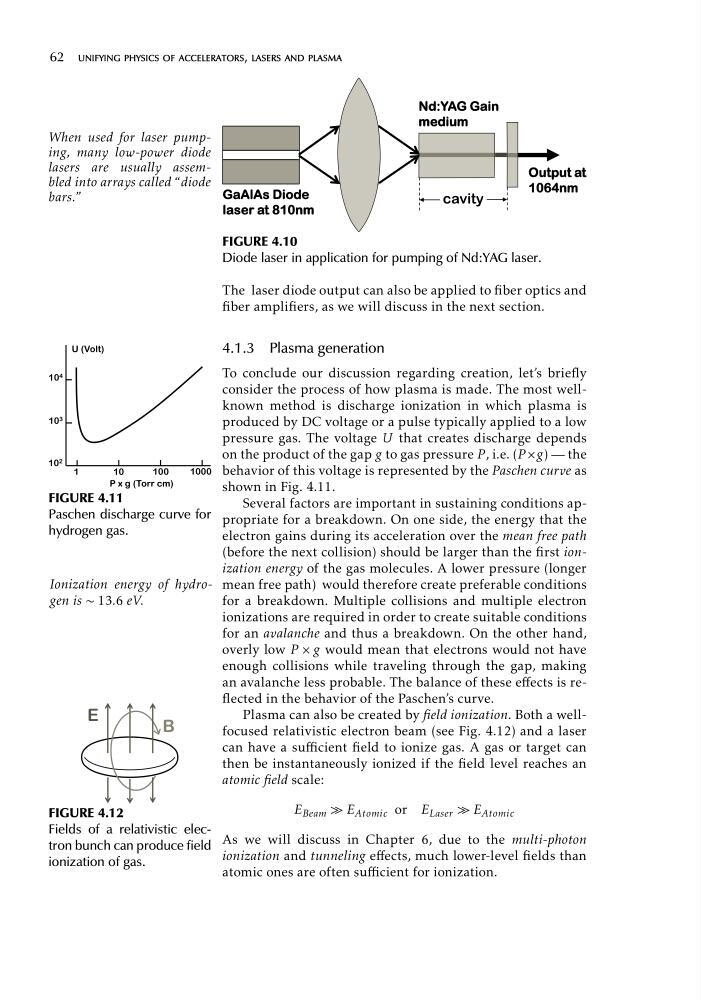
FIGURE 4.10
Diode laser in application for pumping of Nd:YAG laser.
The laser diode output can also be applied to fiber optics and
fiber amplifiers, as we will discuss in the next section.
4.1.3 Plasma generation
To conclude our discussion regarding creation, let’s briefly
consider the process of how plasma is made. The most wellknown method is discharge ionization in which plasma is
produced by DC voltage or a pulse typically applied to a low
pressure gas. The voltage U that creates discharge depends
on the product of the gap g to gas pressure P, i.e. (P g) — the
behavior of this voltage is represented by the
×
Paschen curve as
shown in Fig. 4.11.
Several factors are important in sustaining conditions appropriate for a breakdown. On one side, the energy that the
electron gains during its acceleration over the mean free path
(before the next collision) should be larger than the first ionization energy of the gas molecules. A lower pressure (longer
mean free path) would therefore create preferable conditions
for a breakdown. Multiple collisions and multiple electron
ionizations are required in order to create suitable conditions
for an avalanche and thus a breakdown. On the other hand,
overly low P × g would mean that electrons would not have
enough collisions while traveling through the gap, making
an avalanche less probable. The balance of these effects is reflected in the behavior of the Paschen’s curve.
Plasma can also be created by field ionization. Both a wellfocused relativistic electron beam (see Fig. 4.12) and a laser
can have a sufficient field to ionize gas. A gas or target can
then be instantaneously ionized if the field level reaches an
atomic field scale:
E Beam » E Atomic or E Laser » E Atomic
As we will discuss in Chapter 6, due to the multi-photon
ionization and tunneling effects, much lower-level fields than
atomic ones are often sufficient for ionization.
P
urve for
f hydro89ROW
3[J7RUUF
FIGURE 4.11
Paschen discharge c
hydrogen gas.
Ionization energy o
gen is ∼ 13.6 eV.
%
tic elecuce field
(
FIGURE 4.12
Fields of a relativis
tron bunch can prod
ionization of gas.
When used for laser pumping, many low-power diode
lasers are usually assembled into arrays called “diode
bars.”
FDYLW\
FIGURE 4.10
Diode laser in application for pumping of Nd:YAG laser.
The laser diode output can also be applied to fiber optics and
fiber amplifiers, as we will discuss in the next section.
4.1.3 Plasma generation
To conclude our discussion regarding creation, let’s briefly
consider the process of how plasma is made. The most wellknown method is discharge ionization in which plasma is
produced by DC voltage or a pulse typically applied to a low
pressure gas. The voltage U that creates discharge depends
on the product of the gap g to gas pressure P, i.e. (P g) — the
behavior of this voltage is represented by the
×
Paschen curve as
shown in Fig. 4.11.
Several factors are important in sustaining conditions appropriate for a breakdown. On one side, the energy that the
electron gains during its acceleration over the mean free path
(before the next collision) should be larger than the first ionization energy of the gas molecules. A lower pressure (longer
mean free path) would therefore create preferable conditions
for a breakdown. Multiple collisions and multiple electron
ionizations are required in order to create suitable conditions
for an avalanche and thus a breakdown. On the other hand,
overly low P × g would mean that electrons would not have
enough collisions while traveling through the gap, making
an avalanche less probable. The balance of these effects is reflected in the behavior of the Paschen’s curve.
Plasma can also be created by field ionization. Both a wellfocused relativistic electron beam (see Fig. 4.12) and a laser
can have a sufficient field to ionize gas. A gas or target can
then be instantaneously ionized if the field level reaches an
atomic field scale:
E Beam » E Atomic or E Laser » E Atomic
As we will discuss in Chapter 6, due to the multi-photon
ionization and tunneling effects, much lower-level fields than
atomic ones are often sufficient for ionization.
P
urve for
f hydro89ROW
3[J7RUUF
FIGURE 4.11
Paschen discharge c
hydrogen gas.
Ionization energy o
gen is ∼ 13.6 eV.
%
tic elecuce field
(
FIGURE 4.12
Fields of a relativis
tron bunch can prod
ionization of gas.