

synergies between accelerators, lasers and plasma 63
4.2 Energize
Next comes the process of energizing the beam, laser or
plasma. In the case of a charged particle beam, this involves
acceleration (electrostatic, betatron, acceleration in RF cavities and structures, or plasma acceleration). In the case of a
laser, it involves amplification (standard, chirped pulse amplification, optical parametric chirped pulse amplification,
etc.), and for plasma, excitation of waves by various means
such as short pulse of a laser or beam.
4.2.1 Beam acceleration
The simplest and exceedingly widespread acceleration
method is electrostatic acceleration (Fig. 4.13). Not so widely
used now is betatron acceleration principle, which is based
on Maxwell’s Eq. 2.4.
Perhaps the most versatile acceleration method involves
the use of resonators — also known as RF cavities. Cavities
can be arranged in structures and made to be suitable for the
acceleration of any types of particles from electrons (which
almost immediately become relativistic) to protons or ions.
Often, acceleration is combined with focusing, either via
magnetic quadrupoles inserted between acceleration sections, or via an EM wave with a quadrupole component as
in a RFQ accelerating structure.
4.2.2 Laser amplifiers
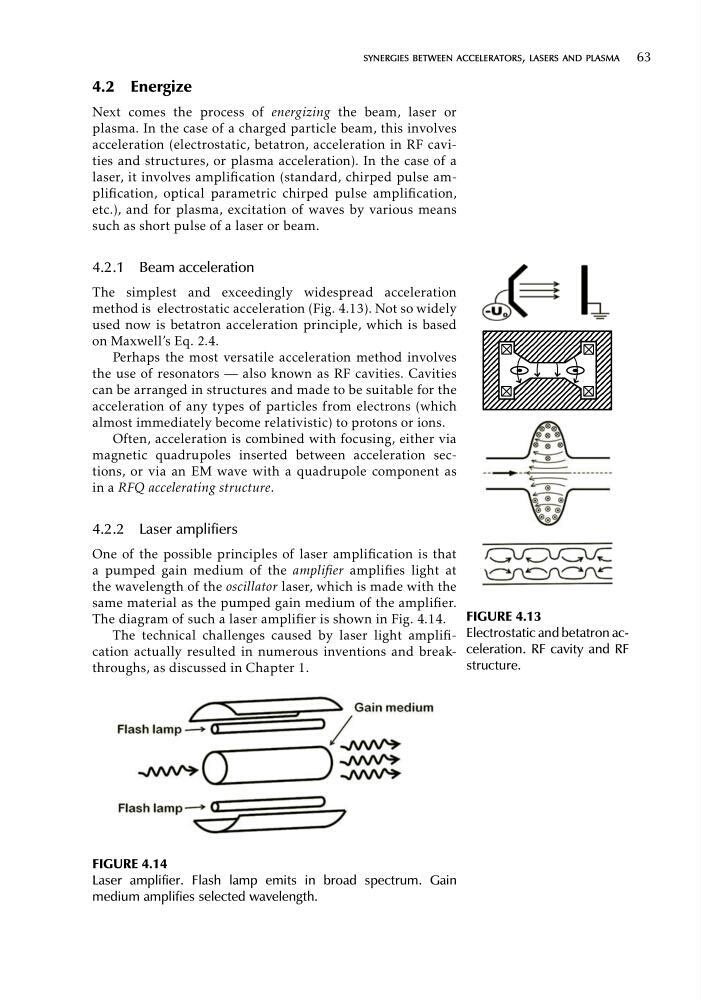
One of the possible principles of laser amplification is that
a pumped gain medium of the amplifier amplifies light at
the wavelength of the oscillator laser, which is made with the
same material as the pumped gain medium of the amplifier.
The diagram of such a laser amplifier is shown in Fig. 4.14.
The technical challenges caused by laser light amplification actually resulted in numerous inventions and breakthroughs, as discussed in Chapter 1.
FIGURE 4.13
Electrostatic and betatron acceleration. RF cavity and RF
structure.
FIGURE 4.14
Laser amplifier. Flash lamp emits in broad spectrum. Gain
medium amplifies selected wavelength.
4.2 Energize
Next comes the process of energizing the beam, laser or
plasma. In the case of a charged particle beam, this involves
acceleration (electrostatic, betatron, acceleration in RF cavities and structures, or plasma acceleration). In the case of a
laser, it involves amplification (standard, chirped pulse amplification, optical parametric chirped pulse amplification,
etc.), and for plasma, excitation of waves by various means
such as short pulse of a laser or beam.
4.2.1 Beam acceleration
The simplest and exceedingly widespread acceleration
method is electrostatic acceleration (Fig. 4.13). Not so widely
used now is betatron acceleration principle, which is based
on Maxwell’s Eq. 2.4.
Perhaps the most versatile acceleration method involves
the use of resonators — also known as RF cavities. Cavities
can be arranged in structures and made to be suitable for the
acceleration of any types of particles from electrons (which
almost immediately become relativistic) to protons or ions.
Often, acceleration is combined with focusing, either via
magnetic quadrupoles inserted between acceleration sections, or via an EM wave with a quadrupole component as
in a RFQ accelerating structure.
4.2.2 Laser amplifiers
One of the possible principles of laser amplification is that
a pumped gain medium of the amplifier amplifies light at
the wavelength of the oscillator laser, which is made with the
same material as the pumped gain medium of the amplifier.
The diagram of such a laser amplifier is shown in Fig. 4.14.
The technical challenges caused by laser light amplification actually resulted in numerous inventions and breakthroughs, as discussed in Chapter 1.
FIGURE 4.13
Electrostatic and betatron acceleration. RF cavity and RF
structure.
FIGURE 4.14
Laser amplifier. Flash lamp emits in broad spectrum. Gain
medium amplifies selected wavelength.