

synergies between accelerators, lasers and plasma 61
from level L 2 to L 1 (as shown in Fig. 4.8), resulting in an optical gain.
An advantage of four-level
As you can see from the above description, a minimum of laser systems is that much
three levels are needed to arrange a laser, but it is possible to less pumping power is
create four and higher-level laser systems as well.
needed for the creation of
The first laser built was a three-level ruby laser emitting population inversion.
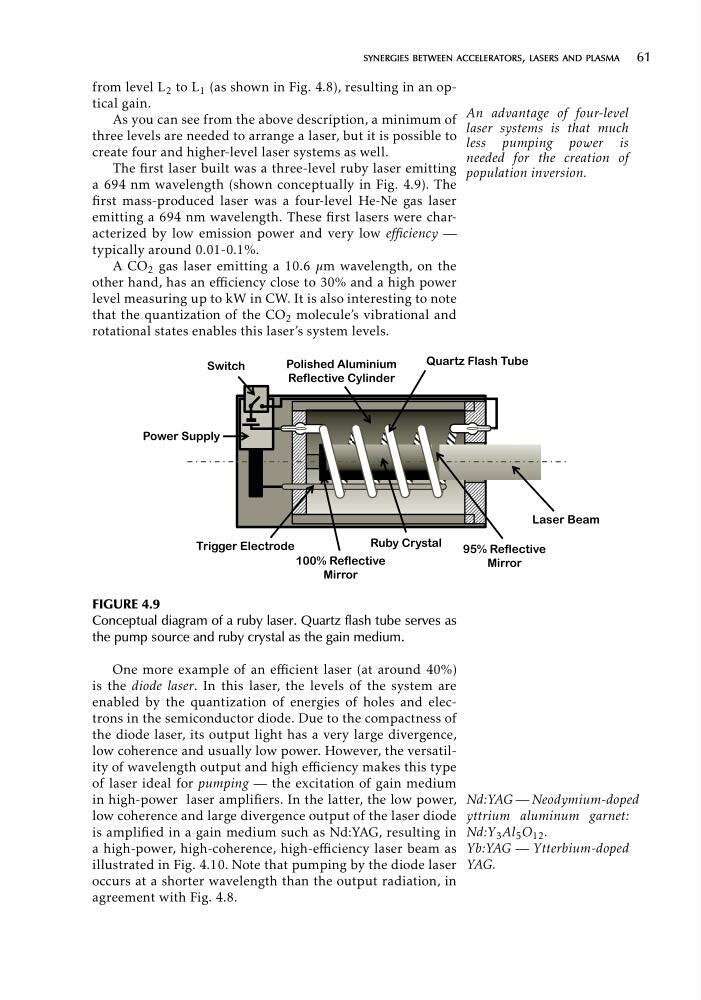
a 694 nm wavelength (shown conceptually in Fig. 4.9). The
first mass-produced laser was a four-level He-Ne gas laser
emitting a 694 nm wavelength. These first lasers were characterized by low emission power and very low efficiency —
typically around 0.01-0.1%.
A CO 2 gas laser emitting a 10.6 μm wavelength, on the
other hand, has an efficiency close to 30% and a high power
level measuring up to kW in CW. It is also interesting to note
that the quantization of the CO 2 molecule’s vibrational and
rotational states enables this laser’s system levels.
FIGURE 4.9
Conceptual diagram of a ruby laser. Quartz flash tube serves as
the pump source and ruby crystal as the gain medium.
One more example of an efficient laser (at around 40%)
is the diode laser. In this laser, the levels of the system are
enabled by the quantization of energies of holes and electrons in the semiconductor diode. Due to the compactness of
the diode laser, its output light has a very large divergence,
low coherence and usually low power. However, the versatility of wavelength output and high efficiency makes this type
of laser ideal for pumping — the excitation of gain medium
in high-power laser amplifiers. In the latter, the low power, Nd:YAG — Neodymium-doped
low coherence and large divergence output of the laser diode yttrium aluminum garnet:
is amplified in a gain medium such as Nd:YAG, resulting in Nd:Y 3 Al 5 O 12 .
a high-power, high-coherence, high-efficiency laser beam as Yb:YAG — Ytterbium-doped
illustrated in Fig. 4.10. Note that pumping by the diode laser YAG.
occurs at a shorter wavelength than the output radiation, in
agreement with Fig. 4.8.
from level L 2 to L 1 (as shown in Fig. 4.8), resulting in an optical gain.
An advantage of four-level
As you can see from the above description, a minimum of laser systems is that much
three levels are needed to arrange a laser, but it is possible to less pumping power is
create four and higher-level laser systems as well.
needed for the creation of
The first laser built was a three-level ruby laser emitting population inversion.
a 694 nm wavelength (shown conceptually in Fig. 4.9). The
first mass-produced laser was a four-level He-Ne gas laser
emitting a 694 nm wavelength. These first lasers were characterized by low emission power and very low efficiency —
typically around 0.01-0.1%.
A CO 2 gas laser emitting a 10.6 μm wavelength, on the
other hand, has an efficiency close to 30% and a high power
level measuring up to kW in CW. It is also interesting to note
that the quantization of the CO 2 molecule’s vibrational and
rotational states enables this laser’s system levels.
FIGURE 4.9
Conceptual diagram of a ruby laser. Quartz flash tube serves as
the pump source and ruby crystal as the gain medium.
One more example of an efficient laser (at around 40%)
is the diode laser. In this laser, the levels of the system are
enabled by the quantization of energies of holes and electrons in the semiconductor diode. Due to the compactness of
the diode laser, its output light has a very large divergence,
low coherence and usually low power. However, the versatility of wavelength output and high efficiency makes this type
of laser ideal for pumping — the excitation of gain medium
in high-power laser amplifiers. In the latter, the low power, Nd:YAG — Neodymium-doped
low coherence and large divergence output of the laser diode yttrium aluminum garnet:
is amplified in a gain medium such as Nd:YAG, resulting in Nd:Y 3 Al 5 O 12 .
a high-power, high-coherence, high-efficiency laser beam as Yb:YAG — Ytterbium-doped
illustrated in Fig. 4.10. Note that pumping by the diode laser YAG.
occurs at a shorter wavelength than the output radiation, in
agreement with Fig. 4.8.