

60 unifying physics of accelerators, lasers and plasma
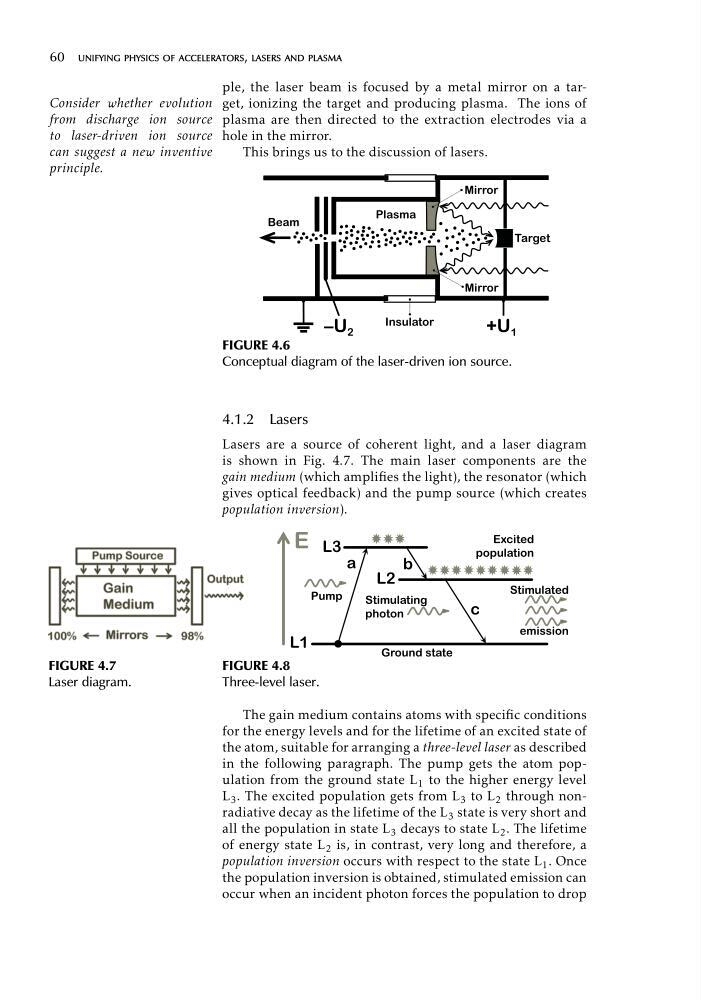
ple, the laser beam is focused by a metal mirror on a tarConsider whether evolution get, ionizing the target and producing plasma. The ions of
from discharge ion source plasma are then directed to the extraction electrodes via a
to laser-driven ion source hole in the mirror.
can suggest a new inventive
This brings us to the discussion of lasers.
principle.
FIGURE 4.6
Conceptual diagram of the laser-driven ion source.
,QVXODWRU
0LUURU
7DUJHW
8
8
3ODVPD
0LUURU
%HDP
4.1.2 Lasers
Lasers are a source of coherent light, and a laser diagram
is shown in Fig. 4.7. The main laser components are the
gain medium (which amplifies the light), the resonator (which
gives optical feedback) and the pump source (which creates
population inversion).
/
/
/
3XPS
6WLPXODWLQJ
SKRWRQ
*URXQGVWDWH
([FLWHG
SRSXODWLRQ
6WLPXODWHG
HPLVVLRQ
(
D
F
E
FIGURE 4.7
Laser diagram.
FIGURE 4.8
Three-level laser.
The gain medium contains atoms with specific conditions
for the energy levels and for the lifetime of an excited state of
the atom, suitable for arranging a three-level laser as described
in the following paragraph. The pump gets the atom population from the ground state L 1 to the higher energy level
L 3 . The excited population gets from L 3 to L 2 through nonradiative decay as the lifetime of the L 3 state is very short and
all the population in state L 3 decays to state L 2 . The lifetime
of energy state L 2 is, in contrast, very long and therefore, a
population inversion occurs with respect to the state L 1 . Once
the population inversion is obtained, stimulated emission can
occur when an incident photon forces the population to drop
ple, the laser beam is focused by a metal mirror on a tarConsider whether evolution get, ionizing the target and producing plasma. The ions of
from discharge ion source plasma are then directed to the extraction electrodes via a
to laser-driven ion source hole in the mirror.
can suggest a new inventive
This brings us to the discussion of lasers.
principle.
FIGURE 4.6
Conceptual diagram of the laser-driven ion source.
,QVXODWRU
0LUURU
7DUJHW
8
8
3ODVPD
0LUURU
%HDP
4.1.2 Lasers
Lasers are a source of coherent light, and a laser diagram
is shown in Fig. 4.7. The main laser components are the
gain medium (which amplifies the light), the resonator (which
gives optical feedback) and the pump source (which creates
population inversion).
/
/
/
3XPS
6WLPXODWLQJ
SKRWRQ
*URXQGVWDWH
([FLWHG
SRSXODWLRQ
6WLPXODWHG
HPLVVLRQ
(
D
F
E
FIGURE 4.7
Laser diagram.
FIGURE 4.8
Three-level laser.
The gain medium contains atoms with specific conditions
for the energy levels and for the lifetime of an excited state of
the atom, suitable for arranging a three-level laser as described
in the following paragraph. The pump gets the atom population from the ground state L 1 to the higher energy level
L 3 . The excited population gets from L 3 to L 2 through nonradiative decay as the lifetime of the L 3 state is very short and
all the population in state L 3 decays to state L 2 . The lifetime
of energy state L 2 is, in contrast, very long and therefore, a
population inversion occurs with respect to the state L 1 . Once
the population inversion is obtained, stimulated emission can
occur when an incident photon forces the population to drop