

synchrotron radiation 49
3.2.2 SR-induced emittance growth
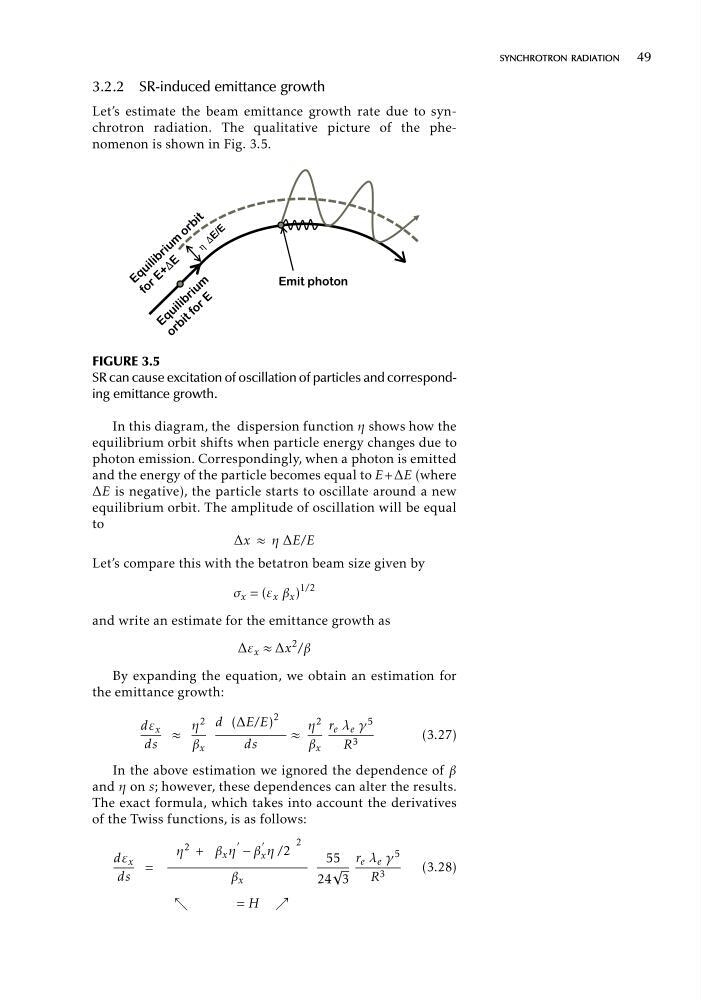
Let’s estimate the beam emittance growth rate due to synchrotron radiation. The qualitative picture of the phenomenon is shown in Fig. 3.5.
(PLWSKRWRQ
FIGURE 3.5
SR can cause excitation of oscillation of particles and corresponding emittance growth.
In this diagram, the dispersion function η shows how the
equilibrium orbit shifts when particle energy changes due to
photon emission. Correspondingly, when a photon is emitted
and the energy of the particle becomes equal to E +ΔE (where
ΔE is negative), the particle starts to oscillate around a new
equilibrium orbit. The amplitude of oscillation will be equal
to
Δx ≈ η ΔE/E
Let’s compare this with the betatron beam size given by
)
1/2
σ x = (ε x β x
and write an estimate for the emittance growth as
Δε x ≈ Δx
2 /β
By expanding the equation, we obtain an estimation for
the emittance growth:
dε x
η 2 d (ΔE/E)
2
η 2 r e λ e γ 5
≈
≈
(3.27)
ds
β x
ds
β x
R 3
In the above estimation we ignored the dependence of β
and η on s; however, these dependences can alter the results.
The exact formula, which takes into account the derivatives
of the Twiss functions, is as follows:
'
'
2
η 2 + β x η − β x η /2
γ 5
dε x
55 r e λ e
=
√
(3.28)
R 3
ds
β x
24 3
�
= H /
3.2.2 SR-induced emittance growth
Let’s estimate the beam emittance growth rate due to synchrotron radiation. The qualitative picture of the phenomenon is shown in Fig. 3.5.
(PLWSKRWRQ
FIGURE 3.5
SR can cause excitation of oscillation of particles and corresponding emittance growth.
In this diagram, the dispersion function η shows how the
equilibrium orbit shifts when particle energy changes due to
photon emission. Correspondingly, when a photon is emitted
and the energy of the particle becomes equal to E +ΔE (where
ΔE is negative), the particle starts to oscillate around a new
equilibrium orbit. The amplitude of oscillation will be equal
to
Δx ≈ η ΔE/E
Let’s compare this with the betatron beam size given by
)
1/2
σ x = (ε x β x
and write an estimate for the emittance growth as
Δε x ≈ Δx
2 /β
By expanding the equation, we obtain an estimation for
the emittance growth:
dε x
η 2 d (ΔE/E)
2
η 2 r e λ e γ 5
≈
≈
(3.27)
ds
β x
ds
β x
R 3
In the above estimation we ignored the dependence of β
and η on s; however, these dependences can alter the results.
The exact formula, which takes into account the derivatives
of the Twiss functions, is as follows:
'
'
2
η 2 + β x η − β x η /2
γ 5
dε x
55 r e λ e
=
√
(3.28)
R 3
ds
β x
24 3
�
= H /