

48 unifying physics of accelerators, lasers and plasma
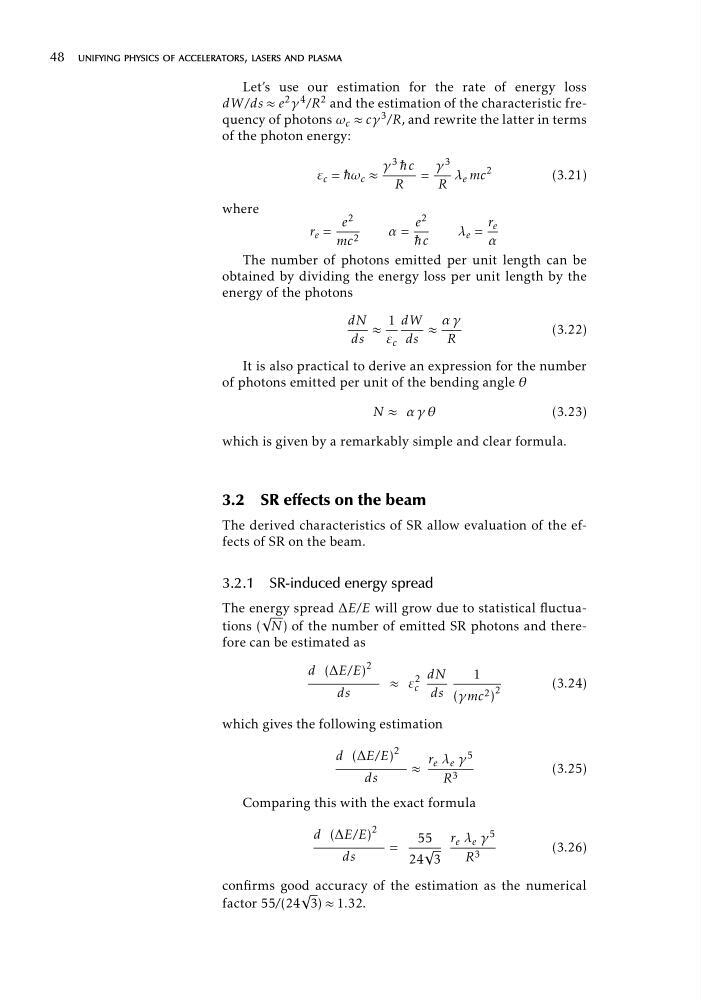
Let’s use our estimation for the rate of energy loss
dW /ds ≈ e 2 γ 4 /R 2 and the estimation of the characteristic frequency of photons ω c ≈ cγ 3 /R, and rewrite the latter in terms
of the photon energy:
γ 3 n c
γ 3
ε c = nω c ≈
=
λ e mc
2
(3.21)
R
R
where
e 2
e 2
r e
r e =
α =
λ =
2
e
mc
n c
α
The number of photons emitted per unit length can be
obtained by dividing the energy loss per unit length by the
energy of the photons
dN
1 dW α γ
ds
≈ ε c ds
≈
(3.22)
R
It is also practical to derive an expression for the number
of photons emitted per unit of the bending angle θ
N ≈ α γ θ
(3.23)
which is given by a remarkably simple and clear formula.
3.2 SR effects on the beam
The derived characteristics of SR allow evaluation of the effects of SR on the beam.
3.2.1 SR-induced energy spread
The energy spread ΔE/E will grow due to statistical fluctua√
tions ( N ) of the number of emitted SR photons and therefore can be estimated as
d (
2
ΔE/E)
≈
2 dN
1
ε c
(3.24)
ds
ds (γmc 2 )
2
which gives the following estimation
2
d (ΔE/E)
r
ds
≈
e
γ 5
λ e
(3.25)
R 3
Comparing this with the exact formula
d (ΔE/E)
2
55 r λ
√
γ 5
=
e e
(3.26)
ds
24 3
R 3
confirms good accuracy
√
of the estimation as the numerical
factor 55/(24 3) ≈ 1.32.
Let’s use our estimation for the rate of energy loss
dW /ds ≈ e 2 γ 4 /R 2 and the estimation of the characteristic frequency of photons ω c ≈ cγ 3 /R, and rewrite the latter in terms
of the photon energy:
γ 3 n c
γ 3
ε c = nω c ≈
=
λ e mc
2
(3.21)
R
R
where
e 2
e 2
r e
r e =
α =
λ =
2
e
mc
n c
α
The number of photons emitted per unit length can be
obtained by dividing the energy loss per unit length by the
energy of the photons
dN
1 dW α γ
ds
≈ ε c ds
≈
(3.22)
R
It is also practical to derive an expression for the number
of photons emitted per unit of the bending angle θ
N ≈ α γ θ
(3.23)
which is given by a remarkably simple and clear formula.
3.2 SR effects on the beam
The derived characteristics of SR allow evaluation of the effects of SR on the beam.
3.2.1 SR-induced energy spread
The energy spread ΔE/E will grow due to statistical fluctua√
tions ( N ) of the number of emitted SR photons and therefore can be estimated as
d (
2
ΔE/E)
≈
2 dN
1
ε c
(3.24)
ds
ds (γmc 2 )
2
which gives the following estimation
2
d (ΔE/E)
r
ds
≈
e
γ 5
λ e
(3.25)
R 3
Comparing this with the exact formula
d (ΔE/E)
2
55 r λ
√
γ 5
=
e e
(3.26)
ds
24 3
R 3
confirms good accuracy
√
of the estimation as the numerical
factor 55/(24 3) ≈ 1.32.