

basics of accelerators and of the art of inventiveness 15
principles to TRIZ. We call this extension Accelerating Science
TRIZ or AS-TRIZ, highlighting via its name a wide applicability of the method to various areas of science, even those
beyond the field of accelerators.
Below are just a few suggested additional parameters for
the AS-TRIZ matrix of contradictions (which are based on
manipulated beams and corresponding characteristics discussed in Section 1.2.1), and just a couple of inventive principles to start with — see Table 1.4 and Table 1.5. We will
populate this table as we move along the chapters.
TABLE 1.4
Emerging AS-TRIZ parameters
No. Parameter
1.
Energy
2.
Rate of energy change
3.
Emittance
4.
Luminosity
5.
Brightness
6.
Intensity
7.
Efficiency
8.
Power
9.
Integrity of materials
10. Time duration or length
11. Spatial extent
12. Sensitivity to imperfections
13. Cooling rate
14. ...
...
...
21. ...
TABLE 1.5
Emerging AS-TRIZ principles
No. Principle
1.
...
2.
...
3.
Undamageable or already damaged
4.
Volume-to-surface ratio
5.
...
...
...
21. ...
The first inventive principle shown in Table 1.5, number 3: “Undamageable or already damaged,” is illustrated by
the three examples below, while 4, “Volume-to-surface ratio,” naturally arises, for example, from Maxwell’s equation,
where an integral on a surface is connected to the integral
over volume EdS ∝ ρdV , or from other similar equations,
e.g., from thermodynamics. We will discuss examples corresponding to this principle later on in the book.
Let us illustrate an application of AS-TRIZ to a couple of
accelerator science examples.
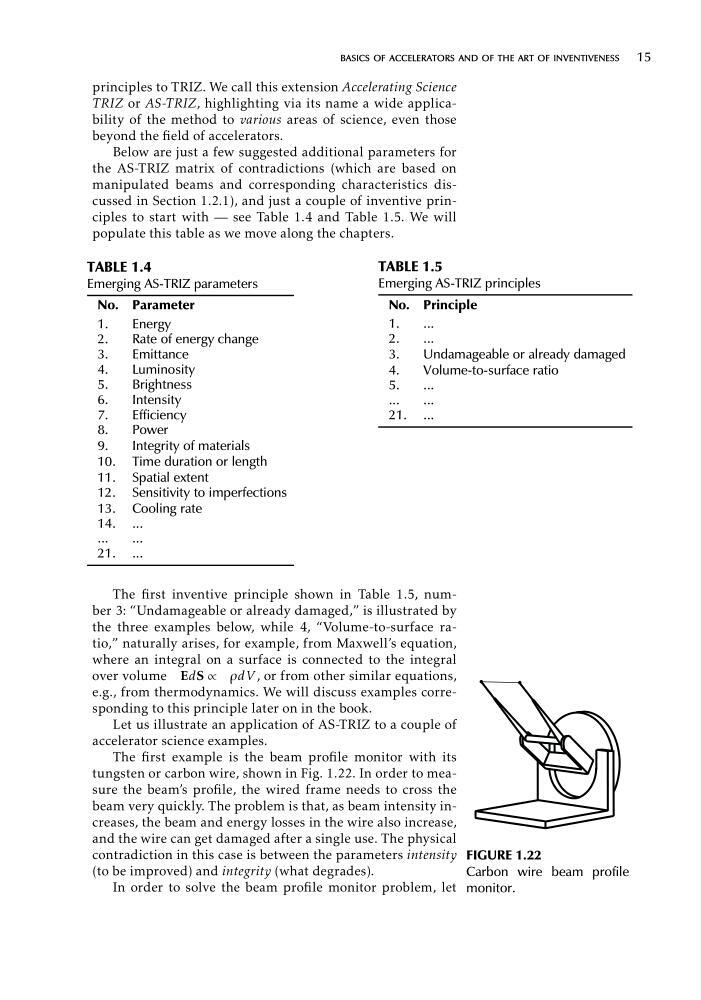
The first example is the beam profile monitor with its
tungsten or carbon wire, shown in Fig. 1.22. In order to measure the beam’s profile, the wired frame needs to cross the
beam very quickly. The problem is that, as beam intensity increases, the beam and energy losses in the wire also increase,
and the wire can get damaged after a single use. The physical
contradiction in this case is between the parameters intensity
(to be improved) and integrity (what degrades).
Carbon wire beam profile
In order to solve the beam profile monitor problem, let monitor.
FIGURE 1.22
principles to TRIZ. We call this extension Accelerating Science
TRIZ or AS-TRIZ, highlighting via its name a wide applicability of the method to various areas of science, even those
beyond the field of accelerators.
Below are just a few suggested additional parameters for
the AS-TRIZ matrix of contradictions (which are based on
manipulated beams and corresponding characteristics discussed in Section 1.2.1), and just a couple of inventive principles to start with — see Table 1.4 and Table 1.5. We will
populate this table as we move along the chapters.
TABLE 1.4
Emerging AS-TRIZ parameters
No. Parameter
1.
Energy
2.
Rate of energy change
3.
Emittance
4.
Luminosity
5.
Brightness
6.
Intensity
7.
Efficiency
8.
Power
9.
Integrity of materials
10. Time duration or length
11. Spatial extent
12. Sensitivity to imperfections
13. Cooling rate
14. ...
...
...
21. ...
TABLE 1.5
Emerging AS-TRIZ principles
No. Principle
1.
...
2.
...
3.
Undamageable or already damaged
4.
Volume-to-surface ratio
5.
...
...
...
21. ...
The first inventive principle shown in Table 1.5, number 3: “Undamageable or already damaged,” is illustrated by
the three examples below, while 4, “Volume-to-surface ratio,” naturally arises, for example, from Maxwell’s equation,
where an integral on a surface is connected to the integral
over volume EdS ∝ ρdV , or from other similar equations,
e.g., from thermodynamics. We will discuss examples corresponding to this principle later on in the book.
Let us illustrate an application of AS-TRIZ to a couple of
accelerator science examples.
The first example is the beam profile monitor with its
tungsten or carbon wire, shown in Fig. 1.22. In order to measure the beam’s profile, the wired frame needs to cross the
beam very quickly. The problem is that, as beam intensity increases, the beam and energy losses in the wire also increase,
and the wire can get damaged after a single use. The physical
contradiction in this case is between the parameters intensity
(to be improved) and integrity (what degrades).
Carbon wire beam profile
In order to solve the beam profile monitor problem, let monitor.
FIGURE 1.22