

14 unifying physics of accelerators, lasers and plasma
The reader can now see that the 1920 poem by Valery
Bryusov, which describes an electron as a planet in its own
world (see Fig. 1.19), can also be seen as reflection of the
nested doll inventive principle, this time in poetic science fiction.
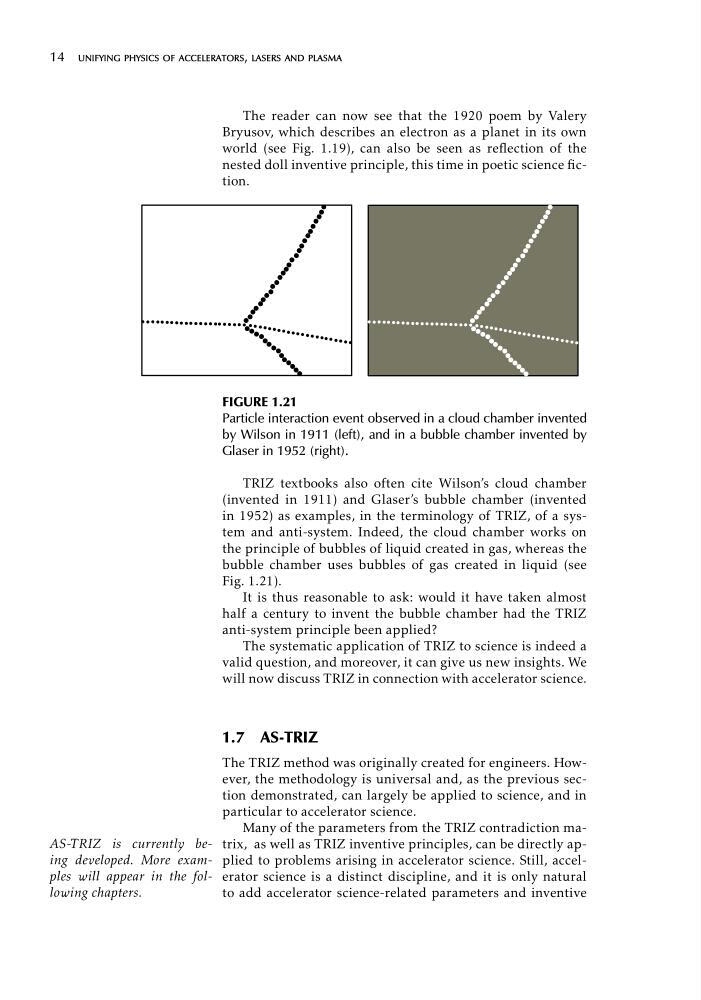
FIGURE 1.21
Particle interaction event observed in a cloud chamber invented
by Wilson in 1911 (left), and in a bubble chamber invented by
Glaser in 1952 (right).
TRIZ textbooks also often cite Wilson’s cloud chamber
(invented in 1911) and Glaser’s bubble chamber (invented
in 1952) as examples, in the terminology of TRIZ, of a system and anti-system. Indeed, the cloud chamber works on
the principle of bubbles of liquid created in gas, whereas the
bubble chamber uses bubbles of gas created in liquid (see
Fig. 1.21).
It is thus reasonable to ask: would it have taken almost
half a century to invent the bubble chamber had the TRIZ
anti-system principle been applied?
The systematic application of TRIZ to science is indeed a
valid question, and moreover, it can give us new insights. We
will now discuss TRIZ in connection with accelerator science.
1.7 AS-TRIZ
The TRIZ method was originally created for engineers. However, the methodology is universal and, as the previous section demonstrated, can largely be applied to science, and in
particular to accelerator science.
Many of the parameters from the TRIZ contradiction maAS-TRIZ is currently be- trix, as well as TRIZ inventive principles, can be directly aping developed. More exam- plied to problems arising in accelerator science. Still, accelples will appear in the fol- erator science is a distinct discipline, and it is only natural
lowing chapters.
to add accelerator science-related parameters and inventive
The reader can now see that the 1920 poem by Valery
Bryusov, which describes an electron as a planet in its own
world (see Fig. 1.19), can also be seen as reflection of the
nested doll inventive principle, this time in poetic science fiction.
FIGURE 1.21
Particle interaction event observed in a cloud chamber invented
by Wilson in 1911 (left), and in a bubble chamber invented by
Glaser in 1952 (right).
TRIZ textbooks also often cite Wilson’s cloud chamber
(invented in 1911) and Glaser’s bubble chamber (invented
in 1952) as examples, in the terminology of TRIZ, of a system and anti-system. Indeed, the cloud chamber works on
the principle of bubbles of liquid created in gas, whereas the
bubble chamber uses bubbles of gas created in liquid (see
Fig. 1.21).
It is thus reasonable to ask: would it have taken almost
half a century to invent the bubble chamber had the TRIZ
anti-system principle been applied?
The systematic application of TRIZ to science is indeed a
valid question, and moreover, it can give us new insights. We
will now discuss TRIZ in connection with accelerator science.
1.7 AS-TRIZ
The TRIZ method was originally created for engineers. However, the methodology is universal and, as the previous section demonstrated, can largely be applied to science, and in
particular to accelerator science.
Many of the parameters from the TRIZ contradiction maAS-TRIZ is currently be- trix, as well as TRIZ inventive principles, can be directly aping developed. More exam- plied to problems arising in accelerator science. Still, accelples will appear in the fol- erator science is a distinct discipline, and it is only natural
lowing chapters.
to add accelerator science-related parameters and inventive