

basics of accelerators and of the art of inventiveness 13
TABLE 1.3
TRIZ inventive principles
No.Principle
No.Principle
No.Principle
1. Segmentation
15. Dynamics
29. Pneumatics, hydraulics
2. Taking out
16. Partial or excessive actions 30. Flexible shells, thin films
3. Local quality
17. Another dimension
31. Porous materials
4. Asymmetry
18. Mechanical vibration
32. Color changes
5. Merging
19. Periodic action
33. Homogeneity
6. Universality
20. Continuity of useful action 34. Discarding, recovering
7. Russian dolls
21. Skipping
35. Parameter changes
8. Anti-weight
22. Blessing in disguise
36. Phase transitions
9. Preliminary anti-action
23. Feedback
37. Thermal expansion
10. Preliminary action
24. Intermediary
38. Strong oxidants
11. Beforehand cushioning
25. Self-service
39. Inert atmosphere
12. Equipotentiality
26. Copying
40. Composite materials
13. “The other way round”
27. Cheap short-lived objects
14. Spheroidality — Curvature 28. Mechanics substitution
1.6 TRIZ method for science
We have finally arrived at the section that will elucidate the
meaning of the epigraph to this chapter.
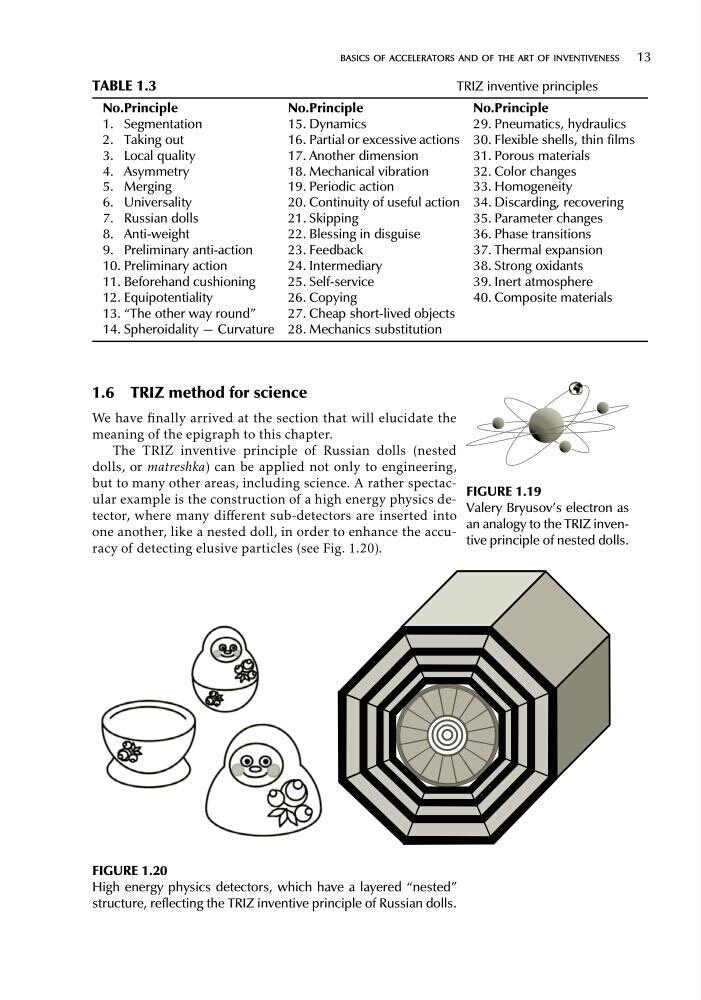
The TRIZ inventive principle of Russian dolls (nested
dolls, or matreshka) can be applied not only to engineering,
but to many other areas, including science. A rather spectacular example is the construction of a high energy physics deFIGURE 1.19
Valery Bryusov’s electron
tector, where many different sub-detectors are inserted into
as
one another, like a nested doll, in order to enhance the accuan analogy to the TRIZ inventive principle
racy
of nested dolls.
of detecting elusive particles (see Fig. 1.20).
FIGURE 1.20
High energy physics detectors, which have a layered “nested”
structure, reflecting the TRIZ inventive principle of Russian dolls.
TABLE 1.3
TRIZ inventive principles
No.Principle
No.Principle
No.Principle
1. Segmentation
15. Dynamics
29. Pneumatics, hydraulics
2. Taking out
16. Partial or excessive actions 30. Flexible shells, thin films
3. Local quality
17. Another dimension
31. Porous materials
4. Asymmetry
18. Mechanical vibration
32. Color changes
5. Merging
19. Periodic action
33. Homogeneity
6. Universality
20. Continuity of useful action 34. Discarding, recovering
7. Russian dolls
21. Skipping
35. Parameter changes
8. Anti-weight
22. Blessing in disguise
36. Phase transitions
9. Preliminary anti-action
23. Feedback
37. Thermal expansion
10. Preliminary action
24. Intermediary
38. Strong oxidants
11. Beforehand cushioning
25. Self-service
39. Inert atmosphere
12. Equipotentiality
26. Copying
40. Composite materials
13. “The other way round”
27. Cheap short-lived objects
14. Spheroidality — Curvature 28. Mechanics substitution
1.6 TRIZ method for science
We have finally arrived at the section that will elucidate the
meaning of the epigraph to this chapter.
The TRIZ inventive principle of Russian dolls (nested
dolls, or matreshka) can be applied not only to engineering,
but to many other areas, including science. A rather spectacular example is the construction of a high energy physics deFIGURE 1.19
Valery Bryusov’s electron
tector, where many different sub-detectors are inserted into
as
one another, like a nested doll, in order to enhance the accuan analogy to the TRIZ inventive principle
racy
of nested dolls.
of detecting elusive particles (see Fig. 1.20).
FIGURE 1.20
High energy physics detectors, which have a layered “nested”
structure, reflecting the TRIZ inventive principle of Russian dolls.