

16 unifying physics of accelerators, lasers and plasma
us apply emerging AS-TRIZ principle 3: “Undamageable or
already damaged.” That is, we must replace the material that
can be damaged with another media which either cannot be
damaged (light) or is already “damaged” (e.g., plasma).
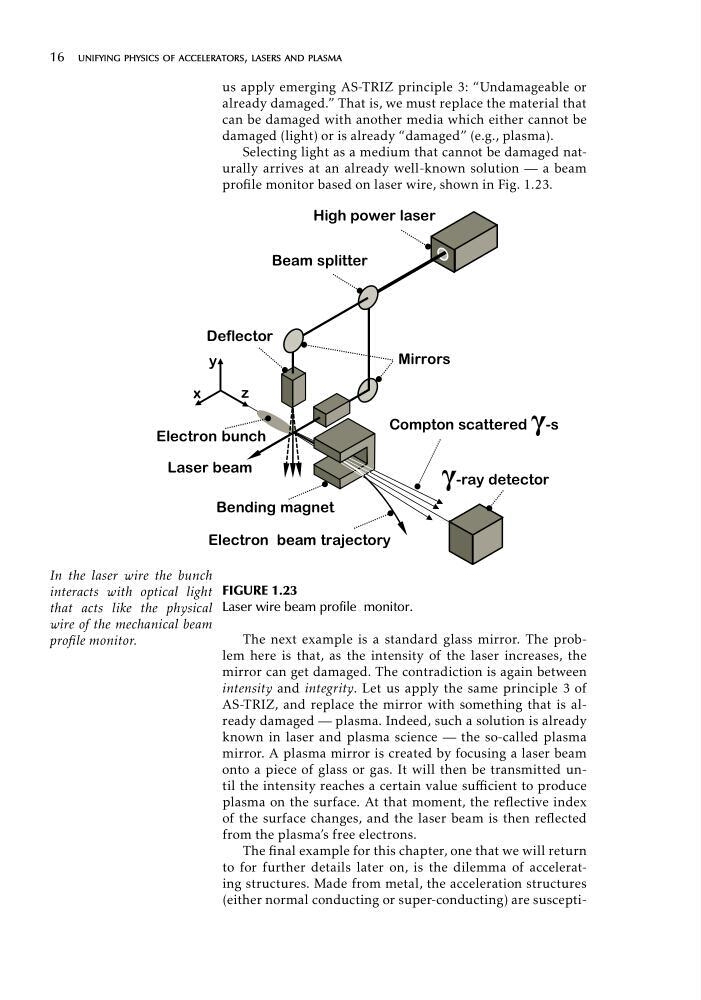
Selecting light as a medium that cannot be damaged naturally arrives at an already well-known solution — a beam
profile monitor based on laser wire, shown in Fig. 1.23.
\
[
]
(OHFWURQEXQFK
/DVHUEHDP
0LUURUV
%HDPVSOLWWHU
'HIOHFWRU
+LJKSRZHUODVHU
%HQGLQJPDJQHW
(OHFWURQEHDPWUDMHFWRU\
&RPSWRQVFDWWHUHG
UD\GHWHFWRU
V
FIGURE 1.23
Laser wire beam profile monitor.
The next example is a standard glass mirror. The problem here is that, as the intensity of the laser increases, the
mirror can get damaged. The contradiction is again between
intensity and integrity. Let us apply the same principle 3 of
AS-TRIZ, and replace the mirror with something that is already damaged — plasma. Indeed, such a solution is already
known in laser and plasma science — the so-called plasma
mirror. A plasma mirror is created by focusing a laser beam
onto a piece of glass or gas. It will then be transmitted until the intensity reaches a certain value sufficient to produce
plasma on the surface. At that moment, the reflective index
of the surface changes, and the laser beam is then reflected
from the plasma’s free electrons.
The final example for this chapter, one that we will return
to for further details later on, is the dilemma of accelerating structures. Made from metal, the acceleration structures
(either normal conducting or super-conducting) are susceptiIn the laser wire the bunch
interacts with optical light
that acts like the physical
wire of the mechanical beam
profile monitor.
us apply emerging AS-TRIZ principle 3: “Undamageable or
already damaged.” That is, we must replace the material that
can be damaged with another media which either cannot be
damaged (light) or is already “damaged” (e.g., plasma).
Selecting light as a medium that cannot be damaged naturally arrives at an already well-known solution — a beam
profile monitor based on laser wire, shown in Fig. 1.23.
\
[
]
(OHFWURQEXQFK
/DVHUEHDP
0LUURUV
%HDPVSOLWWHU
'HIOHFWRU
+LJKSRZHUODVHU
%HQGLQJPDJQHW
(OHFWURQEHDPWUDMHFWRU\
&RPSWRQVFDWWHUHG
UD\GHWHFWRU
V
FIGURE 1.23
Laser wire beam profile monitor.
The next example is a standard glass mirror. The problem here is that, as the intensity of the laser increases, the
mirror can get damaged. The contradiction is again between
intensity and integrity. Let us apply the same principle 3 of
AS-TRIZ, and replace the mirror with something that is already damaged — plasma. Indeed, such a solution is already
known in laser and plasma science — the so-called plasma
mirror. A plasma mirror is created by focusing a laser beam
onto a piece of glass or gas. It will then be transmitted until the intensity reaches a certain value sufficient to produce
plasma on the surface. At that moment, the reflective index
of the surface changes, and the laser beam is then reflected
from the plasma’s free electrons.
The final example for this chapter, one that we will return
to for further details later on, is the dilemma of accelerating structures. Made from metal, the acceleration structures
(either normal conducting or super-conducting) are susceptiIn the laser wire the bunch
interacts with optical light
that acts like the physical
wire of the mechanical beam
profile monitor.