

6 unifying physics of accelerators, lasers and plasma
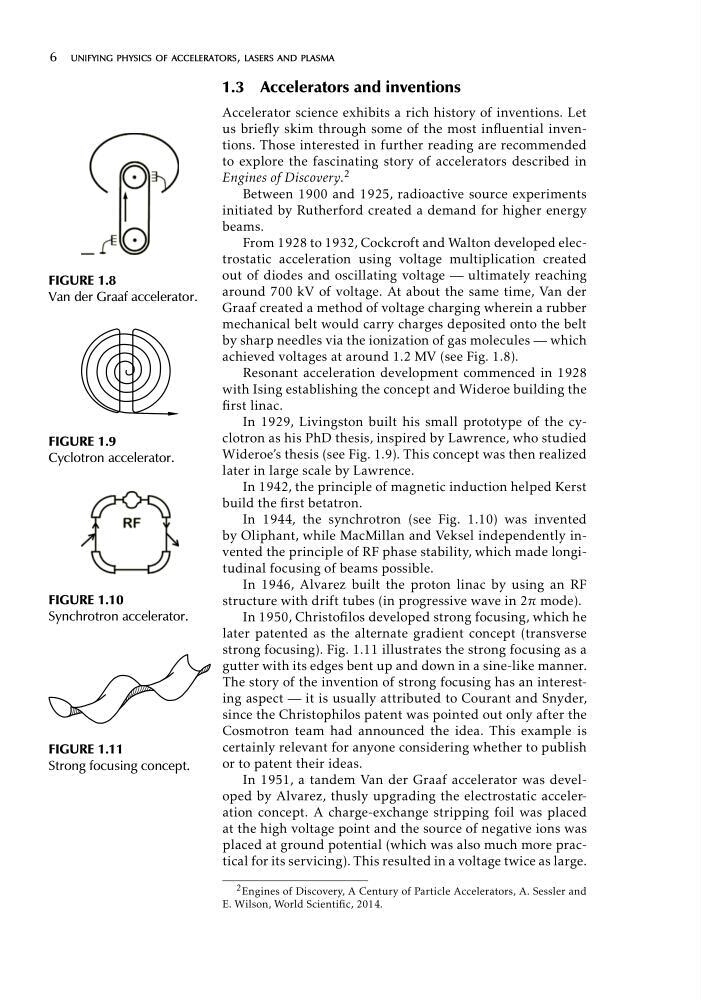
FIGURE 1.8
Van der Graaf accelerator.
FIGURE 1.9
Cyclotron accelerator.
FIGURE 1.10
Synchrotron accelerator.
FIGURE 1.11
Strong focusing concept.
1.3 Accelerators and inventions
Accelerator science exhibits a rich history of inventions. Let
us briefly skim through some of the most influential inventions. Those interested in further reading are recommended
to explore the fascinating story of accelerators described in
Engines of Discovery. 2
Between 1900 and 1925, radioactive source experiments
initiated by Rutherford created a demand for higher energy
beams.
From 1928 to 1932, Cockcroft and Walton developed electrostatic acceleration using voltage multiplication created
out of diodes and oscillating voltage — ultimately reaching
around 700 kV of voltage. At about the same time, Van der
Graaf created a method of voltage charging wherein a rubber
mechanical belt would carry charges deposited onto the belt
by sharp needles via the ionization of gas molecules — which
achieved voltages at around 1.2 MV (see Fig. 1.8).
Resonant acceleration development commenced in 1928
with Ising establishing the concept and Wideroe building the
first linac.
In 1929, Livingston built his small prototype of the cyclotron as his PhD thesis, inspired by Lawrence, who studied
Wideroe’s thesis (see Fig. 1.9). This concept was then realized
later in large scale by Lawrence.
In 1942, the principle of magnetic induction helped Kerst
build the first betatron.
In 1944, the synchrotron (see Fig. 1.10) was invented
by Oliphant, while MacMillan and Veksel independently invented the principle of RF phase stability, which made longitudinal focusing of beams possible.
In 1946, Alvarez built the proton linac by using an RF
structure with drift tubes (in progressive wave in 2π mode).
In 1950, Christofilos developed strong focusing, which he
later patented as the alternate gradient concept (transverse
strong focusing). Fig. 1.11 illustrates the strong focusing as a
gutter with its edges bent up and down in a sine-like manner.
The story of the invention of strong focusing has an interesting aspect — it is usually attributed to Courant and Snyder,
since the Christophilos patent was pointed out only after the
Cosmotron team had announced the idea. This example is
certainly relevant for anyone considering whether to publish
or to patent their ideas.
In 1951, a tandem Van der Graaf accelerator was developed by Alvarez, thusly upgrading the electrostatic acceleration concept. A charge-exchange stripping foil was placed
at the high voltage point and the source of negative ions was
placed at ground potential (which was also much more practical for its servicing). This resulted in a voltage twice as large.
2 Engines of Discovery, A Century of Particle Accelerators, A. Sessler and
E. Wilson, World Scientific, 2014.
FIGURE 1.8
Van der Graaf accelerator.
FIGURE 1.9
Cyclotron accelerator.
FIGURE 1.10
Synchrotron accelerator.
FIGURE 1.11
Strong focusing concept.
1.3 Accelerators and inventions
Accelerator science exhibits a rich history of inventions. Let
us briefly skim through some of the most influential inventions. Those interested in further reading are recommended
to explore the fascinating story of accelerators described in
Engines of Discovery. 2
Between 1900 and 1925, radioactive source experiments
initiated by Rutherford created a demand for higher energy
beams.
From 1928 to 1932, Cockcroft and Walton developed electrostatic acceleration using voltage multiplication created
out of diodes and oscillating voltage — ultimately reaching
around 700 kV of voltage. At about the same time, Van der
Graaf created a method of voltage charging wherein a rubber
mechanical belt would carry charges deposited onto the belt
by sharp needles via the ionization of gas molecules — which
achieved voltages at around 1.2 MV (see Fig. 1.8).
Resonant acceleration development commenced in 1928
with Ising establishing the concept and Wideroe building the
first linac.
In 1929, Livingston built his small prototype of the cyclotron as his PhD thesis, inspired by Lawrence, who studied
Wideroe’s thesis (see Fig. 1.9). This concept was then realized
later in large scale by Lawrence.
In 1942, the principle of magnetic induction helped Kerst
build the first betatron.
In 1944, the synchrotron (see Fig. 1.10) was invented
by Oliphant, while MacMillan and Veksel independently invented the principle of RF phase stability, which made longitudinal focusing of beams possible.
In 1946, Alvarez built the proton linac by using an RF
structure with drift tubes (in progressive wave in 2π mode).
In 1950, Christofilos developed strong focusing, which he
later patented as the alternate gradient concept (transverse
strong focusing). Fig. 1.11 illustrates the strong focusing as a
gutter with its edges bent up and down in a sine-like manner.
The story of the invention of strong focusing has an interesting aspect — it is usually attributed to Courant and Snyder,
since the Christophilos patent was pointed out only after the
Cosmotron team had announced the idea. This example is
certainly relevant for anyone considering whether to publish
or to patent their ideas.
In 1951, a tandem Van der Graaf accelerator was developed by Alvarez, thusly upgrading the electrostatic acceleration concept. A charge-exchange stripping foil was placed
at the high voltage point and the source of negative ions was
placed at ground potential (which was also much more practical for its servicing). This resulted in a voltage twice as large.
2 Engines of Discovery, A Century of Particle Accelerators, A. Sessler and
E. Wilson, World Scientific, 2014.