

7
basics of accelerators and of the art of inventiveness
In 1953, Courant, Snyder, and Livingston built the weak
focusing 3.3 GeV Cosmotron in Brookhaven, and in 1957,
Veksler built a 10 GeV (which was the world record at that
time) synchrophasotron in Dubna, whose magnet weighed
36,000 tons and was registered in the Guinness Book of
World Records. This record in energy was overtaken by the
CERN Proton Synchrotron in 1959, constructed under the
leadership of Sir John Adams. The CERN PS was the first
strong focusing accelerator, closely followed by the AGS at
Brookhaven.
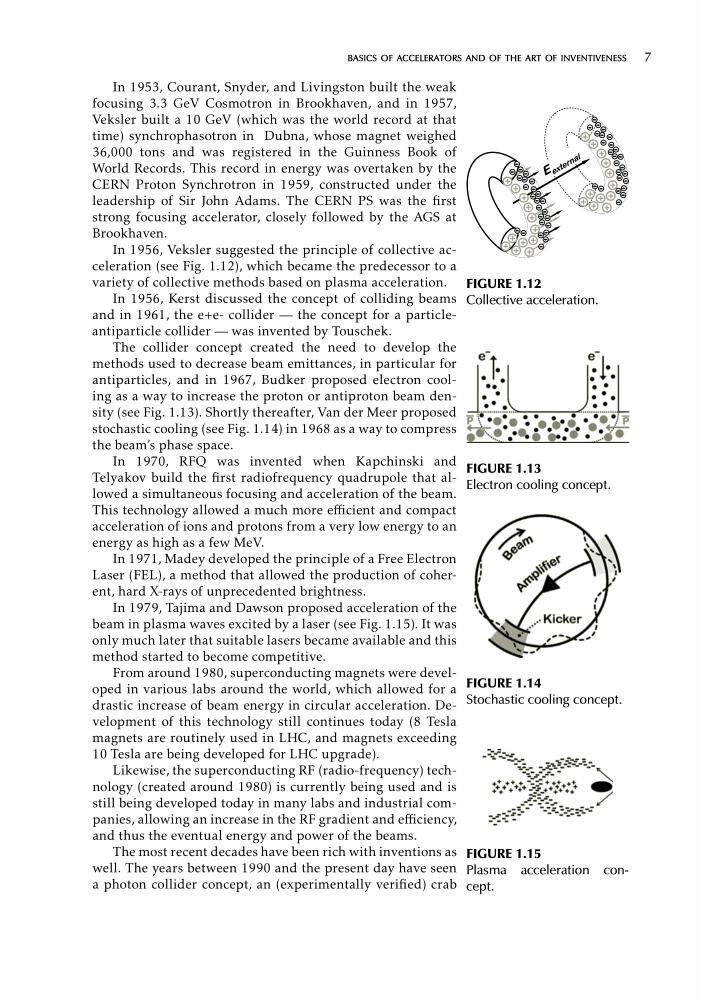
In 1956, Veksler suggested the principle of collective acceleration (see Fig. 1.12), which became the predecessor to a
variety of collective methods based on plasma acceleration.
In 1956, Kerst discussed the concept of colliding beams
and in 1961, the e+e- collider — the concept for a particleantiparticle collider — was invented by Touschek.
The collider concept created the need to develop the
methods used to decrease beam emittances, in particular for
antiparticles, and in 1967, Budker proposed electron cooling as a way to increase the proton or antiproton beam density (see Fig. 1.13). Shortly thereafter, Van der Meer proposed
stochastic cooling (see Fig. 1.14) in 1968 as a way to compress
the beam’s phase space.
In 1970, RFQ was invented when Kapchinski and
Telyakov build the first radiofrequency quadrupole that allowed a simultaneous focusing and acceleration of the beam.
This technology allowed a much more efficient and compact
acceleration of ions and protons from a very low energy to an
energy as high as a few MeV.
In 1971, Madey developed the principle of a Free Electron
Laser (FEL), a method that allowed the production of coherent, hard X-rays of unprecedented brightness.
In 1979, Tajima and Dawson proposed acceleration of the
beam in plasma waves excited by a laser (see Fig. 1.15). It was
only much later that suitable lasers became available and this
method started to become competitive.
From around 1980, superconducting magnets were developed in various labs around the world, which allowed for a
drastic increase of beam energy in circular acceleration. Development of this technology still continues today (8 Tesla
magnets are routinely used in LHC, and magnets exceeding
10 Tesla are being developed for LHC upgrade).
Likewise, the superconducting RF (radio-frequency) technology (created around 1980) is currently being used and is
still being developed today in many labs and industrial companies, allowing an increase in the RF gradient and efficiency,
and thus the eventual energy and power of the beams.
The most recent decades have been rich with inventions as
well. The years between 1990 and the present day have seen
a photon collider concept, an (experimentally verified) crab
FIGURE 1.12
Collective acceleration.
FIGURE 1.13
Electron cooling concept.
FIGURE 1.14
Stochastic cooling concept.
FIGURE 1.15
Plasma acceleration concept.
basics of accelerators and of the art of inventiveness
In 1953, Courant, Snyder, and Livingston built the weak
focusing 3.3 GeV Cosmotron in Brookhaven, and in 1957,
Veksler built a 10 GeV (which was the world record at that
time) synchrophasotron in Dubna, whose magnet weighed
36,000 tons and was registered in the Guinness Book of
World Records. This record in energy was overtaken by the
CERN Proton Synchrotron in 1959, constructed under the
leadership of Sir John Adams. The CERN PS was the first
strong focusing accelerator, closely followed by the AGS at
Brookhaven.
In 1956, Veksler suggested the principle of collective acceleration (see Fig. 1.12), which became the predecessor to a
variety of collective methods based on plasma acceleration.
In 1956, Kerst discussed the concept of colliding beams
and in 1961, the e+e- collider — the concept for a particleantiparticle collider — was invented by Touschek.
The collider concept created the need to develop the
methods used to decrease beam emittances, in particular for
antiparticles, and in 1967, Budker proposed electron cooling as a way to increase the proton or antiproton beam density (see Fig. 1.13). Shortly thereafter, Van der Meer proposed
stochastic cooling (see Fig. 1.14) in 1968 as a way to compress
the beam’s phase space.
In 1970, RFQ was invented when Kapchinski and
Telyakov build the first radiofrequency quadrupole that allowed a simultaneous focusing and acceleration of the beam.
This technology allowed a much more efficient and compact
acceleration of ions and protons from a very low energy to an
energy as high as a few MeV.
In 1971, Madey developed the principle of a Free Electron
Laser (FEL), a method that allowed the production of coherent, hard X-rays of unprecedented brightness.
In 1979, Tajima and Dawson proposed acceleration of the
beam in plasma waves excited by a laser (see Fig. 1.15). It was
only much later that suitable lasers became available and this
method started to become competitive.
From around 1980, superconducting magnets were developed in various labs around the world, which allowed for a
drastic increase of beam energy in circular acceleration. Development of this technology still continues today (8 Tesla
magnets are routinely used in LHC, and magnets exceeding
10 Tesla are being developed for LHC upgrade).
Likewise, the superconducting RF (radio-frequency) technology (created around 1980) is currently being used and is
still being developed today in many labs and industrial companies, allowing an increase in the RF gradient and efficiency,
and thus the eventual energy and power of the beams.
The most recent decades have been rich with inventions as
well. The years between 1990 and the present day have seen
a photon collider concept, an (experimentally verified) crab
FIGURE 1.12
Collective acceleration.
FIGURE 1.13
Electron cooling concept.
FIGURE 1.14
Stochastic cooling concept.
FIGURE 1.15
Plasma acceleration concept.