

4 unifying physics of accelerators, lasers and plasma
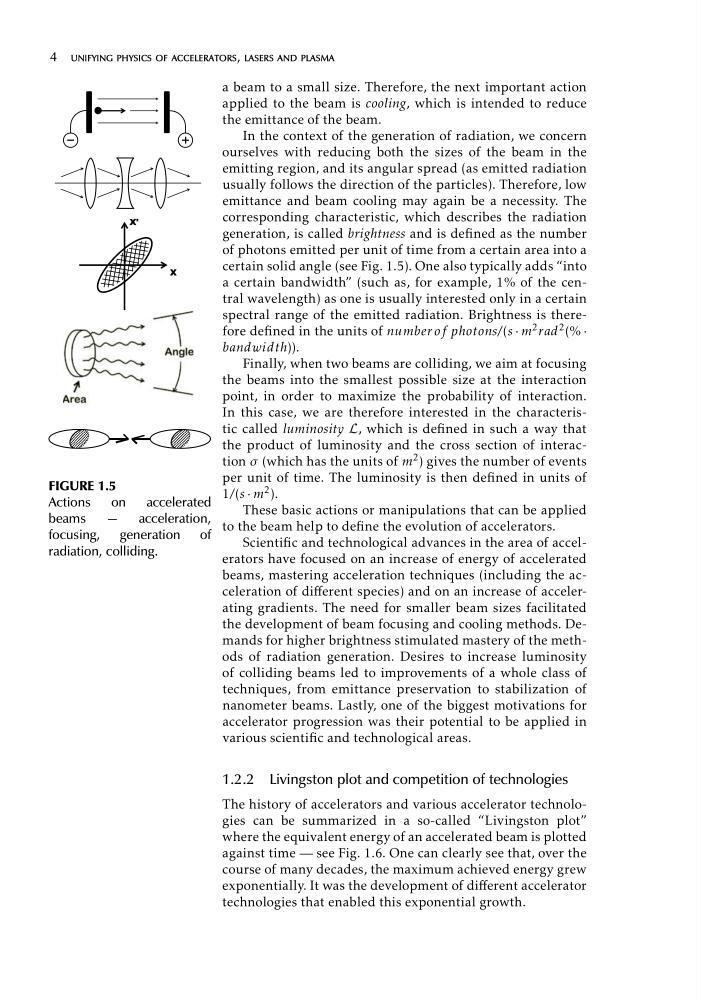
FIGURE 1.5
Actions
on
accelerated
beams — acceleration,
focusing, generation of
radiation, colliding.
a beam to a small size. Therefore, the next important action
applied to the beam is cooling, which is intended to reduce
the emittance of the beam.
In the context of the generation of radiation, we concern
ourselves with reducing both the sizes of the beam in the
emitting region, and its angular spread (as emitted radiation
usually follows the direction of the particles). Therefore, low
emittance and beam cooling may again be a necessity. The
corresponding characteristic, which describes the radiation
generation, is called brightness and is defined as the number
of photons emitted per unit of time from a certain area into a
certain solid angle (see Fig. 1.5). One also typically adds “into
a certain bandwidth” (such as, for example, 1% of the central wavelength) as one is usually interested only in a certain
spectral range of the emitted radiation. Brightness is therefore defined in the units of number of photons/(s · m 2 rad 2 (% ·
bandwidth)).
Finally, when two beams are colliding, we aim at focusing
the beams into the smallest possible size at the interaction
point, in order to maximize the probability of interaction.
In this case, we are therefore interested in the characteristic called luminosity L, which is defined in such a way that
the product of luminosity and the cross section of interaction σ (which has the units of m 2 ) gives the number of events
per unit of time. The luminosity is then defined in units of
1/(s · m 2 ).
These basic actions or manipulations that can be applied
to the beam help to define the evolution of accelerators.
Scientific and technological advances in the area of accelerators have focused on an increase of energy of accelerated
beams, mastering acceleration techniques (including the acceleration of different species) and on an increase of accelerating gradients. The need for smaller beam sizes facilitated
the development of beam focusing and cooling methods. Demands for higher brightness stimulated mastery of the methods of radiation generation. Desires to increase luminosity
of colliding beams led to improvements of a whole class of
techniques, from emittance preservation to stabilization of
nanometer beams. Lastly, one of the biggest motivations for
accelerator progression was their potential to be applied in
various scientific and technological areas.
1.2.2 Livingston plot and competition of technologies
The history of accelerators and various accelerator technologies can be summarized in a so-called “Livingston plot”
where the equivalent energy of an accelerated beam is plotted
against time — see Fig. 1.6. One can clearly see that, over the
course of many decades, the maximum achieved energy grew
exponentially. It was the development of different accelerator
technologies that enabled this exponential growth.
FIGURE 1.5
Actions
on
accelerated
beams — acceleration,
focusing, generation of
radiation, colliding.
a beam to a small size. Therefore, the next important action
applied to the beam is cooling, which is intended to reduce
the emittance of the beam.
In the context of the generation of radiation, we concern
ourselves with reducing both the sizes of the beam in the
emitting region, and its angular spread (as emitted radiation
usually follows the direction of the particles). Therefore, low
emittance and beam cooling may again be a necessity. The
corresponding characteristic, which describes the radiation
generation, is called brightness and is defined as the number
of photons emitted per unit of time from a certain area into a
certain solid angle (see Fig. 1.5). One also typically adds “into
a certain bandwidth” (such as, for example, 1% of the central wavelength) as one is usually interested only in a certain
spectral range of the emitted radiation. Brightness is therefore defined in the units of number of photons/(s · m 2 rad 2 (% ·
bandwidth)).
Finally, when two beams are colliding, we aim at focusing
the beams into the smallest possible size at the interaction
point, in order to maximize the probability of interaction.
In this case, we are therefore interested in the characteristic called luminosity L, which is defined in such a way that
the product of luminosity and the cross section of interaction σ (which has the units of m 2 ) gives the number of events
per unit of time. The luminosity is then defined in units of
1/(s · m 2 ).
These basic actions or manipulations that can be applied
to the beam help to define the evolution of accelerators.
Scientific and technological advances in the area of accelerators have focused on an increase of energy of accelerated
beams, mastering acceleration techniques (including the acceleration of different species) and on an increase of accelerating gradients. The need for smaller beam sizes facilitated
the development of beam focusing and cooling methods. Demands for higher brightness stimulated mastery of the methods of radiation generation. Desires to increase luminosity
of colliding beams led to improvements of a whole class of
techniques, from emittance preservation to stabilization of
nanometer beams. Lastly, one of the biggest motivations for
accelerator progression was their potential to be applied in
various scientific and technological areas.
1.2.2 Livingston plot and competition of technologies
The history of accelerators and various accelerator technologies can be summarized in a so-called “Livingston plot”
where the equivalent energy of an accelerated beam is plotted
against time — see Fig. 1.6. One can clearly see that, over the
course of many decades, the maximum achieved energy grew
exponentially. It was the development of different accelerator
technologies that enabled this exponential growth.