

3
basics of accelerators and of the art of inventiveness
structure of its fields, which can be achieved by propagating
the EM wave in an appropriately shaped accelerating structure. These three methods are illustrated in Fig. 1.3.
Assuming we know how to accelerate the beam, we can
ask the question of why would we want to do that? That is,
how are we planning to use the accelerated beam? One can
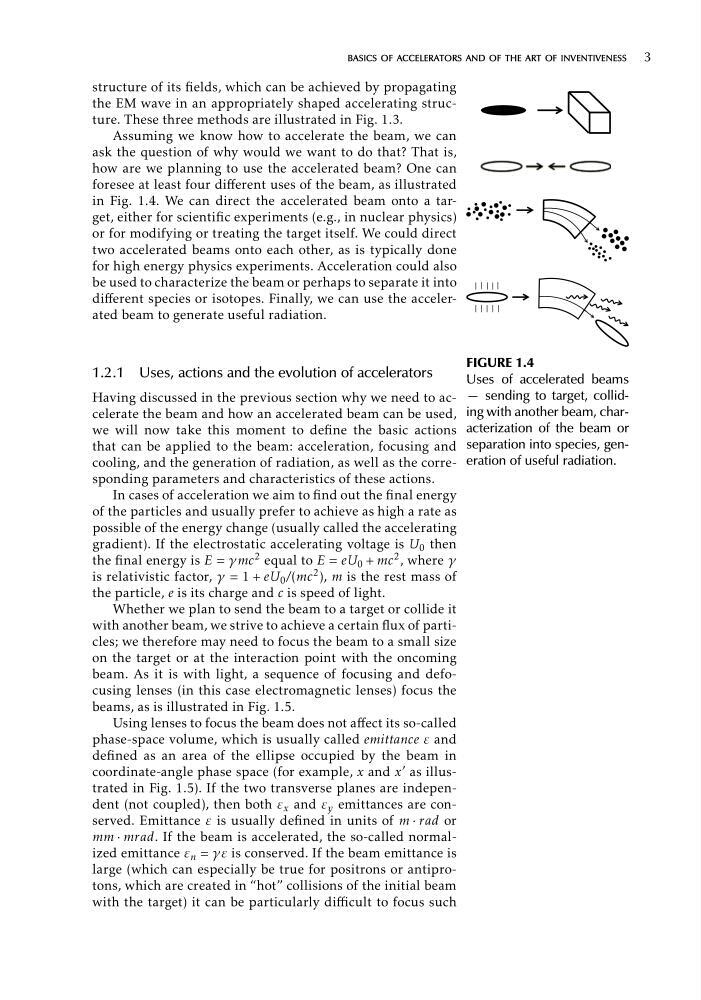
foresee at least four different uses of the beam, as illustrated
in Fig. 1.4. We can direct the accelerated beam onto a target, either for scientific experiments (e.g., in nuclear physics)
or for modifying or treating the target itself. We could direct
two accelerated beams onto each other, as is typically done
for high energy physics experiments. Acceleration could also
be used to characterize the beam or perhaps to separate it into
different species or isotopes. Finally, we can use the accelerated beam to generate useful radiation.
1.2.1 Uses, actions and the evolution of accelerators
Having discussed in the previous section why we need to accelerate the beam and how an accelerated beam can be used,
we will now take this moment to define the basic actions
that can be applied to the beam: acceleration, focusing and
cooling, and the generation of radiation, as well as the corresponding parameters and characteristics of these actions.
In cases of acceleration we aim to find out the final energy
of the particles and usually prefer to achieve as high a rate as
possible of the energy change (usually called the accelerating
gradient). If the electrostatic accelerating voltage is U 0 then
the final energy is E = γmc 2 equal to E = eU 0 + mc 2 , where γ
is relativistic factor, γ = 1 + eU 0 /(mc 2 ), m is the rest mass of
the particle, e is its charge and c is speed of light.
Whether we plan to send the beam to a target or collide it
with another beam, we strive to achieve a certain flux of particles; we therefore may need to focus the beam to a small size
on the target or at the interaction point with the oncoming
beam. As it is with light, a sequence of focusing and defocusing lenses (in this case electromagnetic lenses) focus the
beams, as is illustrated in Fig. 1.5.
Using lenses to focus the beam does not affect its so-called
phase-space volume, which is usually called emittance ε and
defined as an area of the ellipse occupied by the beam in
coordinate-angle phase space (for example, x and x ' as illustrated in Fig. 1.5). If the two transverse planes are independent (not coupled), then both ε x and ε y emittances are conserved. Emittance ε is usually defined in units of m · rad or
mm · mrad. If the beam is accelerated, the so-called normalized emittance ε n = γε is conserved. If the beam emittance is
large (which can especially be true for positrons or antiprotons, which are created in “hot” collisions of the initial beam
with the target) it can be particularly difficult to focus such
FIGURE 1.4
Uses of accelerated beams
— sending to target, colliding with another beam, characterization of the beam or
separation into species, generation of useful radiation.
basics of accelerators and of the art of inventiveness
structure of its fields, which can be achieved by propagating
the EM wave in an appropriately shaped accelerating structure. These three methods are illustrated in Fig. 1.3.
Assuming we know how to accelerate the beam, we can
ask the question of why would we want to do that? That is,
how are we planning to use the accelerated beam? One can
foresee at least four different uses of the beam, as illustrated
in Fig. 1.4. We can direct the accelerated beam onto a target, either for scientific experiments (e.g., in nuclear physics)
or for modifying or treating the target itself. We could direct
two accelerated beams onto each other, as is typically done
for high energy physics experiments. Acceleration could also
be used to characterize the beam or perhaps to separate it into
different species or isotopes. Finally, we can use the accelerated beam to generate useful radiation.
1.2.1 Uses, actions and the evolution of accelerators
Having discussed in the previous section why we need to accelerate the beam and how an accelerated beam can be used,
we will now take this moment to define the basic actions
that can be applied to the beam: acceleration, focusing and
cooling, and the generation of radiation, as well as the corresponding parameters and characteristics of these actions.
In cases of acceleration we aim to find out the final energy
of the particles and usually prefer to achieve as high a rate as
possible of the energy change (usually called the accelerating
gradient). If the electrostatic accelerating voltage is U 0 then
the final energy is E = γmc 2 equal to E = eU 0 + mc 2 , where γ
is relativistic factor, γ = 1 + eU 0 /(mc 2 ), m is the rest mass of
the particle, e is its charge and c is speed of light.
Whether we plan to send the beam to a target or collide it
with another beam, we strive to achieve a certain flux of particles; we therefore may need to focus the beam to a small size
on the target or at the interaction point with the oncoming
beam. As it is with light, a sequence of focusing and defocusing lenses (in this case electromagnetic lenses) focus the
beams, as is illustrated in Fig. 1.5.
Using lenses to focus the beam does not affect its so-called
phase-space volume, which is usually called emittance ε and
defined as an area of the ellipse occupied by the beam in
coordinate-angle phase space (for example, x and x ' as illustrated in Fig. 1.5). If the two transverse planes are independent (not coupled), then both ε x and ε y emittances are conserved. Emittance ε is usually defined in units of m · rad or
mm · mrad. If the beam is accelerated, the so-called normalized emittance ε n = γε is conserved. If the beam emittance is
large (which can especially be true for positrons or antiprotons, which are created in “hot” collisions of the initial beam
with the target) it can be particularly difficult to focus such
FIGURE 1.4
Uses of accelerated beams
— sending to target, colliding with another beam, characterization of the beam or
separation into species, generation of useful radiation.