

2 unifying physics of accelerators, lasers and plasma
Accelerator science demonstrates a rich history of inventions, often inspired by nature itself. We are very often motivated by nature and try to compete with it, not always knowing who invented certain things first — nature or humans.
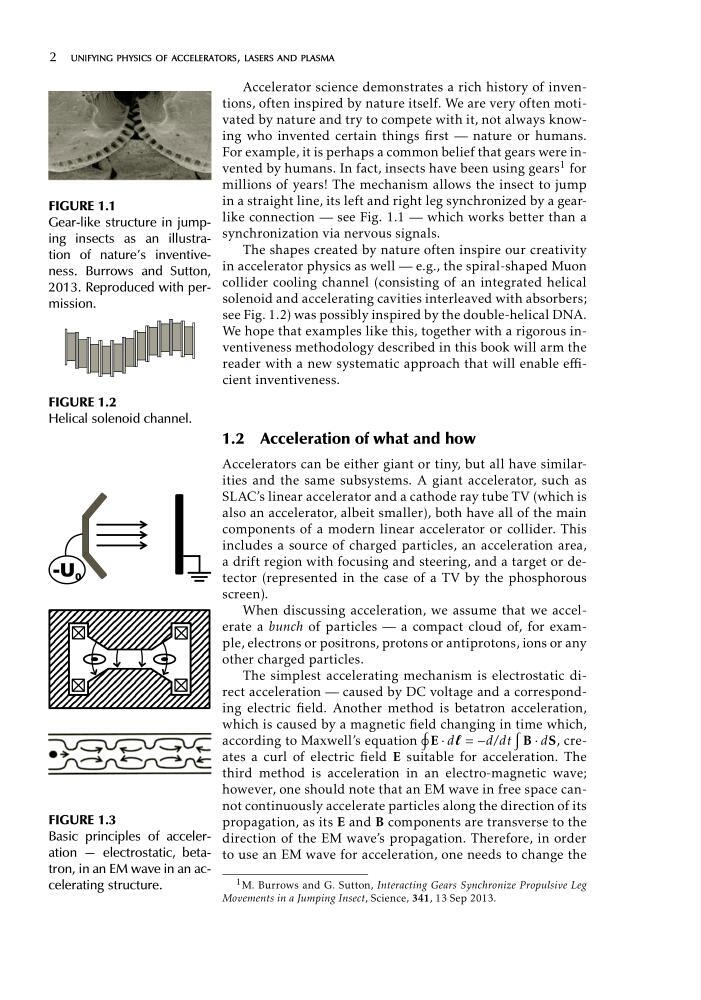
For example, it is perhaps a common belief that gears were invented by humans. In fact, insects have been using gears 1 for
millions of years! The mechanism allows the insect to jump
FIGURE 1.1
in a straight line, its left and right leg synchronized by a gearGear-like structure in jump like connection — see Fig. 1.1 — which works better than a
ing insects as an illustra synchronization via nervous signals.
tion of nature’s inventiveThe shapes created by nature often inspire our creativity
ness. Burrows and Sutton, in accelerator physics as well — e.g., the spiral-shaped Muon
2013.
collider
Reproduced with percooling channel (consisting of an integrated helical
mission.
solenoid and accelerating cavities interleaved with absorbers;
see Fig. 1.2) was possibly inspired by the double-helical DNA.
We hope that examples like this, together with a rigorous inventiveness methodology described in this book will arm the
reader with a new systematic approach that will enable efficient inventiveness.
FIGURE 1.2
Helical solenoid channel.
1.2 Acceleration of what and how
Accelerators can be either giant or tiny, but all have similarities and the same subsystems. A giant accelerator, such as
SLAC’s linear accelerator and a cathode ray tube TV (which is
also an accelerator, albeit smaller), both have all of the main
components of a modern linear accelerator or collider. This
includes a source of charged particles, an acceleration area,
a drift region with focusing and steering, and a target or detector (represented in the case of a TV by the phosphorous
screen).
When discussing acceleration, we assume that we accelerate a bunch of particles — a compact cloud of, for example, electrons or positrons, protons or antiprotons, ions or any
other charged particles.
The simplest accelerating mechanism is electrostatic direct acceleration — caused by DC voltage and a corresponding electric field. Another method is betatron acceleration,
which is caused by a magnetic field changing in time which,
according to Maxwell’s equation E dt = d/dt B dS, creates a curl of electric field E suitable
·
for
−
acceleration.
·
The
third method is acceleration in an electro-magnetic wave;
however, one should note that an EM wave in free space cannot continuously accelerate particles along the direction of its
FIGURE 1.3
propagation, as its E and B components are transverse to the
Basic principles of acceler direction of the EM wave’s propagation. Therefore, in order
ation — electrostatic, beta to use an EM wave for acceleration, one needs to change the
tron, in an EM wave in an accelerating structure.
1 M. Burrows and G. Sutton, Interacting Gears Synchronize Propulsive Leg
Movements in a Jumping Insect, Science, 341, 13 Sep 2013.
Accelerator science demonstrates a rich history of inventions, often inspired by nature itself. We are very often motivated by nature and try to compete with it, not always knowing who invented certain things first — nature or humans.
For example, it is perhaps a common belief that gears were invented by humans. In fact, insects have been using gears 1 for
millions of years! The mechanism allows the insect to jump
FIGURE 1.1
in a straight line, its left and right leg synchronized by a gearGear-like structure in jump like connection — see Fig. 1.1 — which works better than a
ing insects as an illustra synchronization via nervous signals.
tion of nature’s inventiveThe shapes created by nature often inspire our creativity
ness. Burrows and Sutton, in accelerator physics as well — e.g., the spiral-shaped Muon
2013.
collider
Reproduced with percooling channel (consisting of an integrated helical
mission.
solenoid and accelerating cavities interleaved with absorbers;
see Fig. 1.2) was possibly inspired by the double-helical DNA.
We hope that examples like this, together with a rigorous inventiveness methodology described in this book will arm the
reader with a new systematic approach that will enable efficient inventiveness.
FIGURE 1.2
Helical solenoid channel.
1.2 Acceleration of what and how
Accelerators can be either giant or tiny, but all have similarities and the same subsystems. A giant accelerator, such as
SLAC’s linear accelerator and a cathode ray tube TV (which is
also an accelerator, albeit smaller), both have all of the main
components of a modern linear accelerator or collider. This
includes a source of charged particles, an acceleration area,
a drift region with focusing and steering, and a target or detector (represented in the case of a TV by the phosphorous
screen).
When discussing acceleration, we assume that we accelerate a bunch of particles — a compact cloud of, for example, electrons or positrons, protons or antiprotons, ions or any
other charged particles.
The simplest accelerating mechanism is electrostatic direct acceleration — caused by DC voltage and a corresponding electric field. Another method is betatron acceleration,
which is caused by a magnetic field changing in time which,
according to Maxwell’s equation E dt = d/dt B dS, creates a curl of electric field E suitable
·
for
−
acceleration.
·
The
third method is acceleration in an electro-magnetic wave;
however, one should note that an EM wave in free space cannot continuously accelerate particles along the direction of its
FIGURE 1.3
propagation, as its E and B components are transverse to the
Basic principles of acceler direction of the EM wave’s propagation. Therefore, in order
ation — electrostatic, beta to use an EM wave for acceleration, one needs to change the
tron, in an EM wave in an accelerating structure.
1 M. Burrows and G. Sutton, Interacting Gears Synchronize Propulsive Leg
Movements in a Jumping Insect, Science, 341, 13 Sep 2013.