

234 unifying physics of accelerators, lasers and plasma
technological innovation have since then been analyzed, criticized, and a new model has been developed.
The contradiction between these linear models and practice can be illustrated via the example of accelerator science
and technology. The invention of “strong focusing” in the
1950s was a revolutionary change in accelerator technology.
It enabled numerous applications. This invention may have
come about as a result of a pure fundamental interest — however, it was developed as a result of the pursuit of a certain
concrete goal, and was made possible due to certain technologies available at that time.
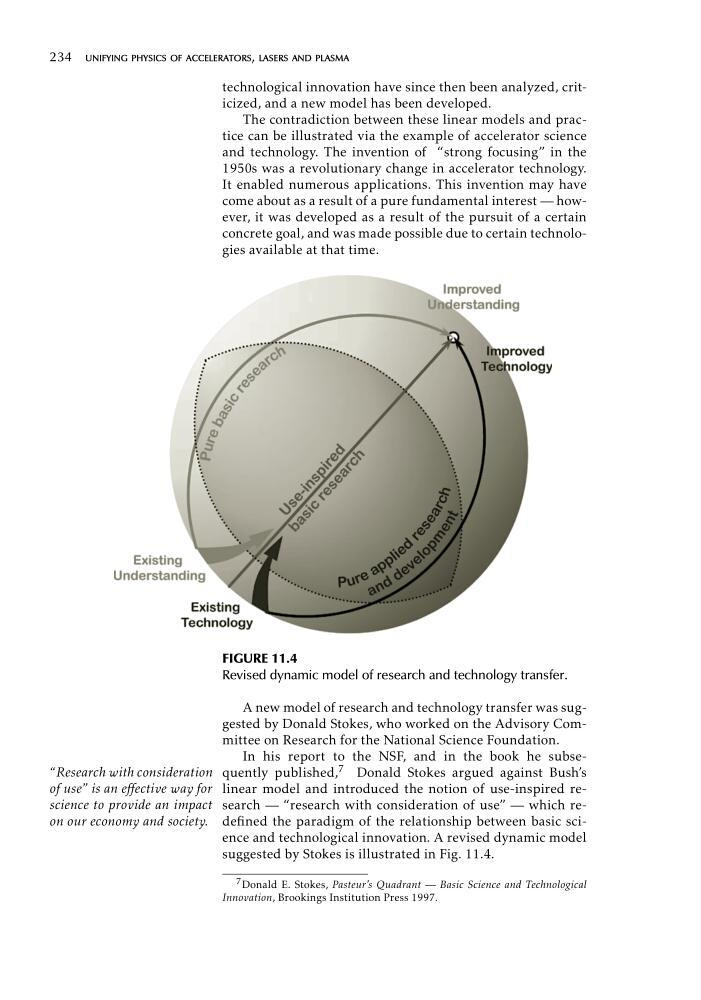
FIGURE 11.4
Revised dynamic model of research and technology transfer.
A new model of research and technology transfer was suggested by Donald Stokes, who worked on the Advisory Committee on Research for the National Science Foundation.
In his report to the NSF, and in the book he subse“Research with consideration quently published, 7 Donald Stokes argued against Bush’s
of use” is an effective way for linear model and introduced the notion of use-inspired rescience to provide an impact search — “research with consideration of use” — which reon our economy and society. defined the paradigm of the relationship between basic science and technological innovation. A revised dynamic model
suggested by Stokes is illustrated in Fig. 11.4.
7 Donald E. Stokes, Pasteur’s Quadrant — Basic Science and Technological
Innovation, Brookings Institution Press 1997.
technological innovation have since then been analyzed, criticized, and a new model has been developed.
The contradiction between these linear models and practice can be illustrated via the example of accelerator science
and technology. The invention of “strong focusing” in the
1950s was a revolutionary change in accelerator technology.
It enabled numerous applications. This invention may have
come about as a result of a pure fundamental interest — however, it was developed as a result of the pursuit of a certain
concrete goal, and was made possible due to certain technologies available at that time.
FIGURE 11.4
Revised dynamic model of research and technology transfer.
A new model of research and technology transfer was suggested by Donald Stokes, who worked on the Advisory Committee on Research for the National Science Foundation.
In his report to the NSF, and in the book he subse“Research with consideration quently published, 7 Donald Stokes argued against Bush’s
of use” is an effective way for linear model and introduced the notion of use-inspired rescience to provide an impact search — “research with consideration of use” — which reon our economy and society. defined the paradigm of the relationship between basic science and technological innovation. A revised dynamic model
suggested by Stokes is illustrated in Fig. 11.4.
7 Donald E. Stokes, Pasteur’s Quadrant — Basic Science and Technological
Innovation, Brookings Institution Press 1997.