

inventions and innovations in science 235
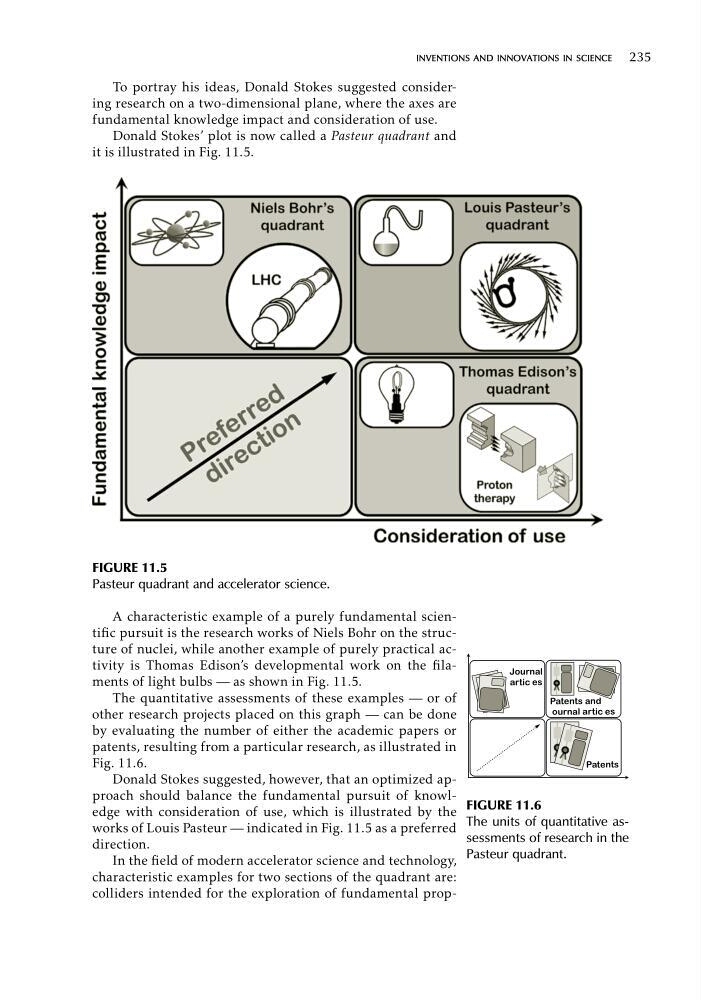
To portray his ideas, Donald Stokes suggested considering research on a two-dimensional plane, where the axes are
fundamental knowledge impact and consideration of use.
Donald Stokes’ plot is now called a Pasteur quadrant and
it is illustrated in Fig. 11.5.
FIGURE 11.5
Pasteur quadrant and accelerator science.
A characteristic example of a purely fundamental scientific pursuit is the research works of Niels Bohr on the structure of nuclei, while another example of purely practical activity is Thomas Edison’s developmental work on the filaments of light bulbs — as shown in Fig. 11.5.
The quantitative assessments of these examples — or of
other research projects placed on this graph — can be done
by evaluating the number of either the academic papers or
patents, resulting from a particular research, as illustrated in
Fig. 11.6.
Donald Stokes suggested, however, that an optimized approach should balance the fundamental pursuit of knowledge with consideration of use, which is illustrated by the F
works of Louis Pasteur — indicated in Fig. 11.5 as a preferred
direction.
s
In the field of modern accelerator science and technology,
characteristic examples for two sections of the quadrant are:
colliders intended for the exploration of fundamental propIGURE 11.6
The units of quantitative asessments of research in the
Pasteur quadrant.
To portray his ideas, Donald Stokes suggested considering research on a two-dimensional plane, where the axes are
fundamental knowledge impact and consideration of use.
Donald Stokes’ plot is now called a Pasteur quadrant and
it is illustrated in Fig. 11.5.
FIGURE 11.5
Pasteur quadrant and accelerator science.
A characteristic example of a purely fundamental scientific pursuit is the research works of Niels Bohr on the structure of nuclei, while another example of purely practical activity is Thomas Edison’s developmental work on the filaments of light bulbs — as shown in Fig. 11.5.
The quantitative assessments of these examples — or of
other research projects placed on this graph — can be done
by evaluating the number of either the academic papers or
patents, resulting from a particular research, as illustrated in
Fig. 11.6.
Donald Stokes suggested, however, that an optimized approach should balance the fundamental pursuit of knowledge with consideration of use, which is illustrated by the F
works of Louis Pasteur — indicated in Fig. 11.5 as a preferred
direction.
s
In the field of modern accelerator science and technology,
characteristic examples for two sections of the quadrant are:
colliders intended for the exploration of fundamental propIGURE 11.6
The units of quantitative asessments of research in the
Pasteur quadrant.