

inventions and innovations in science 233
11.4 Aiming for Pasteur quadrant
Science has always been a driver for the economy. This is a
commonly accepted statement — however, the mechanisms
of its impact are complicated. Still, their analysis is necessary,
and not only from a philosophical point of view, but also in
order to optimize the research priorities and define the strategies for technological innovation.
One of the attempts to analyze the model for research and
technology transfer was done by Vannevar Bush, who, during
World War II, was instrumental in reorganizing the research
and science community according to the needs of that difficult time. Vannevar Bush’s 1945 report 6 has since defined
post-war scientific policy in the United States and in many
other countries (supposedly, for decades to come).
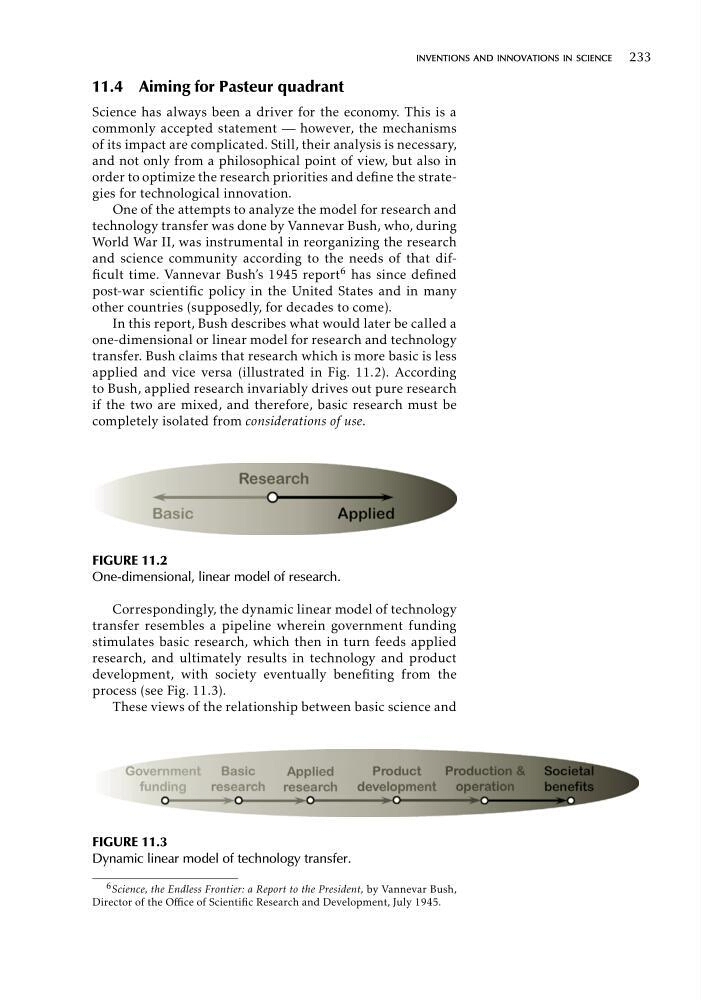
In this report, Bush describes what would later be called a
one-dimensional or linear model for research and technology
transfer. Bush claims that research which is more basic is less
applied and vice versa (illustrated in Fig. 11.2). According
to Bush, applied research invariably drives out pure research
if the two are mixed, and therefore, basic research must be
completely isolated from considerations of use.
FIGURE 11.2
One-dimensional, linear model of research.
Correspondingly, the dynamic linear model of technology
transfer resembles a pipeline wherein government funding
stimulates basic research, which then in turn feeds applied
research, and ultimately results in technology and product
development, with society eventually benefiting from the
process (see Fig. 11.3).
These views of the relationship between basic science and
FIGURE 11.3
Dynamic linear model of technology transfer.
6 Science, the Endless Frontier: a Report to the President, by Vannevar Bush,
Director of the Office of Scientific Research and Development, July 1945.
11.4 Aiming for Pasteur quadrant
Science has always been a driver for the economy. This is a
commonly accepted statement — however, the mechanisms
of its impact are complicated. Still, their analysis is necessary,
and not only from a philosophical point of view, but also in
order to optimize the research priorities and define the strategies for technological innovation.
One of the attempts to analyze the model for research and
technology transfer was done by Vannevar Bush, who, during
World War II, was instrumental in reorganizing the research
and science community according to the needs of that difficult time. Vannevar Bush’s 1945 report 6 has since defined
post-war scientific policy in the United States and in many
other countries (supposedly, for decades to come).
In this report, Bush describes what would later be called a
one-dimensional or linear model for research and technology
transfer. Bush claims that research which is more basic is less
applied and vice versa (illustrated in Fig. 11.2). According
to Bush, applied research invariably drives out pure research
if the two are mixed, and therefore, basic research must be
completely isolated from considerations of use.
FIGURE 11.2
One-dimensional, linear model of research.
Correspondingly, the dynamic linear model of technology
transfer resembles a pipeline wherein government funding
stimulates basic research, which then in turn feeds applied
research, and ultimately results in technology and product
development, with society eventually benefiting from the
process (see Fig. 11.3).
These views of the relationship between basic science and
FIGURE 11.3
Dynamic linear model of technology transfer.
6 Science, the Endless Frontier: a Report to the President, by Vannevar Bush,
Director of the Office of Scientific Research and Development, July 1945.