

232 unifying physics of accelerators, lasers and plasma
an increase of resolution in optical microscopes by a factor of
around five. It does this by applying two pulses of laser light
to an object under study — an excitation pulse and, shortly
afterwards, a de-excitation pulse.
A fluorescent dye introduced into the object is first excited
and then depleted with the second pulse of an appropriately
different wavelength. The key feature of this technique is the
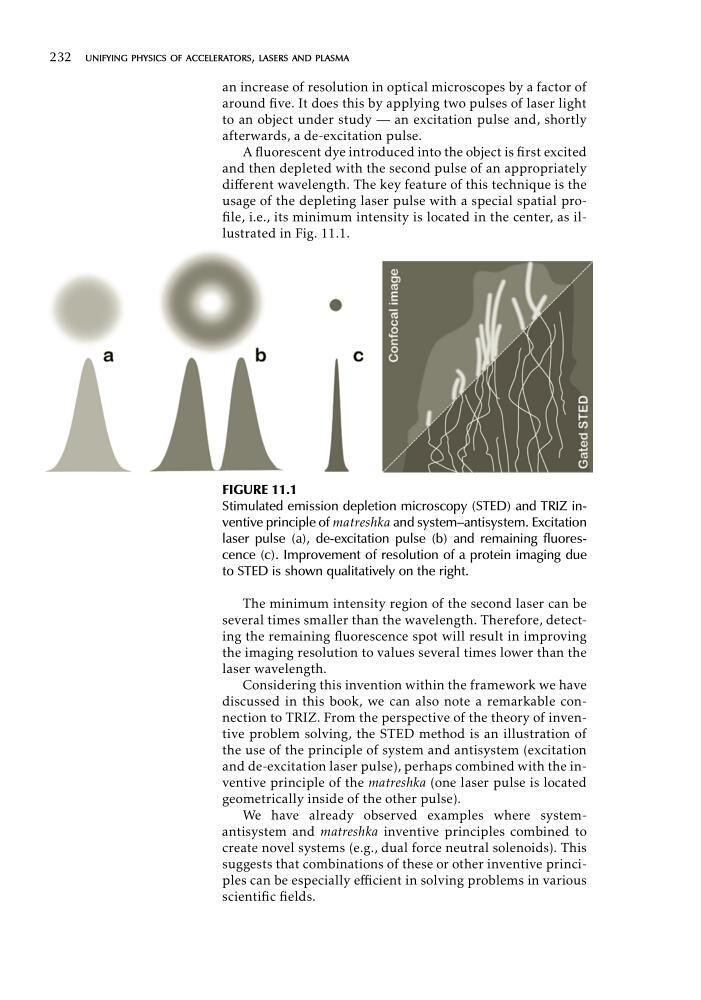
usage of the depleting laser pulse with a special spatial profile, i.e., its minimum intensity is located in the center, as illustrated in Fig. 11.1.
FIGURE 11.1
Stimulated emission depletion microscopy (STED) and TRIZ inventive principle of matreshka and system–antisystem. Excitation
laser pulse (a), de-excitation pulse (b) and remaining fluorescence (c). Improvement of resolution of a protein imaging due
to STED is shown qualitatively on the right.
The minimum intensity region of the second laser can be
several times smaller than the wavelength. Therefore, detecting the remaining fluorescence spot will result in improving
the imaging resolution to values several times lower than the
laser wavelength.
Considering this invention within the framework we have
discussed in this book, we can also note a remarkable connection to TRIZ. From the perspective of the theory of inventive problem solving, the STED method is an illustration of
the use of the principle of system and antisystem (excitation
and de-excitation laser pulse), perhaps combined with the inventive principle of the matreshka (one laser pulse is located
geometrically inside of the other pulse).
We have already observed examples where systemantisystem and matreshka inventive principles combined to
create novel systems (e.g., dual force neutral solenoids). This
suggests that combinations of these or other inventive principles can be especially efficient in solving problems in various
scientific fields.
an increase of resolution in optical microscopes by a factor of
around five. It does this by applying two pulses of laser light
to an object under study — an excitation pulse and, shortly
afterwards, a de-excitation pulse.
A fluorescent dye introduced into the object is first excited
and then depleted with the second pulse of an appropriately
different wavelength. The key feature of this technique is the
usage of the depleting laser pulse with a special spatial profile, i.e., its minimum intensity is located in the center, as illustrated in Fig. 11.1.
FIGURE 11.1
Stimulated emission depletion microscopy (STED) and TRIZ inventive principle of matreshka and system–antisystem. Excitation
laser pulse (a), de-excitation pulse (b) and remaining fluorescence (c). Improvement of resolution of a protein imaging due
to STED is shown qualitatively on the right.
The minimum intensity region of the second laser can be
several times smaller than the wavelength. Therefore, detecting the remaining fluorescence spot will result in improving
the imaging resolution to values several times lower than the
laser wavelength.
Considering this invention within the framework we have
discussed in this book, we can also note a remarkable connection to TRIZ. From the perspective of the theory of inventive problem solving, the STED method is an illustration of
the use of the principle of system and antisystem (excitation
and de-excitation laser pulse), perhaps combined with the inventive principle of the matreshka (one laser pulse is located
geometrically inside of the other pulse).
We have already observed examples where systemantisystem and matreshka inventive principles combined to
create novel systems (e.g., dual force neutral solenoids). This
suggests that combinations of these or other inventive principles can be especially efficient in solving problems in various
scientific fields.