

advanced beam manipulation, cooling, damping and stability 219
izontal second-order dispersion. Second-order dispersion is
produced by FD quadrupoles as well as FD sextupoles, while
the latter produce just half as much of second-order dispersion as the FD quadrupole. Therefore, if we tune the FD horizontal sextupole to cancel the FD chromaticity, half of the
uncompensated second-order dispersion will remain.
A solution to this issue consists of allowing the betamatching section (shown schematically in the beginning of
the beamline in Fig. 10.44) to produce as much horizontal
chromaticity as the final doublet, so that the horizontal FD
sextupoles will run twice as strong and simultaneously cancel the second-order dispersion and horizontal chromaticity.
Geometric aberrations to the final doubled sextupoles are
cancelled in this design by two more sextupoles placed in
phase with the FD sextupoles and upstream from the bend.
The final focus system can be reversed and the IP considered as an entrance point that captures a strongly diverging
beam, such as the one coming out of the laser plasma accelerating bubble. This beam will also have an energy spread and
associated chromaticity effects in the capture optics. A very
small but divergent beam corresponds to a small beta function at the origin; therefore the chromatic effect for such a
beam should be significant. The local chromaticity correction
approach can therefore be applicable also to the laser-plasma
capture optics.
10.6.2 Interaction region corrections
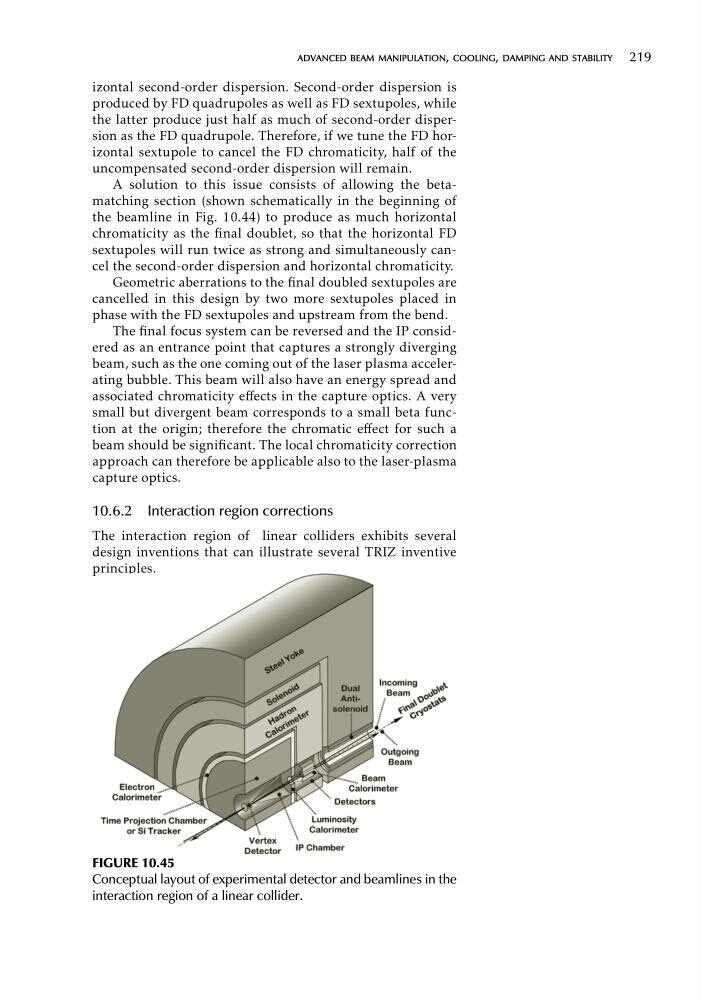
The interaction region of linear colliders exhibits several
design inventions that can illustrate several TRIZ inventive
FIGURE 10.45
Conceptual layout of experimental detector and beamlines in the
interaction region of a linear collider.
principles.
izontal second-order dispersion. Second-order dispersion is
produced by FD quadrupoles as well as FD sextupoles, while
the latter produce just half as much of second-order dispersion as the FD quadrupole. Therefore, if we tune the FD horizontal sextupole to cancel the FD chromaticity, half of the
uncompensated second-order dispersion will remain.
A solution to this issue consists of allowing the betamatching section (shown schematically in the beginning of
the beamline in Fig. 10.44) to produce as much horizontal
chromaticity as the final doublet, so that the horizontal FD
sextupoles will run twice as strong and simultaneously cancel the second-order dispersion and horizontal chromaticity.
Geometric aberrations to the final doubled sextupoles are
cancelled in this design by two more sextupoles placed in
phase with the FD sextupoles and upstream from the bend.
The final focus system can be reversed and the IP considered as an entrance point that captures a strongly diverging
beam, such as the one coming out of the laser plasma accelerating bubble. This beam will also have an energy spread and
associated chromaticity effects in the capture optics. A very
small but divergent beam corresponds to a small beta function at the origin; therefore the chromatic effect for such a
beam should be significant. The local chromaticity correction
approach can therefore be applicable also to the laser-plasma
capture optics.
10.6.2 Interaction region corrections
The interaction region of linear colliders exhibits several
design inventions that can illustrate several TRIZ inventive
FIGURE 10.45
Conceptual layout of experimental detector and beamlines in the
interaction region of a linear collider.
principles.