

218 unifying physics of accelerators, lasers and plasma
they increase the beam size at IP by orders of magnitude) and
need to be compensated.
In a traditional final focus design, the chromaticity correction is performed in dedicated optical sections upstream
from IP. In these sections, sextuple magnets are installed
in dispersion sections and create some chromaticity there,
which will then propagate to the FD, where they will cancel
the FD chromaticity.
The performance of such an FF with non-local chromaticity compensation is often limited, as various additional disturbances (e.g., the SR-generated energy spread), which occur
between the chromatic correction section and the FD, can alter the cancellation conditions.
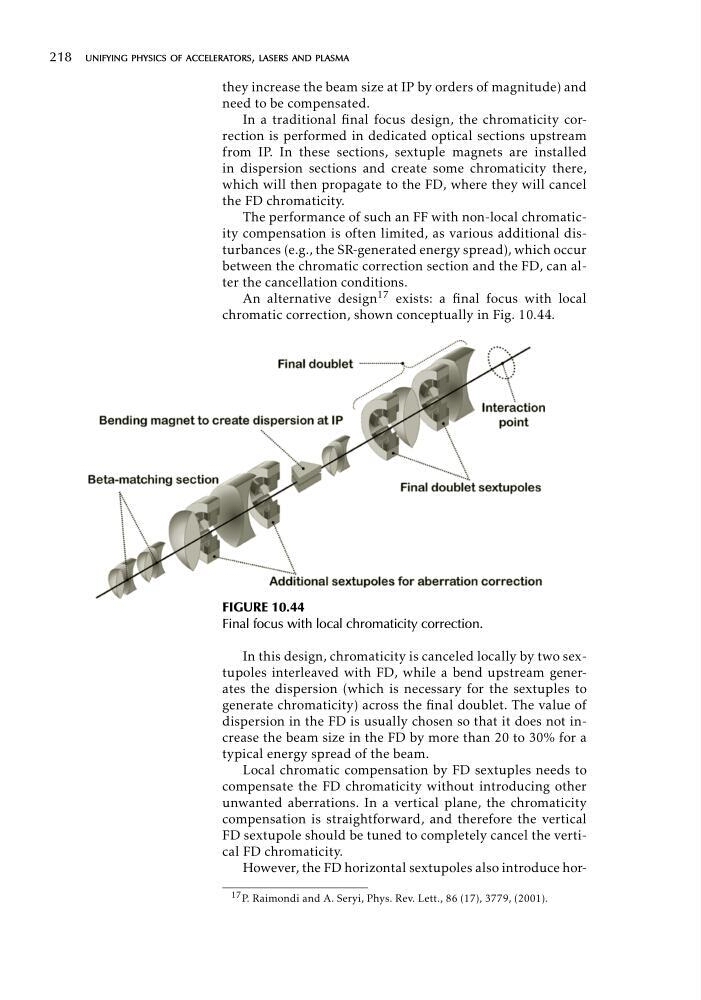
An alternative design 17 exists: a final focus with local
chromatic correction, shown conceptually in Fig. 10.44.
FIGURE 10.44
Final focus with local chromaticity correction.
In this design, chromaticity is canceled locally by two sextupoles interleaved with FD, while a bend upstream generates the dispersion (which is necessary for the sextuples to
generate chromaticity) across the final doublet. The value of
dispersion in the FD is usually chosen so that it does not increase the beam size in the FD by more than 20 to 30% for a
typical energy spread of the beam.
Local chromatic compensation by FD sextuples needs to
compensate the FD chromaticity without introducing other
unwanted aberrations. In a vertical plane, the chromaticity
compensation is straightforward, and therefore the vertical
FD sextupole should be tuned to completely cancel the vertical FD chromaticity.
However, the FD horizontal sextupoles also introduce hor17 P. Raimondi and A. Seryi, Phys. Rev. Lett., 86 (17), 3779, (2001).
they increase the beam size at IP by orders of magnitude) and
need to be compensated.
In a traditional final focus design, the chromaticity correction is performed in dedicated optical sections upstream
from IP. In these sections, sextuple magnets are installed
in dispersion sections and create some chromaticity there,
which will then propagate to the FD, where they will cancel
the FD chromaticity.
The performance of such an FF with non-local chromaticity compensation is often limited, as various additional disturbances (e.g., the SR-generated energy spread), which occur
between the chromatic correction section and the FD, can alter the cancellation conditions.
An alternative design 17 exists: a final focus with local
chromatic correction, shown conceptually in Fig. 10.44.
FIGURE 10.44
Final focus with local chromaticity correction.
In this design, chromaticity is canceled locally by two sextupoles interleaved with FD, while a bend upstream generates the dispersion (which is necessary for the sextuples to
generate chromaticity) across the final doublet. The value of
dispersion in the FD is usually chosen so that it does not increase the beam size in the FD by more than 20 to 30% for a
typical energy spread of the beam.
Local chromatic compensation by FD sextuples needs to
compensate the FD chromaticity without introducing other
unwanted aberrations. In a vertical plane, the chromaticity
compensation is straightforward, and therefore the vertical
FD sextupole should be tuned to completely cancel the vertical FD chromaticity.
However, the FD horizontal sextupoles also introduce hor17 P. Raimondi and A. Seryi, Phys. Rev. Lett., 86 (17), 3779, (2001).