

206 unifying physics of accelerators, lasers and plasma
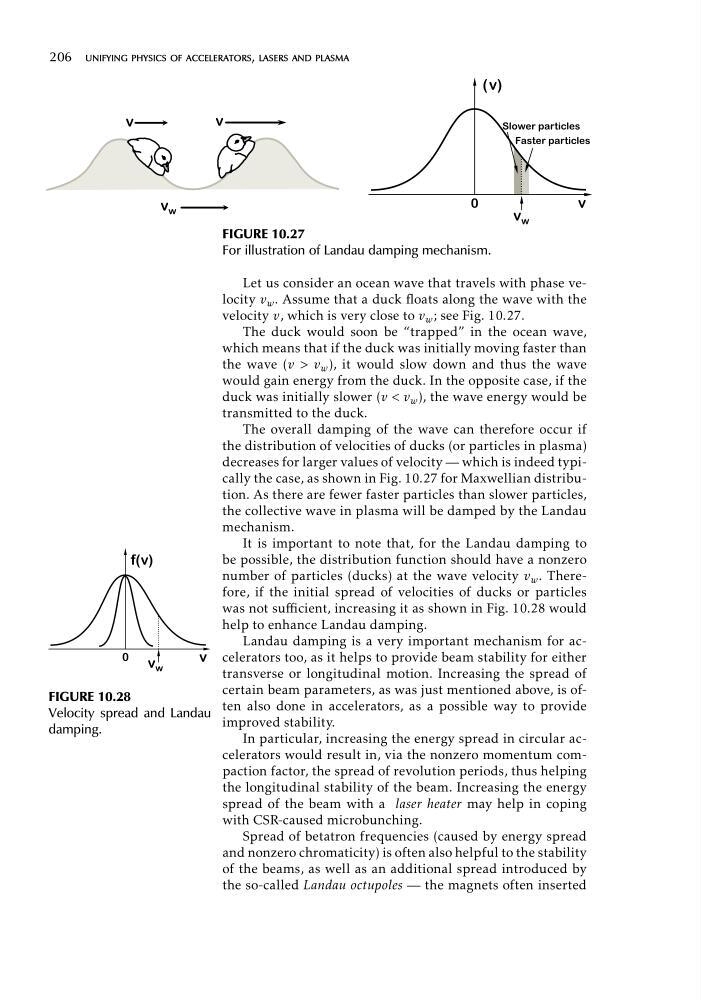
FIGURE 10.27
IY
Y
Y Z
FIGURE 10.28
Velocity spread and Landau
damping.
For illustration of Landau damping mechanism.
Let us consider an ocean wave that travels with phase velocity v . Assume that a duck floats along the wave with the
w
velocity v, which is very close to v ; see Fig. 10.27.
w
The duck would soon be “trapped” in the ocean wave,
which means that if the duck was initially moving faster than
the wave (v > v ), it would slow down and thus the wave
w
would gain energy from the duck. In the opposite case, if the
duck was initially slower (v < v ), the wave energy would be
w
transmitted to the duck.
The overall damping of the wave can therefore occur if
the distribution of velocities of ducks (or particles in plasma)
decreases for larger values of velocity — which is indeed typically the case, as shown in Fig. 10.27 for Maxwellian distribution. As there are fewer faster particles than slower particles,
the collective wave in plasma will be damped by the Landau
mechanism.
It is important to note that, for the Landau damping to
be possible, the distribution function should have a nonzero
number of particles (ducks) at the wave velocity v . Therew
fore, if the initial spread of velocities of ducks or particles
was not sufficient, increasing it as shown in Fig. 10.28 would
help to enhance Landau damping.
Landau damping is a very important mechanism for accelerators too, as it helps to provide beam stability for either
transverse or longitudinal motion. Increasing the spread of
certain beam parameters, as was just mentioned above, is often also done in accelerators, as a possible way to provide
improved stability.
In particular, increasing the energy spread in circular accelerators would result in, via the nonzero momentum compaction factor, the spread of revolution periods, thus helping
the longitudinal stability of the beam. Increasing the energy
spread of the beam with a laser heater may help in coping
with CSR-caused microbunching.
Spread of betatron frequencies (caused by energy spread
and nonzero chromaticity) is often also helpful to the stability
of the beams, as well as an additional spread introduced by
the so-called Landau octupoles — the magnets often inserted
FIGURE 10.27
IY
Y
Y Z
FIGURE 10.28
Velocity spread and Landau
damping.
For illustration of Landau damping mechanism.
Let us consider an ocean wave that travels with phase velocity v . Assume that a duck floats along the wave with the
w
velocity v, which is very close to v ; see Fig. 10.27.
w
The duck would soon be “trapped” in the ocean wave,
which means that if the duck was initially moving faster than
the wave (v > v ), it would slow down and thus the wave
w
would gain energy from the duck. In the opposite case, if the
duck was initially slower (v < v ), the wave energy would be
w
transmitted to the duck.
The overall damping of the wave can therefore occur if
the distribution of velocities of ducks (or particles in plasma)
decreases for larger values of velocity — which is indeed typically the case, as shown in Fig. 10.27 for Maxwellian distribution. As there are fewer faster particles than slower particles,
the collective wave in plasma will be damped by the Landau
mechanism.
It is important to note that, for the Landau damping to
be possible, the distribution function should have a nonzero
number of particles (ducks) at the wave velocity v . Therew
fore, if the initial spread of velocities of ducks or particles
was not sufficient, increasing it as shown in Fig. 10.28 would
help to enhance Landau damping.
Landau damping is a very important mechanism for accelerators too, as it helps to provide beam stability for either
transverse or longitudinal motion. Increasing the spread of
certain beam parameters, as was just mentioned above, is often also done in accelerators, as a possible way to provide
improved stability.
In particular, increasing the energy spread in circular accelerators would result in, via the nonzero momentum compaction factor, the spread of revolution periods, thus helping
the longitudinal stability of the beam. Increasing the energy
spread of the beam with a laser heater may help in coping
with CSR-caused microbunching.
Spread of betatron frequencies (caused by energy spread
and nonzero chromaticity) is often also helpful to the stability
of the beams, as well as an additional spread introduced by
the so-called Landau octupoles — the magnets often inserted