

advanced beam manipulation, cooling, damping and stability 205
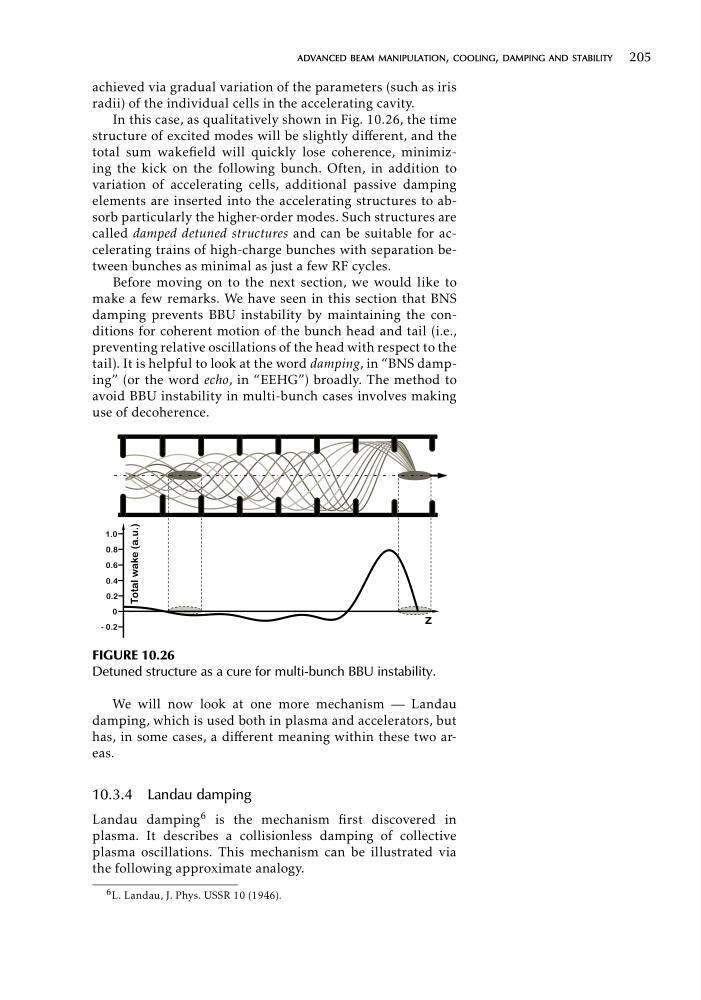
achieved via gradual variation of the parameters (such as iris
radii) of the individual cells in the accelerating cavity.
In this case, as qualitatively shown in Fig. 10.26, the time
structure of excited modes will be slightly different, and the
total sum wakefield will quickly lose coherence, minimizing the kick on the following bunch. Often, in addition to
variation of accelerating cells, additional passive damping
elements are inserted into the accelerating structures to absorb particularly the higher-order modes. Such structures are
called damped detuned structures and can be suitable for accelerating trains of high-charge bunches with separation between bunches as minimal as just a few RF cycles.
Before moving on to the next section, we would like to
make a few remarks. We have seen in this section that BNS
damping prevents BBU instability by maintaining the conditions for coherent motion of the bunch head and tail (i.e.,
preventing relative oscillations of the head with respect to the
tail). It is helpful to look at the word damping, in “BNS damping” (or the word echo, in “EEHG”) broadly. The method to
avoid BBU instability in multi-bunch cases involves making
use of decoherence.
7RWDOZDNHDX
]
FIGURE 10.26
Detuned structure as a cure for multi-bunch BBU instability.
We will now look at one more mechanism — Landau
damping, which is used both in plasma and accelerators, but
has, in some cases, a different meaning within these two areas.
10.3.4 Landau damping
Landau damping 6 is the mechanism first discovered in
plasma. It describes a collisionless damping of collective
plasma oscillations. This mechanism can be illustrated via
the following approximate analogy.
6 L. Landau, J. Phys. USSR 10 (1946).
achieved via gradual variation of the parameters (such as iris
radii) of the individual cells in the accelerating cavity.
In this case, as qualitatively shown in Fig. 10.26, the time
structure of excited modes will be slightly different, and the
total sum wakefield will quickly lose coherence, minimizing the kick on the following bunch. Often, in addition to
variation of accelerating cells, additional passive damping
elements are inserted into the accelerating structures to absorb particularly the higher-order modes. Such structures are
called damped detuned structures and can be suitable for accelerating trains of high-charge bunches with separation between bunches as minimal as just a few RF cycles.
Before moving on to the next section, we would like to
make a few remarks. We have seen in this section that BNS
damping prevents BBU instability by maintaining the conditions for coherent motion of the bunch head and tail (i.e.,
preventing relative oscillations of the head with respect to the
tail). It is helpful to look at the word damping, in “BNS damping” (or the word echo, in “EEHG”) broadly. The method to
avoid BBU instability in multi-bunch cases involves making
use of decoherence.
7RWDOZDNHDX
]
FIGURE 10.26
Detuned structure as a cure for multi-bunch BBU instability.
We will now look at one more mechanism — Landau
damping, which is used both in plasma and accelerators, but
has, in some cases, a different meaning within these two areas.
10.3.4 Landau damping
Landau damping 6 is the mechanism first discovered in
plasma. It describes a collisionless damping of collective
plasma oscillations. This mechanism can be illustrated via
the following approximate analogy.
6 L. Landau, J. Phys. USSR 10 (1946).