

204 unifying physics of accelerators, lasers and plasma
electromagnetic fields — wakefields — that can act back on
the bunch itself.
In the RF accelerating structure, these fields can build up
resonantly and disrupt the bunch itself. This is called the
beam break-up (BBU) instability and it can happen either for
a single bunch or in a multi-bunch case.
The single-beam break-up instability is illustrated in
Fig. 10.24. The cure for the single-bunch BBU is called BNS
damping, according to the names of its creators. 5
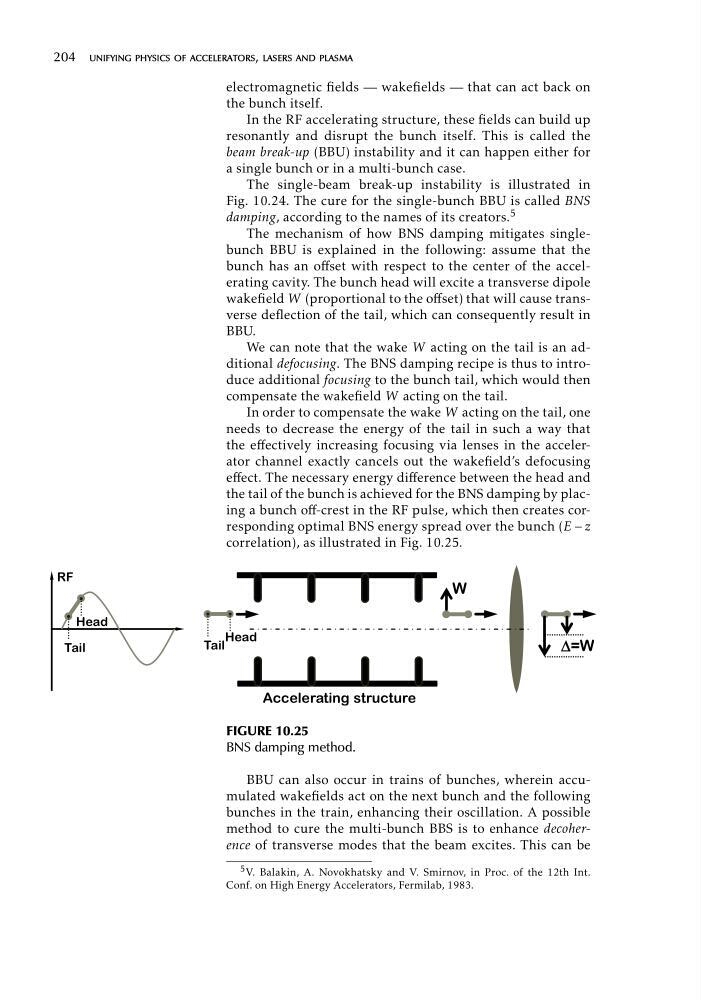
The mechanism of how BNS damping mitigates singlebunch BBU is explained in the following: assume that the
bunch has an offset with respect to the center of the accelerating cavity. The bunch head will excite a transverse dipole
wakefield W (proportional to the offset) that will cause transverse deflection of the tail, which can consequently result in
BBU.
We can note that the wake W acting on the tail is an additional defocusing. The BNS damping recipe is thus to introduce additional focusing to the bunch tail, which would then
compensate the wakefield W acting on the tail.
In order to compensate the wake W acting on the tail, one
needs to decrease the energy of the tail in such a way that
the effectively increasing focusing via lenses in the accelerator channel exactly cancels out the wakefield’s defocusing
effect. The necessary energy difference between the head and
the tail of the bunch is achieved for the BNS damping by placing a bunch off-crest in the RF pulse, which then creates corresponding optimal BNS energy spread over the bunch (E − z
correlation), as illustrated in Fig. 10.25.
FIGURE 10.25
BNS damping method.
BBU can also occur in trains of bunches, wherein accumulated wakefields act on the next bunch and the following
bunches in the train, enhancing their oscillation. A possible
method to cure the multi-bunch BBS is to enhance decoherence of transverse modes that the beam excites. This can be
5 V. Balakin, A. Novokhatsky and V. Smirnov, in Proc. of the 12th Int.
Conf. on High Energy Accelerators, Fermilab, 1983.
7DLO
+HDG
$FFHOHUDWLQJVWUXFWXUH
7DLO
+HDG
5)
:
:
electromagnetic fields — wakefields — that can act back on
the bunch itself.
In the RF accelerating structure, these fields can build up
resonantly and disrupt the bunch itself. This is called the
beam break-up (BBU) instability and it can happen either for
a single bunch or in a multi-bunch case.
The single-beam break-up instability is illustrated in
Fig. 10.24. The cure for the single-bunch BBU is called BNS
damping, according to the names of its creators. 5
The mechanism of how BNS damping mitigates singlebunch BBU is explained in the following: assume that the
bunch has an offset with respect to the center of the accelerating cavity. The bunch head will excite a transverse dipole
wakefield W (proportional to the offset) that will cause transverse deflection of the tail, which can consequently result in
BBU.
We can note that the wake W acting on the tail is an additional defocusing. The BNS damping recipe is thus to introduce additional focusing to the bunch tail, which would then
compensate the wakefield W acting on the tail.
In order to compensate the wake W acting on the tail, one
needs to decrease the energy of the tail in such a way that
the effectively increasing focusing via lenses in the accelerator channel exactly cancels out the wakefield’s defocusing
effect. The necessary energy difference between the head and
the tail of the bunch is achieved for the BNS damping by placing a bunch off-crest in the RF pulse, which then creates corresponding optimal BNS energy spread over the bunch (E − z
correlation), as illustrated in Fig. 10.25.
FIGURE 10.25
BNS damping method.
BBU can also occur in trains of bunches, wherein accumulated wakefields act on the next bunch and the following
bunches in the train, enhancing their oscillation. A possible
method to cure the multi-bunch BBS is to enhance decoherence of transverse modes that the beam excites. This can be
5 V. Balakin, A. Novokhatsky and V. Smirnov, in Proc. of the 12th Int.
Conf. on High Energy Accelerators, Fermilab, 1983.
7DLO
+HDG
$FFHOHUDWLQJVWUXFWXUH
7DLO
+HDG
5)
:
: