

advanced beam manipulation, cooling, damping and stability 203
A low-disruption parameter D « 1 means that the bunch
acts as a thin lens. Its high values (D » 1) link to the instance
when particles oscillate in the field of the opposite colliding
bunch. The number of oscillations is approximately equal to
.
D/(2π) and if D is around or bigger than ∼ 20, there will be
a couple or more oscillations during collision.
Imagine now that the beams had small transverse offsets
before the collision. The beams would attract each other and
start to oscillate. As the collision developed further, the new
portions of the beam would already have larger initial displacements. The oscillations would grow in an unstable manner, limited only by the finite length of the bunch.
An example of beam–beam collisions with D y ∼ 24 and
with an 0.1σ y initial offset between the beams is shown in
Fig. 10.23. We can see that the second half of the collision is
indeed noticeably disrupted.
Collisions in high disruption regimes have both their
challenges and their advantages. As we can note in Fig. 10.23,
the middle part of the collision shows that the beams are
nicely focused on each other. The beam–beam focusing forces
the beams to squeeze tighter and thus give an additional enhancement to the luminosity, which is an advantage. However, beam–beam instability may develop, and therefore the
luminosity enhancement would be compromised by a higher
sensitivity to the initial offsets.
We will later discuss one more collision scenario where
the disruption regime may become useful — in the method
aimed to overcome the hourglass effect (see Section 10.6).
10.3.3 Beam break-up and BNS damping
The pursuit of high-charge and high-current beams leads to
challenges caused by various imperfections. One particular
issue is caused by wakefields.
The interaction of the charged beam with the accelerating
structure, or the vacuum chamber in general, can generate
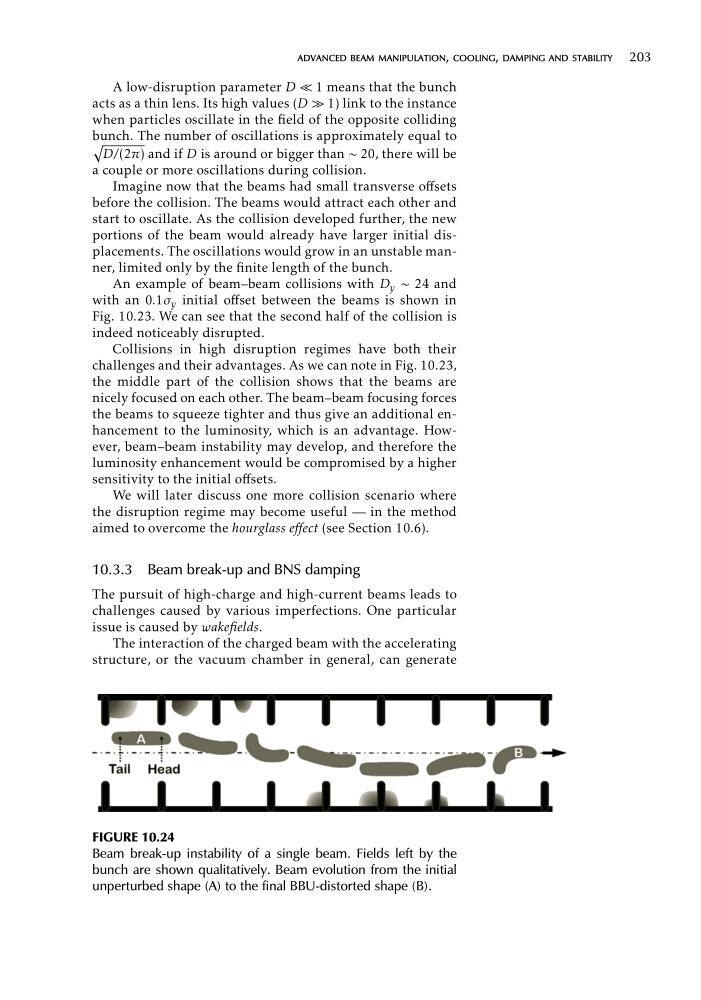
FIGURE 10.24
Beam break-up instability of a single beam. Fields left by the
bunch are shown qualitatively. Beam evolution from the initial
unperturbed shape (A) to the final BBU-distorted shape (B).
A low-disruption parameter D « 1 means that the bunch
acts as a thin lens. Its high values (D » 1) link to the instance
when particles oscillate in the field of the opposite colliding
bunch. The number of oscillations is approximately equal to
.
D/(2π) and if D is around or bigger than ∼ 20, there will be
a couple or more oscillations during collision.
Imagine now that the beams had small transverse offsets
before the collision. The beams would attract each other and
start to oscillate. As the collision developed further, the new
portions of the beam would already have larger initial displacements. The oscillations would grow in an unstable manner, limited only by the finite length of the bunch.
An example of beam–beam collisions with D y ∼ 24 and
with an 0.1σ y initial offset between the beams is shown in
Fig. 10.23. We can see that the second half of the collision is
indeed noticeably disrupted.
Collisions in high disruption regimes have both their
challenges and their advantages. As we can note in Fig. 10.23,
the middle part of the collision shows that the beams are
nicely focused on each other. The beam–beam focusing forces
the beams to squeeze tighter and thus give an additional enhancement to the luminosity, which is an advantage. However, beam–beam instability may develop, and therefore the
luminosity enhancement would be compromised by a higher
sensitivity to the initial offsets.
We will later discuss one more collision scenario where
the disruption regime may become useful — in the method
aimed to overcome the hourglass effect (see Section 10.6).
10.3.3 Beam break-up and BNS damping
The pursuit of high-charge and high-current beams leads to
challenges caused by various imperfections. One particular
issue is caused by wakefields.
The interaction of the charged beam with the accelerating
structure, or the vacuum chamber in general, can generate
FIGURE 10.24
Beam break-up instability of a single beam. Fields left by the
bunch are shown qualitatively. Beam evolution from the initial
unperturbed shape (A) to the final BBU-distorted shape (B).