

202 unifying physics of accelerators, lasers and plasma
Fields of the beam cause synchrotron radiation in the particles of the opposite beam. As previously mentioned, this radiation is called beamstrahlung (Fig. 10.22). It results in an
increase of the energy spread of the beams and smears out
the luminosity spectrum. The produced SR photons create
large numbers of e + e − pairs that create background in the experimental detector. Beamstrahlung energy losses can be estimated using the formulas from Chapter 3. We will leave
these estimations for your exercises while we return to the
transverse dynamic effect.
FIGURE 10.22
Beamstrahlung.
The transverse fields of the flat beam estimated above produce an angular kick for a particle travelling through the opposite colliding bunch. For Gaussian transverse beam distribution, and for a particle near the axis, the total angular kick
of the particle after collision is estimated as:
dx
2N r e
'
Δx =
= −
· x
dz
γσ x σ x + σ y
dy
2N r e
'
Δy =
= −
· y
(10.21)
dz
γσ y σ x + σ y
We can now introduce the notion of the Disruption parameter.
2N r e σ z
2N r e σ z
D x =
and D y =
(10.22)
γσ x σ x + σ y
γσ y σ x + σ y
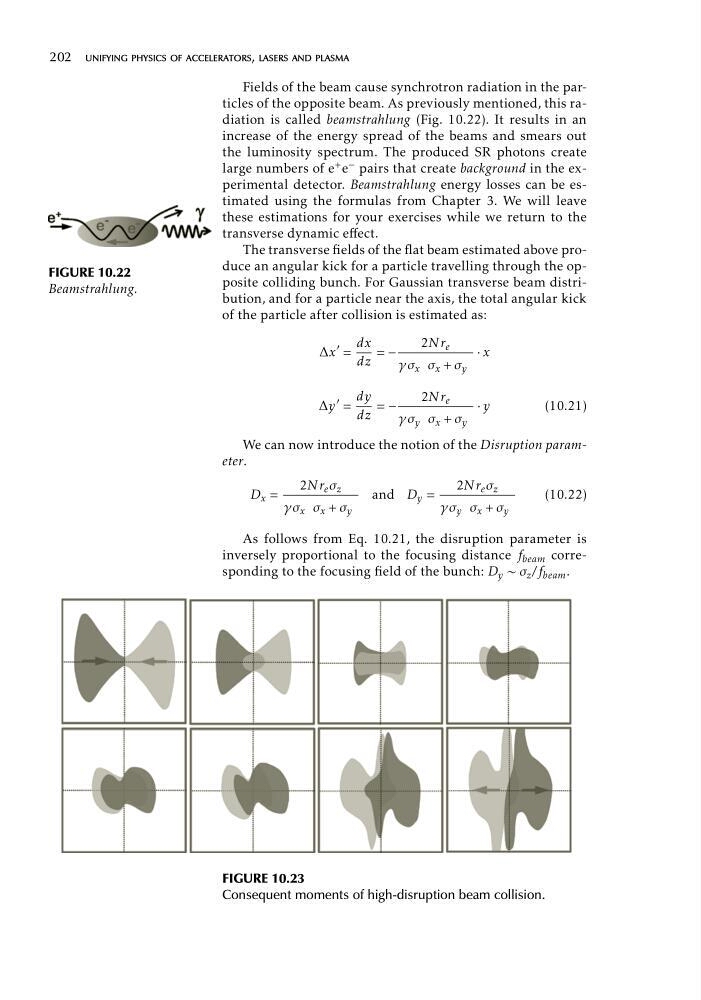
As follows from Eq. 10.21, the disruption parameter is
inversely proportional to the focusing distance f beam corresponding to the focusing field of the bunch: D y ∼ σ z /f beam .
FIGURE 10.23
Consequent moments of high-disruption beam collision.
Fields of the beam cause synchrotron radiation in the particles of the opposite beam. As previously mentioned, this radiation is called beamstrahlung (Fig. 10.22). It results in an
increase of the energy spread of the beams and smears out
the luminosity spectrum. The produced SR photons create
large numbers of e + e − pairs that create background in the experimental detector. Beamstrahlung energy losses can be estimated using the formulas from Chapter 3. We will leave
these estimations for your exercises while we return to the
transverse dynamic effect.
FIGURE 10.22
Beamstrahlung.
The transverse fields of the flat beam estimated above produce an angular kick for a particle travelling through the opposite colliding bunch. For Gaussian transverse beam distribution, and for a particle near the axis, the total angular kick
of the particle after collision is estimated as:
dx
2N r e
'
Δx =
= −
· x
dz
γσ x σ x + σ y
dy
2N r e
'
Δy =
= −
· y
(10.21)
dz
γσ y σ x + σ y
We can now introduce the notion of the Disruption parameter.
2N r e σ z
2N r e σ z
D x =
and D y =
(10.22)
γσ x σ x + σ y
γσ y σ x + σ y
As follows from Eq. 10.21, the disruption parameter is
inversely proportional to the focusing distance f beam corresponding to the focusing field of the bunch: D y ∼ σ z /f beam .
FIGURE 10.23
Consequent moments of high-disruption beam collision.