

198 unifying physics of accelerators, lasers and plasma
energy spread to the beam, sufficient to cure the CSR instability.
10.2.2 Beam laser slicing
Beam laser slicing is a technique that selects a femtosecond
short portion of radiation from a much longer initial electron
pulse.
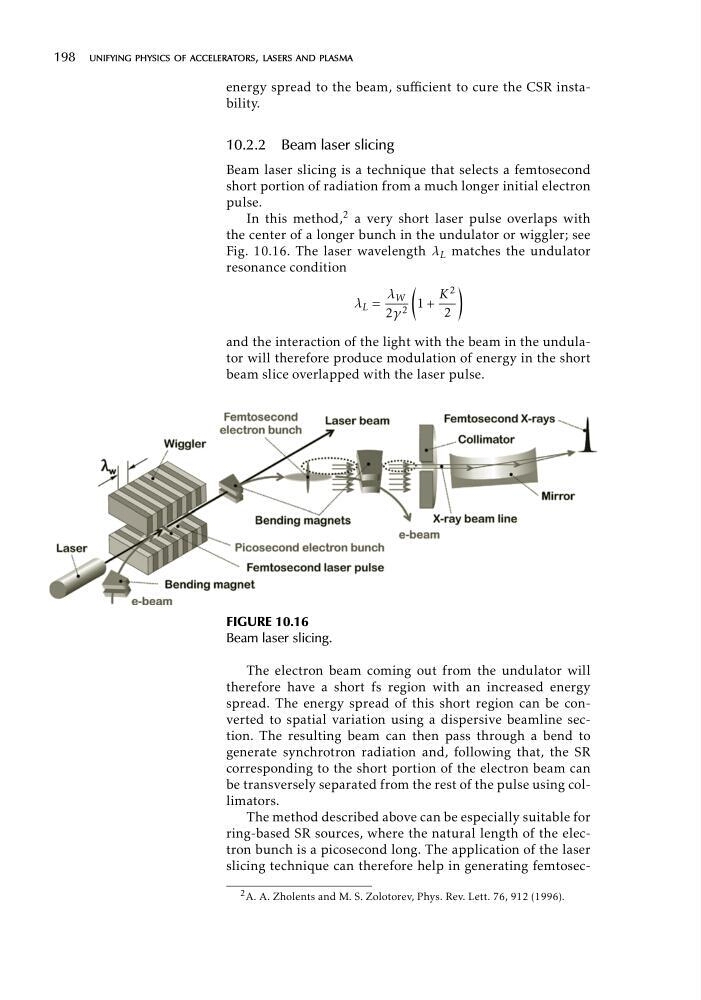
In this method, 2 a very short laser pulse overlaps with
the center of a longer bunch in the undulator or wiggler; see
Fig. 10.16. The laser wavelength λ L matches the undulator
resonance condition
(
)
K 2
λ W
λ L =
1 +
2γ 2
2
and the interaction of the light with the beam in the undulator will therefore produce modulation of energy in the short
beam slice overlapped with the laser pulse.
FIGURE 10.16
Beam laser slicing.
The electron beam coming out from the undulator will
therefore have a short fs region with an increased energy
spread. The energy spread of this short region can be converted to spatial variation using a dispersive beamline section. The resulting beam can then pass through a bend to
generate synchrotron radiation and, following that, the SR
corresponding to the short portion of the electron beam can
be transversely separated from the rest of the pulse using collimators.
The method described above can be especially suitable for
ring-based SR sources, where the natural length of the electron bunch is a picosecond long. The application of the laser
slicing technique can therefore help in generating femtosec2 A. A. Zholents and M. S. Zolotorev, Phys. Rev. Lett. 76, 912 (1996).
energy spread to the beam, sufficient to cure the CSR instability.
10.2.2 Beam laser slicing
Beam laser slicing is a technique that selects a femtosecond
short portion of radiation from a much longer initial electron
pulse.
In this method, 2 a very short laser pulse overlaps with
the center of a longer bunch in the undulator or wiggler; see
Fig. 10.16. The laser wavelength λ L matches the undulator
resonance condition
(
)
K 2
λ W
λ L =
1 +
2γ 2
2
and the interaction of the light with the beam in the undulator will therefore produce modulation of energy in the short
beam slice overlapped with the laser pulse.
FIGURE 10.16
Beam laser slicing.
The electron beam coming out from the undulator will
therefore have a short fs region with an increased energy
spread. The energy spread of this short region can be converted to spatial variation using a dispersive beamline section. The resulting beam can then pass through a bend to
generate synchrotron radiation and, following that, the SR
corresponding to the short portion of the electron beam can
be transversely separated from the rest of the pulse using collimators.
The method described above can be especially suitable for
ring-based SR sources, where the natural length of the electron bunch is a picosecond long. The application of the laser
slicing technique can therefore help in generating femtosec2 A. A. Zholents and M. S. Zolotorev, Phys. Rev. Lett. 76, 912 (1996).