

8QGXODWRU
8QGXODWRU
/DVHU
,QLWLDOHEHDP
/DVHU
%HQGLQJPDJQHWV
(
(
(
(
]
]
]
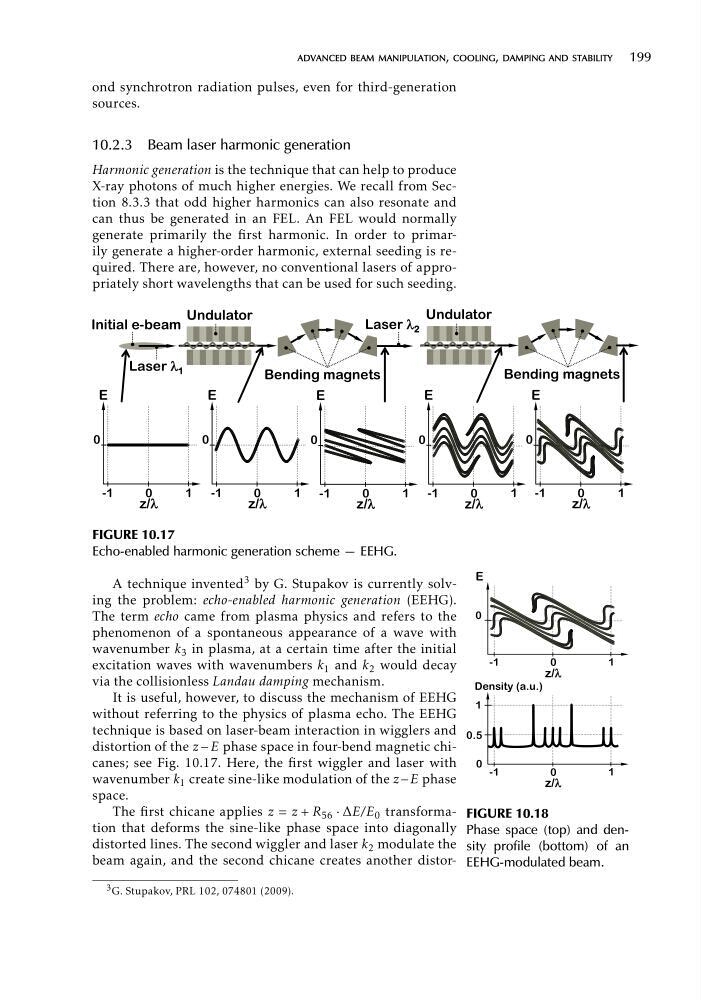
FIGURE 10.17
Echo-enabled harmonic generation scheme — EEHG.
%HQGLQJPDJQHWV
(
]
]
(
]
'HQVLW\DX
]
FIGURE 10.18
Phase space (top) and density profile (bottom) of an
EEHG-modulated beam.
advanced beam manipulation, cooling, damping and stability 199
ond synchrotron radiation pulses, even for third-generation
sources.
10.2.3 Beam laser harmonic generation
Harmonic generation is the technique that can help to produce
X-ray photons of much higher energies. We recall from Section 8.3.3 that odd higher harmonics can also resonate and
can thus be generated in an FEL. An FEL would normally
generate primarily the first harmonic. In order to primarily generate a higher-order harmonic, external seeding is required. There are, however, no conventional lasers of appropriately short wavelengths that can be used for such seeding.
A technique invented 3 by G. Stupakov is currently solving the problem: echo-enabled harmonic generation (EEHG).
The term echo came from plasma physics and refers to the
phenomenon of a spontaneous appearance of a wave with
wavenumber k 3 in plasma, at a certain time after the initial
excitation waves with wavenumbers k 1 and k 2 would decay
via the collisionless Landau damping mechanism.
It is useful, however, to discuss the mechanism of EEHG
without referring to the physics of plasma echo. The EEHG
technique is based on laser-beam interaction in wigglers and
distortion of the z − E phase space in four-bend magnetic chicanes; see Fig. 10.17. Here, the first wiggler and laser with
wavenumber k 1 create sine-like modulation of the z −E phase
space.
The first chicane applies z = z + R 56 · ΔE/E 0 transformation that deforms the sine-like phase space into diagonally
distorted lines. The second wiggler and laser k 2 modulate the
beam again, and the second chicane creates another distor3 G. Stupakov, PRL 102, 074801 (2009).
8QGXODWRU
/DVHU
,QLWLDOHEHDP
/DVHU
%HQGLQJPDJQHWV
(
(
(
(
]
]
]
FIGURE 10.17
Echo-enabled harmonic generation scheme — EEHG.
%HQGLQJPDJQHWV
(
]
]
(
]
'HQVLW\DX
]
FIGURE 10.18
Phase space (top) and density profile (bottom) of an
EEHG-modulated beam.
advanced beam manipulation, cooling, damping and stability 199
ond synchrotron radiation pulses, even for third-generation
sources.
10.2.3 Beam laser harmonic generation
Harmonic generation is the technique that can help to produce
X-ray photons of much higher energies. We recall from Section 8.3.3 that odd higher harmonics can also resonate and
can thus be generated in an FEL. An FEL would normally
generate primarily the first harmonic. In order to primarily generate a higher-order harmonic, external seeding is required. There are, however, no conventional lasers of appropriately short wavelengths that can be used for such seeding.
A technique invented 3 by G. Stupakov is currently solving the problem: echo-enabled harmonic generation (EEHG).
The term echo came from plasma physics and refers to the
phenomenon of a spontaneous appearance of a wave with
wavenumber k 3 in plasma, at a certain time after the initial
excitation waves with wavenumbers k 1 and k 2 would decay
via the collisionless Landau damping mechanism.
It is useful, however, to discuss the mechanism of EEHG
without referring to the physics of plasma echo. The EEHG
technique is based on laser-beam interaction in wigglers and
distortion of the z − E phase space in four-bend magnetic chicanes; see Fig. 10.17. Here, the first wiggler and laser with
wavenumber k 1 create sine-like modulation of the z −E phase
space.
The first chicane applies z = z + R 56 · ΔE/E 0 transformation that deforms the sine-like phase space into diagonally
distorted lines. The second wiggler and laser k 2 modulate the
beam again, and the second chicane creates another distor3 G. Stupakov, PRL 102, 074801 (2009).