

advanced beam manipulation, cooling, damping and stability 197
ulate the electron beam or to improve the properties of FEL
radiation.
We recall from Chapter 8 that the light of a resonant harmonic will be exponentially amplified in an undulator, taking the energy from the electron beam. The inverse can also
be true — sending laser light at the resonant harmonic into
the undulator will affect the electron beam (inverse FEL), creating variations of its energy.
The inverse FEL principle is the basis for many techniques
used to manipulate electron beams, create short pulses of
radiation, generate higher harmonics, create two-color FEL
pulses and many others uses.
10.2.1 Beam laser heating
Short laser pulses can be used to improve the properties of
short pulses of FEL radiation. The first example we will consider is the laser heater.
The generation of femtosecond-short X-ray pulses requires fs-short electron bunches. However, as we saw earlier
in this chapter, the creation of short bunches in bunch compressors can be complicated due to CSR effects that can cause
instability and microbunching.
Instabilities can often be suppressed (thanks to decoherence — see discussion of Landau damping in Section 10.3.4
later in this chapter) if the beam has sufficient spread of its
relevant phase space coordinates (the energy spread, in the
case of CSR instability).
The issue that has been observed in FELs is that the beam
energy spread coming from a photocathode gun is extremely
small, and insufficient for suppressing CSR instability.
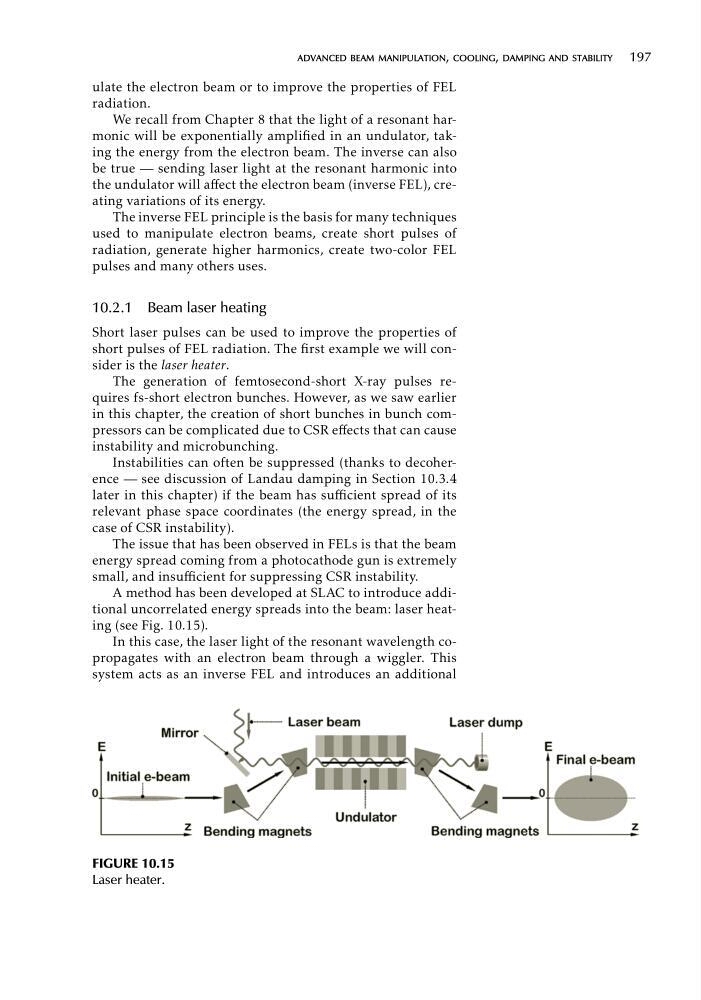
A method has been developed at SLAC to introduce additional uncorrelated energy spreads into the beam: laser heating (see Fig. 10.15).
In this case, the laser light of the resonant wavelength copropagates with an electron beam through a wiggler. This
system acts as an inverse FEL and introduces an additional
FIGURE 10.15
Laser heater.
ulate the electron beam or to improve the properties of FEL
radiation.
We recall from Chapter 8 that the light of a resonant harmonic will be exponentially amplified in an undulator, taking the energy from the electron beam. The inverse can also
be true — sending laser light at the resonant harmonic into
the undulator will affect the electron beam (inverse FEL), creating variations of its energy.
The inverse FEL principle is the basis for many techniques
used to manipulate electron beams, create short pulses of
radiation, generate higher harmonics, create two-color FEL
pulses and many others uses.
10.2.1 Beam laser heating
Short laser pulses can be used to improve the properties of
short pulses of FEL radiation. The first example we will consider is the laser heater.
The generation of femtosecond-short X-ray pulses requires fs-short electron bunches. However, as we saw earlier
in this chapter, the creation of short bunches in bunch compressors can be complicated due to CSR effects that can cause
instability and microbunching.
Instabilities can often be suppressed (thanks to decoherence — see discussion of Landau damping in Section 10.3.4
later in this chapter) if the beam has sufficient spread of its
relevant phase space coordinates (the energy spread, in the
case of CSR instability).
The issue that has been observed in FELs is that the beam
energy spread coming from a photocathode gun is extremely
small, and insufficient for suppressing CSR instability.
A method has been developed at SLAC to introduce additional uncorrelated energy spreads into the beam: laser heating (see Fig. 10.15).
In this case, the laser light of the resonant wavelength copropagates with an electron beam through a wiggler. This
system acts as an inverse FEL and introduces an additional
FIGURE 10.15
Laser heater.