

196 unifying physics of accelerators, lasers and plasma
fields will add together constructively — which is equivalent
to the case of a single short pulse travelling inside the laser
cavity.
10.1.8 Self-seeded FEL
Various techniques used in optics and particularly in laser
systems are ideologically similar to techniques employed for
creating short pulses of FEL radiation. The self-seeding technique described in this section has certain similarities with
the mode-locking method described in the previous section.
Recall that, in the SASE regime, the FEL lasing starts from
noise, and also remember that the length of the slice that contributes to radiation is much shorter than the length of the
electron bunch.
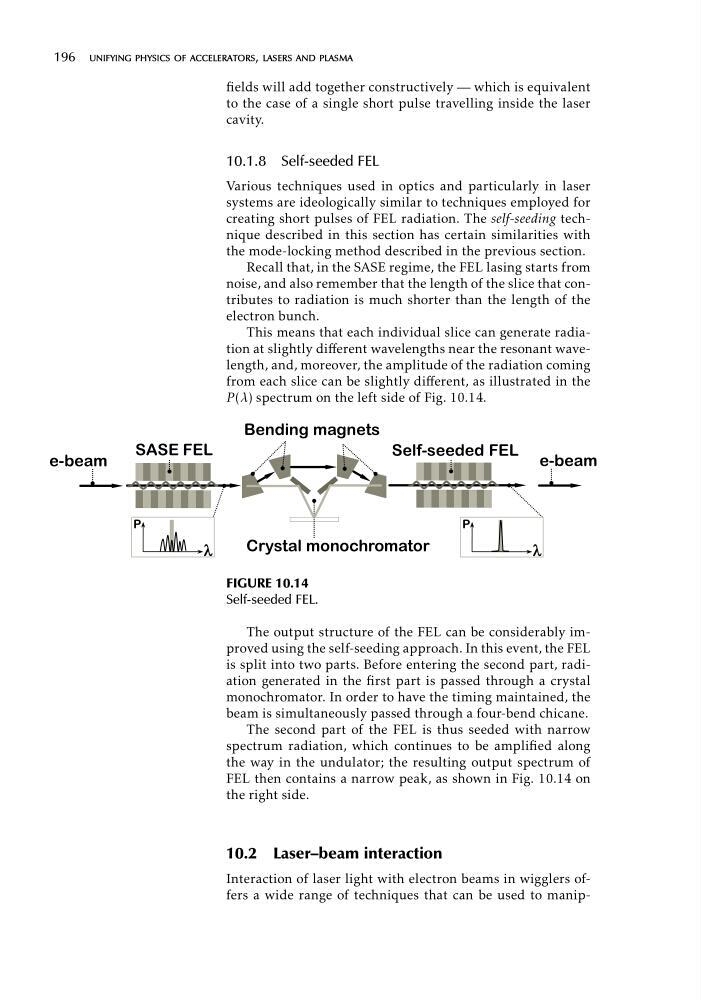
This means that each individual slice can generate radiation at slightly different wavelengths near the resonant wavelength, and, moreover, the amplitude of the radiation coming
from each slice can be slightly different, as illustrated in the
P(λ) spectrum on the left side of Fig. 10.14.
%HQGLQJPDJQHWV
6$6()(/
HEHDP
6HOIVHHGHG)(/
&U\VWDOPRQRFKURPDWRU
HEHDP
3
3
FIGURE 10.14
Self-seeded FEL.
The output structure of the FEL can be considerably improved using the self-seeding approach. In this event, the FEL
is split into two parts. Before entering the second part, radiation generated in the first part is passed through a crystal
monochromator. In order to have the timing maintained, the
beam is simultaneously passed through a four-bend chicane.
The second part of the FEL is thus seeded with narrow
spectrum radiation, which continues to be amplified along
the way in the undulator; the resulting output spectrum of
FEL then contains a narrow peak, as shown in Fig. 10.14 on
the right side.
10.2 Laser–beam interaction
Interaction of laser light with electron beams in wigglers offers a wide range of techniques that can be used to manip
fields will add together constructively — which is equivalent
to the case of a single short pulse travelling inside the laser
cavity.
10.1.8 Self-seeded FEL
Various techniques used in optics and particularly in laser
systems are ideologically similar to techniques employed for
creating short pulses of FEL radiation. The self-seeding technique described in this section has certain similarities with
the mode-locking method described in the previous section.
Recall that, in the SASE regime, the FEL lasing starts from
noise, and also remember that the length of the slice that contributes to radiation is much shorter than the length of the
electron bunch.
This means that each individual slice can generate radiation at slightly different wavelengths near the resonant wavelength, and, moreover, the amplitude of the radiation coming
from each slice can be slightly different, as illustrated in the
P(λ) spectrum on the left side of Fig. 10.14.
%HQGLQJPDJQHWV
6$6()(/
HEHDP
6HOIVHHGHG)(/
&U\VWDOPRQRFKURPDWRU
HEHDP
3
3
FIGURE 10.14
Self-seeded FEL.
The output structure of the FEL can be considerably improved using the self-seeding approach. In this event, the FEL
is split into two parts. Before entering the second part, radiation generated in the first part is passed through a crystal
monochromator. In order to have the timing maintained, the
beam is simultaneously passed through a four-bend chicane.
The second part of the FEL is thus seeded with narrow
spectrum radiation, which continues to be amplified along
the way in the undulator; the resulting output spectrum of
FEL then contains a narrow peak, as shown in Fig. 10.14 on
the right side.
10.2 Laser–beam interaction
Interaction of laser light with electron beams in wigglers offers a wide range of techniques that can be used to manip