

advanced beam manipulation, cooling, damping and stability 195
First, the gain medium (amplifier crystal in Fig. 10.12) is
pumped by the laser diode. A short initial pulse from the
“master oscillator” is then injected into the input of the system through the thin-film polarizer and the Faraday rotator,
both of which are switched on for this short moment in order
to let the input pulse pass.
The initial pulse then undergoes many round trips
through the system, its power level getting amplified each
time it passes the gain medium until it reaches a high level.
Finally, another switch is powered (Pockels cell in Fig. 10.12)
and the amplified pulse is released from the system.
10.1.7 Mode locking
Mode locking is the technique for achieving short laser pulses.
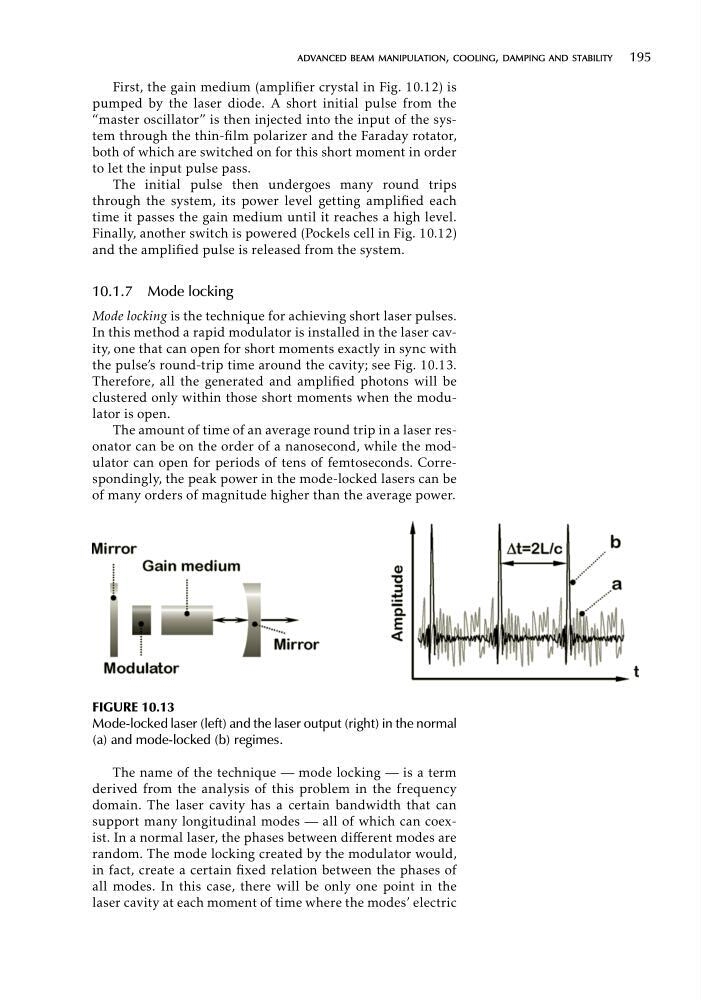
In this method a rapid modulator is installed in the laser cavity, one that can open for short moments exactly in sync with
the pulse’s round-trip time around the cavity; see Fig. 10.13.
Therefore, all the generated and amplified photons will be
clustered only within those short moments when the modulator is open.
The amount of time of an average round trip in a laser resonator can be on the order of a nanosecond, while the modulator can open for periods of tens of femtoseconds. Correspondingly, the peak power in the mode-locked lasers can be
of many orders of magnitude higher than the average power.
FIGURE 10.13
Mode-locked laser (left) and the laser output (right) in the normal
(a) and mode-locked (b) regimes.
The name of the technique — mode locking — is a term
derived from the analysis of this problem in the frequency
domain. The laser cavity has a certain bandwidth that can
support many longitudinal modes — all of which can coexist. In a normal laser, the phases between different modes are
random. The mode locking created by the modulator would,
in fact, create a certain fixed relation between the phases of
all modes. In this case, there will be only one point in the
laser cavity at each moment of time where the modes’ electric
First, the gain medium (amplifier crystal in Fig. 10.12) is
pumped by the laser diode. A short initial pulse from the
“master oscillator” is then injected into the input of the system through the thin-film polarizer and the Faraday rotator,
both of which are switched on for this short moment in order
to let the input pulse pass.
The initial pulse then undergoes many round trips
through the system, its power level getting amplified each
time it passes the gain medium until it reaches a high level.
Finally, another switch is powered (Pockels cell in Fig. 10.12)
and the amplified pulse is released from the system.
10.1.7 Mode locking
Mode locking is the technique for achieving short laser pulses.
In this method a rapid modulator is installed in the laser cavity, one that can open for short moments exactly in sync with
the pulse’s round-trip time around the cavity; see Fig. 10.13.
Therefore, all the generated and amplified photons will be
clustered only within those short moments when the modulator is open.
The amount of time of an average round trip in a laser resonator can be on the order of a nanosecond, while the modulator can open for periods of tens of femtoseconds. Correspondingly, the peak power in the mode-locked lasers can be
of many orders of magnitude higher than the average power.
FIGURE 10.13
Mode-locked laser (left) and the laser output (right) in the normal
(a) and mode-locked (b) regimes.
The name of the technique — mode locking — is a term
derived from the analysis of this problem in the frequency
domain. The laser cavity has a certain bandwidth that can
support many longitudinal modes — all of which can coexist. In a normal laser, the phases between different modes are
random. The mode locking created by the modulator would,
in fact, create a certain fixed relation between the phases of
all modes. In this case, there will be only one point in the
laser cavity at each moment of time where the modes’ electric